Abstract
The rapid growth of social media platforms has transformed digital marketing by enabling influencers to shape consumer preferences, purchasing decisions, and brand reputation. Influencer marketing has become a multi-billion-dollar industry, allowing businesses to promote products and services through individuals with significant online followings. While this marketing strategy offers substantial commercial opportunities, it also presents significant legal and ethical challenges concerning misleading advertisements, hidden sponsorships, deceptive endorsements, consumer privacy, data protection, and protection of vulnerable consumers, particularly children and adolescents. Traditional advertising regulations often struggle to address the evolving nature of influencer-generated content, making regulatory reform essential. Consumer protection authorities across jurisdictions have introduced disclosure requirements, advertising guidelines, and digital platform accountability measures to ensure transparency and fairness in online commercial communications. International organizations and national regulators increasingly require influencers to disclose paid partnerships, avoid deceptive marketing practices, and ensure that promotional claims are truthful and substantiated. This paper critically examines the impact of social media influencers on consumer protection laws and advertising regulations through the perspectives of international legal frameworks, comparative regulatory approaches, and emerging digital governance. It further analyzes contemporary legal challenges relating to influencer accountability, artificial intelligence-generated influencers, cross-border advertising, and platform regulation. Finally, the study proposes legal reforms aimed at strengthening transparency, consumer trust, regulatory enforcement, and responsible digital marketing practices while preserving innovation within the evolving digital economy.
- Social Media Influencers
- Consumer Protection
- Advertising Law
- Digital Marketing
- Influencer Marketing
- Disclosure Requirements
- Consumer Rights
- Digital Platforms
- Advertising Regulations
- Online Endorsements
Introduction#
The emergence of social media has fundamentally transformed the relationship between businesses and consumers by creating new forms of digital communication and commercial engagement. Platforms such as Instagram, YouTube, Facebook, TikTok, X (formerly Twitter), and LinkedIn have enabled individuals with substantial online followings, commonly referred to as social media influencers, to become influential participants in advertising and consumer decision-making. Unlike traditional celebrity endorsements, influencer marketing relies upon perceived authenticity, personal engagement, and direct interaction with audiences, making promotional content appear more trustworthy and relatable. Businesses increasingly collaborate with influencers to promote products, services, and brands through sponsored posts, product reviews, affiliate marketing, live streams, and digital campaigns. Consequently, influencer marketing has become one of the fastest-growing sectors of the digital economy, generating substantial commercial benefits for brands and content creators alike. However, the rapid expansion of influencer marketing has also created significant legal and regulatory concerns regarding transparency, consumer protection, misleading advertisements, hidden sponsorships, false product claims, privacy, and accountability. Consumers may be unable to distinguish genuine personal opinions from paid commercial endorsements when influencers fail to disclose sponsorship arrangements adequately. Such practices undermine informed consumer choice and may constitute deceptive advertising under consumer protection laws. Vulnerable groups, particularly children and adolescents, are especially susceptible to persuasive influencer content, raising additional concerns regarding ethical advertising and digital consumer rights. Governments and regulatory authorities worldwide have therefore introduced legal frameworks requiring influencers and advertisers to disclose material commercial relationships and ensure that promotional claims remain truthful, verifiable, and non-misleading.
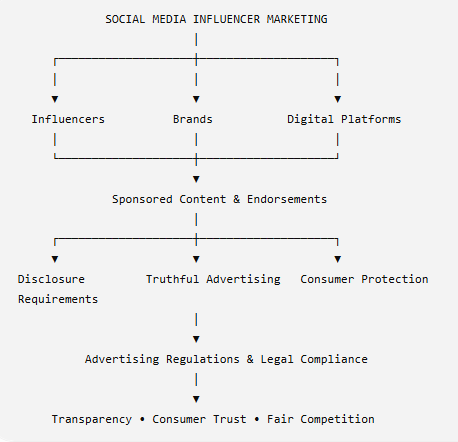
Figure: Conceptual background
International organizations and domestic regulators increasingly recognize that digital marketing should be governed by the same principles of fairness, transparency, accountability, and consumer welfare that apply to traditional advertising. Technological developments, including artificial intelligence-generated influencers, virtual influencers, algorithmic advertising, personalized recommendations, and cross-border digital platforms, have further complicated regulatory enforcement by blurring distinctions between human content creators, automated advertising, and platform-generated promotional content. The cross-border nature of social media also presents jurisdictional challenges, as influencers, advertisers, platforms, and consumers frequently operate across multiple legal systems with differing regulatory standards. Consequently, consumer protection authorities, advertising regulators, and digital platform operators are required to collaborate more closely to ensure effective compliance and enforcement. This paper critically examines the impact of social media influencers on consumer protection laws and advertising regulations through comparative legal analysis and international regulatory developments. It evaluates existing legal frameworks governing influencer marketing, identifies emerging legal challenges associated with digital advertising, and proposes future legal reforms aimed at strengthening transparency, consumer trust, responsible influencer practices, and effective regulatory governance in the evolving digital marketplace.
Contemporary Legal Challenges in Influencer Marketing and Consumer Protection#
Despite the establishment of regulatory frameworks governing influencer marketing, numerous legal challenges continue to affect consumer protection in the digital advertising ecosystem. One of the most significant concerns is the prevalence of misleading endorsements, where influencers promote products without adequately disclosing commercial relationships or make exaggerated claims regarding product performance without sufficient evidence. Such practices may mislead consumers into believing that endorsements reflect genuine personal opinions rather than paid advertisements, thereby undermining informed consumer decision-making. Another major challenge concerns hidden advertising and inadequate disclosure. Although many jurisdictions require influencers to use standardized disclosure labels such as "#Ad" or "#Sponsored," inconsistent placement, unclear language, or ambiguous hashtags often reduce the effectiveness of these disclosures. The protection of children and adolescent consumers represents another critical issue because younger audiences are particularly susceptible to persuasive influencer content and may lack the ability to distinguish commercial promotions from entertainment. This concern is especially significant in relation to food products, cosmetics, gaming, financial services, gambling applications, and health-related products promoted through social media platforms. Artificial intelligence-generated influencers and virtual influencers have introduced additional legal complexities regarding accountability, transparency, and authenticity. AI-generated digital personalities can promote products without clearly identifying whether the content has been created or managed by automated systems, raising concerns regarding deception and consumer trust. The increasing use of personalized advertising based on consumer profiling and algorithmic recommendations further implicates privacy and data protection laws. Social media platforms collect vast quantities of personal information to deliver targeted advertisements, requiring compliance with data protection regulations such as the GDPR and other national privacy laws. Another emerging issue involves cross-border influencer marketing, where influencers, advertisers, digital platforms, and consumers operate across multiple jurisdictions with differing legal standards, making enforcement difficult. Regulators frequently encounter challenges in determining jurisdiction, applicable law, and responsibility for unlawful content. Fake followers, purchased engagement, manipulated reviews, and fraudulent influencer metrics also undermine market transparency and distort competition by misleading advertisers regarding the actual reach and influence of digital content creators. Intellectual property disputes involving unauthorized use of copyrighted content, trademarks, music, and brand identities further complicate influencer marketing. Additionally, the promotion of financial products, cryptocurrencies, dietary supplements, and healthcare products by influencers has generated increasing regulatory scrutiny due to potential consumer harm arising from inaccurate or unverified claims. Addressing these challenges requires stronger enforcement mechanisms, improved international regulatory cooperation, enhanced digital literacy among consumers, effective platform accountability, and continuous adaptation of legal frameworks to technological innovation. A balanced regulatory approach that encourages responsible digital marketing while protecting consumer rights remains essential for maintaining trust, fairness, and transparency within the rapidly expanding influencer economy.
Future Directions and Legal Reforms for Influencer Marketing Regulation#
The continuing evolution of social media platforms and digital marketing practices requires modern legal frameworks capable of protecting consumers while supporting innovation and economic growth within the digital economy. Future legal reforms should prioritize the establishment of comprehensive statutory regulations specifically governing influencer marketing rather than relying solely on general consumer protection and advertising laws. Governments should develop uniform legal definitions of social media influencers, sponsored content, paid partnerships, affiliate marketing, and virtual influencers to reduce regulatory uncertainty and improve enforcement. One of the most important reforms involves strengthening mandatory disclosure requirements by requiring standardized, prominent, and easily understandable labels for all sponsored content regardless of platform or format. Regulatory authorities should also introduce clearer rules governing artificial intelligence-generated influencers, requiring disclosure whenever consumers interact with virtual personalities or AI-generated promotional content. Strengthening platform accountability represents another significant priority. Social media companies should implement effective monitoring systems capable of identifying undisclosed advertisements, misleading endorsements, fraudulent engagement practices, and illegal commercial content while cooperating with regulatory agencies in enforcement actions. Data protection laws should be expanded to regulate algorithmic advertising, consumer profiling, behavioral targeting, and automated recommendation systems, ensuring that digital advertising respects consumer privacy and informed consent. Special legal safeguards should be introduced for children and vulnerable consumers, including restrictions on advertising unhealthy foods, gambling services, financial products, and age-inappropriate content through influencer marketing. International cooperation will become increasingly important because digital advertising frequently transcends national boundaries. Organizations such as the Organisation for Economic Co-operation and Development (OECD), the International Consumer Protection and Enforcement Network (ICPEN), and regional regulatory bodies should collaborate to harmonize disclosure standards, improve cross-border enforcement, and facilitate information sharing regarding deceptive online marketing practices. Consumer education should also receive greater emphasis through digital literacy initiatives that enable individuals to identify sponsored content, understand advertising techniques, and make informed purchasing decisions. Influencers themselves should receive professional training regarding advertising law, consumer rights, intellectual property, privacy obligations, and ethical digital communication. Future reforms should encourage industry self-regulation through professional codes of conduct while maintaining effective governmental oversight to address serious violations.
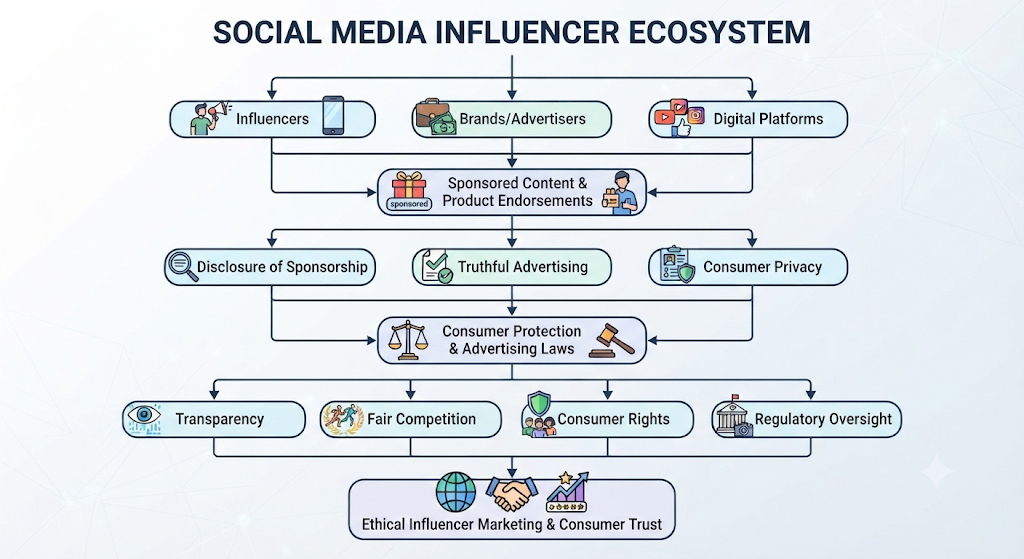
Figure: The Impact of Social Media Influencers on Consumer Protection Laws and Advertising Regulations
Ultimately, influencer marketing should operate within a legal framework founded upon transparency, honesty, accountability, and consumer trust. By modernizing advertising regulations, strengthening international cooperation, and ensuring responsible use of emerging technologies, governments can promote fair competition, protect consumer rights, and foster a sustainable digital marketplace that benefits businesses, influencers, platforms, and consumers alike.
Conclusion#
Social media influencer marketing has fundamentally transformed modern advertising by reshaping the ways in which businesses communicate with consumers and influence purchasing decisions. Unlike traditional advertising, influencer marketing relies upon authenticity, personal engagement, and digital interaction, enabling influencers to establish trusted relationships with their audiences across various social media platforms. While this form of marketing has created substantial economic opportunities for businesses, content creators, and digital platforms, it has also introduced complex legal challenges concerning misleading advertisements, hidden sponsorships, deceptive endorsements, consumer privacy, intellectual property, and protection of vulnerable consumers. Regulatory authorities across the world have increasingly recognized that influencer marketing must operate within established principles of consumer protection, transparency, accountability, and fair competition. International guidelines, comparative legal frameworks, and national consumer protection laws now require influencers and advertisers to disclose commercial relationships, substantiate promotional claims, and avoid deceptive marketing practices that may mislead consumers. Nevertheless, the rapid evolution of digital technologies, artificial intelligence-generated influencers, personalized advertising, algorithmic content promotion, and cross-border social media platforms continues to challenge traditional regulatory approaches. Effective legal governance therefore requires continuous adaptation of advertising regulations to emerging technologies while maintaining consistency with constitutional values, consumer rights, and international standards. Future legal reforms should strengthen mandatory disclosure requirements, improve platform accountability, regulate artificial intelligence-driven marketing, and enhance international cooperation for addressing cross-border advertising violations. Greater emphasis should also be placed on protecting children and other vulnerable consumers who may be particularly susceptible to influencer-based promotions. Consumer education and digital literacy initiatives are equally important in enabling individuals to recognize sponsored content, evaluate advertising claims critically, and make informed purchasing decisions. Influencers themselves should adopt ethical standards of professional conduct by ensuring transparency, honesty, and responsible communication in all commercial collaborations. Social media platforms, advertisers, regulators, and influencers must work collaboratively to establish a trustworthy digital marketing environment that encourages innovation while safeguarding consumer welfare. Ultimately, influencer marketing should not be viewed merely as a commercial strategy but as a regulated form of digital communication carrying significant legal and ethical responsibilities. By strengthening legal oversight, promoting transparency, and fostering responsible digital practices, governments can ensure that influencer marketing contributes positively to economic growth, consumer confidence, fair competition, and the sustainable development of the global digital economy.
Works Cited#
- Advertising Standards Authority. (2023). CAP Code: The UK Code of Non-broadcast Advertising and Direct & Promotional Marketing. ASA.
- Central Consumer Protection Authority. (2022). Guidelines for Prevention of Misleading Advertisements and Endorsements for Misleading Advertisements. Government of India.
- Central Consumer Protection Authority. (2023). Guidelines for Influencer Advertising in Digital Media. Government of India.
- European Parliament and Council of the European Union. (2005). Directive 2005/29/EC on Unfair Commercial Practices. Official Journal of the European Union.
- European Parliament and Council of the European Union. (2016). General Data Protection Regulation (GDPR). Official Journal of the European Union.
- European Parliament and Council of the European Union. (2022). Digital Services Act (Regulation (EU) 2022/2065). Official Journal of the European Union.
- Federal Trade Commission. (2023). FTC Endorsement Guides: Guides Concerning the Use of Endorsements and Testimonials in Advertising. FTC.
- Government of India. (2019). Consumer Protection Act, 2019. Ministry of Consumer Affairs, Food and Public Distribution.
- Government of India. (2020). Consumer Protection (E-Commerce) Rules, 2020. Ministry of Consumer Affairs, Food and Public Distribution.
- International Consumer Protection and Enforcement Network. (2023). Guidelines on Online Consumer Protection. ICPEN.
- Kotler, P., Kartajaya, H., & Setiawan, I. (2021). Marketing 5.0: Technology for Humanity. Wiley.
- Organisation for Economic Co-operation and Development. (2016). OECD Recommendation of the Council on Consumer Protection in E-commerce. OECD Publishing.
- Organisation for Economic Co-operation and Development. (2023). Digital Economy Outlook 2023. OECD Publishing.
- United Nations. (2015). United Nations Guidelines for Consumer Protection. United Nations.
- World Federation of Advertisers. (2022). Global Principles for Influencer Marketing. WFA.
- Boerman, S. C. (2020). The Effects of the Standardized Instagram Disclosure for Micro- and Macro-Influencers. Computers in Human Behavior, 103, 199–207.
- Evans, N. J., Phua, J., Lim, J., & Jun, H. (2017). Disclosing Instagram Influencer Advertising: The Effects of Disclosure Language on Advertising Recognition. Journal of Interactive Advertising, 17(2), 138–149.
- Freberg, K. (2019). Social Media for Strategic Communication: Creative Strategies and Research-Based Applications. Sage Publications.
- De Veirman, M., Cauberghe, V., & Hudders, L. (2017). Marketing Through Instagram Influencers: The Impact of Number of Followers and Product Divergence. International Journal of Advertising, 36(5), 798–828.
- International Chamber of Commerce. (2024). ICC Advertising and Marketing Communications Code. ICC