Abstract
Job satisfaction, work motivation, and organizational commitment are critical determinants of employee performance, productivity, and organizational effectiveness. In today's dynamic and highly competitive work environment, understanding these factors has become increasingly important for both government and private sector organizations. Although both sectors aim to achieve organizational goals efficiently, they differ significantly in terms of work culture, job security, promotion opportunities, compensation, leadership practices, and performance expectations, which influence employees' attitudes and behaviour. This study examines the comparative levels of job satisfaction, work motivation, and organizational commitment among government and private sector employees. It explores how organizational policies, leadership style, workplace environment, recognition, career growth, and work-life balance affect employees' motivation and commitment. The study highlights that government employees generally experience greater job security and organizational stability, while private sector employees often demonstrate higher performance motivation and adaptability due to competitive work environments and merit-based reward systems. The paper also discusses the challenges faced by employees in both sectors, including work stress, technological changes, increasing performance demands, and changing organizational expectations. Furthermore, it emphasizes the importance of supportive leadership, employee engagement, professional development, and effective human resource practices in improving workplace satisfaction and organizational commitment. The study concludes that creating a positive organizational climate, ensuring fair reward systems, promoting employee well-being, and encouraging continuous motivation are essential for enhancing productivity, job satisfaction, and long-term organizational success in both government and private sector organizations.
- Job Satisfaction
- Work Motivation
- Organizational Commitment
- Government Employees
- Private Sector Employees
- Employee Performance
- Workplace Environment
- Employee Engagement
- Human Resource Management
- Leadership
Introduction#
Organizations across the world recognize human resources as their most valuable asset because employees directly influence productivity, service quality, innovation, organizational performance, and long-term institutional success. In the rapidly changing economic and technological environment of the modern era, organizations face increasing challenges related to globalization, digital transformation, automation, changing workforce expectations, and intense competition. As a result, maintaining a motivated, satisfied, and committed workforce has become a strategic priority for both government and private sector organizations. Among the various psychological and organizational factors influencing employee performance, job satisfaction, work motivation, and organizational commitment are considered the most significant determinants of workplace effectiveness. Job satisfaction refers to employees' positive feelings and attitudes toward their jobs, arising from factors such as salary, work environment, recognition, career advancement, leadership, and interpersonal relationships. Work motivation represents the internal and external forces that stimulate employees to perform their duties efficiently, achieve organizational objectives, and continuously improve their performance. Organizational commitment reflects the psychological attachment, loyalty, and willingness of employees to remain associated with their organization and contribute to its long-term success. Although these three constructs are closely interrelated, they are influenced by organizational culture, leadership style, reward systems, job security, work-life balance, and opportunities for professional growth. Government and private sector organizations differ considerably in these aspects, making comparative studies essential for understanding employee behaviour across different organizational settings.
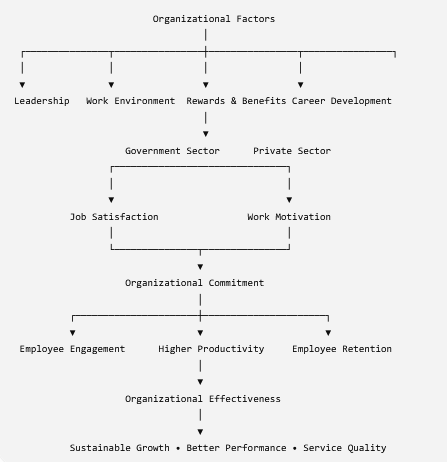
Figure: Comparative Study of Government & Private sector employees
Government organizations generally provide greater job security, structured promotion systems, fixed working hours, pension benefits, and employment stability, which often contribute to long-term organizational commitment and employee retention. However, employees may also experience challenges such as bureaucratic procedures, slower career progression, limited performance-based incentives, and resistance to organizational change. In contrast, private sector organizations operate in highly competitive environments where performance, innovation, efficiency, and customer satisfaction are primary priorities. Private sector employees often receive performance-based rewards, rapid career advancement opportunities, skill development programmes, and competitive compensation packages, which enhance work motivation and productivity. At the same time, greater workload, job insecurity, performance pressure, and work-related stress may reduce job satisfaction and organizational commitment if not managed effectively. In the modern workplace, technological advancements, hybrid work models, artificial intelligence, digital communication, and changing employee expectations have further transformed organizational practices in both sectors. Consequently, organizations are increasingly focusing on employee engagement, supportive leadership, workplace well-being, continuous learning, and effective human resource management to improve satisfaction, motivation, and commitment. Comparative assessment of these variables provides valuable insights for policymakers, administrators, organizational leaders, and human resource professionals in designing evidence-based strategies that enhance employee performance, strengthen organizational culture, improve retention, and achieve sustainable organizational development. Understanding the similarities and differences between government and private sector employees also contributes to developing balanced organizational policies that promote employee well-being while improving institutional efficiency and service quality.
Comparative Study of Work Motivation among Government and Private Sector Employees#
Work motivation is a fundamental psychological force that influences employees' willingness, enthusiasm, and commitment to perform their duties effectively and contribute to organizational goals. It determines the level of effort employees invest in their work, their persistence in overcoming challenges, their readiness to acquire new skills, and their overall job performance. Highly motivated employees generally demonstrate greater productivity, creativity, responsibility, innovation, and organizational loyalty, whereas low motivation often results in reduced efficiency, absenteeism, job dissatisfaction, workplace stress, and higher employee turnover. Work motivation is influenced by a combination of intrinsic factors, such as personal achievement, recognition, professional growth, autonomy, and job satisfaction, as well as extrinsic factors including salary, incentives, promotions, job security, organizational policies, leadership, and working conditions. A comparative analysis of government and private sector employees reveals significant differences in motivational factors due to variations in organizational structure, reward systems, performance expectations, and employment conditions. Government organizations typically offer employees stable employment, fixed salary structures, pension benefits, healthcare facilities, regulated working hours, and long-term career security. These factors provide a strong sense of financial stability and reduce occupational uncertainty, thereby serving as important extrinsic motivators. Employees in the public sector are also motivated by opportunities to contribute to national development, public welfare, and community service, which generate a sense of social responsibility and intrinsic satisfaction. However, motivation among government employees may gradually decline due to bureaucratic procedures, limited opportunities for rapid promotion, standardized compensation systems, slow decision-making processes, and comparatively fewer performance-based rewards. In some cases, the absence of direct links between exceptional performance and career advancement may reduce employees' enthusiasm for innovation and continuous improvement. Conversely, private sector organizations operate within highly competitive business environments where organizational success depends largely on employee performance, productivity, innovation, and customer satisfaction. Consequently, private companies place greater emphasis on motivating employees through competitive salaries, performance-based incentives, bonuses, promotions, recognition programmes, skill development opportunities, and career advancement. Employees are frequently encouraged to improve their competencies through professional training, leadership development programmes, and performance appraisal systems that reward excellence and high achievement. Such practices often create a dynamic and achievement-oriented work culture in which employees remain motivated to meet organizational objectives and improve their professional capabilities. At the same time, private sector employees frequently encounter high workloads, strict deadlines, performance targets, organizational restructuring, and job insecurity, which may generate work-related stress and reduce long-term motivation if appropriate organizational support is lacking. Therefore, maintaining employee motivation in private organizations requires balancing performance expectations with employee well-being, recognition, and work-life balance. Leadership style is another critical determinant of work motivation in both sectors. Transformational leaders who inspire employees through vision, encouragement, participation, recognition, and trust create highly motivated workforces capable of achieving organizational excellence. Participative leadership, effective communication, constructive feedback, and transparent decision-making strengthen employees' sense of belonging and encourage greater commitment to organizational goals. In contrast, authoritarian leadership, poor communication, favoritism, and inadequate recognition often reduce employee morale and workplace motivation regardless of organizational sector. Organizational culture also significantly influences motivational levels. Positive workplace environments characterized by teamwork, mutual respect, inclusiveness, innovation, and professional collaboration encourage employees to contribute actively and perform beyond minimum expectations. Human resource practices such as fair performance appraisal systems, career counselling, mentoring, employee recognition, flexible work arrangements, and continuous professional development further enhance work motivation. Demographic characteristics including age, educational qualifications, work experience, gender, income level, and organizational position may also influence motivational priorities. Younger employees generally seek career advancement, challenging assignments, innovation, and learning opportunities, while experienced employees often value job stability, recognition, leadership responsibilities, and work-life balance. The rapid advancement of technology has further transformed employee motivation across both sectors. Digital transformation, automation, artificial intelligence, hybrid work models, virtual collaboration platforms, and online learning systems have changed the nature of work and created new opportunities for professional growth. Employees who receive adequate technological support, digital training, and opportunities to enhance their skills are generally more motivated to adapt to organizational changes and improve their performance. However, continuous technological change may also create uncertainty, digital fatigue, and skill-related anxiety, particularly among employees with limited technological competence. Organizations must therefore invest in continuous learning and employee support systems to maintain high motivation during periods of organizational transformation. Comparative research consistently indicates that government employees are often motivated primarily by employment stability, social recognition, public service, and work-life balance, whereas private sector employees are more strongly motivated by financial rewards, career progression, performance incentives, professional development, and organizational recognition. Despite these differences, both sectors require supportive leadership, transparent human resource policies, equitable reward systems, and positive workplace environments to sustain employee motivation. Organizations that recognize employee contributions, encourage participation in decision-making, provide opportunities for learning and innovation, and promote physical and psychological well-being are more likely to maintain highly motivated workforces. Ultimately, work motivation serves as a driving force behind employee productivity, organizational effectiveness, and institutional success. Therefore, both government and private sector organizations should adopt comprehensive motivational strategies that integrate financial incentives, professional development, supportive leadership, employee engagement, technological empowerment, and healthy organizational culture to achieve sustainable growth, improved performance, and long-term organizational excellence.
Organizational Commitment among Government and Private Sector Employees#
Organizational commitment is a vital component of organizational behaviour that reflects the psychological attachment, loyalty, and sense of belonging employees develop toward their organization. It represents the willingness of employees to remain with an organization, contribute to its goals, and perform their responsibilities with dedication and sincerity. High organizational commitment is associated with increased job performance, employee retention, organizational citizenship behaviour, reduced absenteeism, lower turnover intentions, and improved institutional effectiveness. In contrast, low organizational commitment often results in reduced productivity, poor morale, decreased employee engagement, workplace dissatisfaction, and higher rates of employee attrition. Organizational commitment is generally categorized into three dimensions: **affective commitment**, which refers to employees' emotional attachment to the organization; **continuance commitment**, which reflects employees' decision to remain because of the costs associated with leaving; and **normative commitment**, which represents employees' sense of moral obligation and loyalty toward the organization. These dimensions are influenced by various organizational and personal factors, including leadership style, organizational culture, job satisfaction, work motivation, career development opportunities, compensation, recognition, work-life balance, and interpersonal relationships. A comparative analysis of government and private sector employees reveals noticeable differences in the nature and level of organizational commitment due to variations in organizational policies, employment conditions, performance expectations, and workplace environments. Government organizations generally foster strong continuance commitment because they provide stable employment, fixed salary structures, pension schemes, healthcare benefits, job security, and predictable career progression. Employees often remain committed to government organizations because of long-term employment stability, retirement benefits, and opportunities to serve society through public administration and community development. Many public sector employees also develop affective commitment by identifying with the organization's mission of public service and social welfare. However, bureaucratic procedures, limited flexibility, slower decision-making, delayed promotions, and fewer performance-based rewards may reduce emotional attachment and enthusiasm among some employees, particularly younger professionals seeking innovation and career advancement.
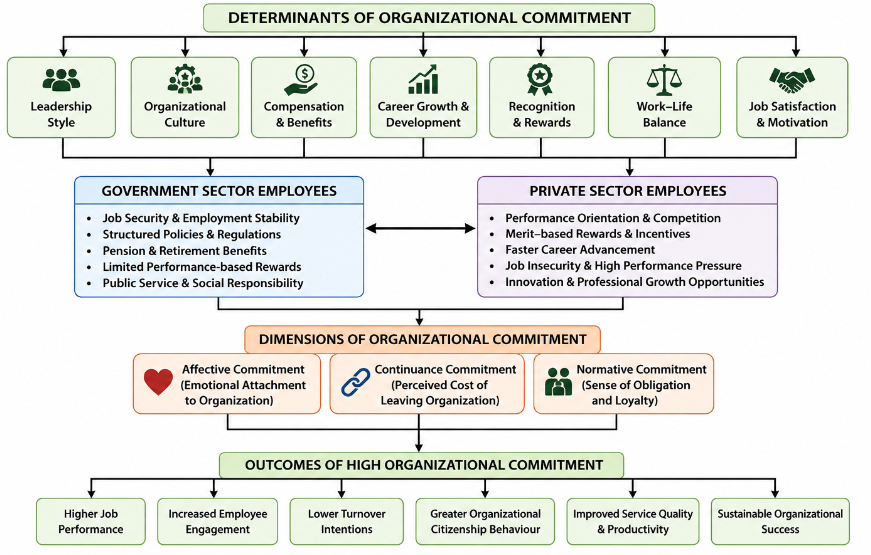
Figure: Organizational Commitment among Government and Private Sector Employees
In contrast, private sector organizations emphasize performance, innovation, efficiency, and competitiveness, creating work environments that demand continuous learning, adaptability, and high productivity. Employees in private organizations often develop affective commitment when they experience supportive leadership, recognition, professional growth, meaningful work, and opportunities for career advancement. Performance-based incentives, employee recognition programmes, leadership development initiatives, and merit-based promotions encourage stronger emotional attachment to organizational goals and values. Nevertheless, organizational restructuring, job insecurity, market competition, high workloads, and performance pressure may weaken long-term commitment if employees perceive limited organizational support or experience excessive occupational stress. Leadership plays a central role in strengthening organizational commitment in both sectors. Transformational leaders inspire employees by communicating a clear vision, encouraging participation, recognizing achievements, and promoting trust and collaboration. Employees who feel respected, valued, and involved in organizational decision-making are more likely to develop strong emotional commitment and remain loyal to their organizations. Similarly, transparent communication, ethical leadership, fairness in performance evaluation, and equitable treatment enhance organizational trust and strengthen employee commitment. Conversely, poor leadership, workplace discrimination, lack of recognition, ineffective communication, and unfair organizational practices reduce employee engagement and increase turnover intentions. Organizational culture also significantly influences commitment by shaping employees' daily experiences and relationships within the workplace. Supportive organizational cultures characterized by teamwork, mutual respect, inclusiveness, innovation, and shared organizational values encourage employees to identify with organizational objectives and contribute actively to institutional success. Human resource management practices further strengthen commitment through competitive compensation, career development opportunities, continuous professional training, mentoring programmes, employee wellness initiatives, flexible work arrangements, and transparent promotion policies. Demographic characteristics such as age, educational level, work experience, marital status, and organizational position may also influence organizational commitment. Experienced employees often demonstrate stronger continuance commitment due to accumulated benefits and long-term career investments, whereas younger employees tend to value learning opportunities, meaningful work, career growth, and organizational flexibility. The modern workplace has introduced additional factors affecting organizational commitment, including digital transformation, hybrid work models, remote working arrangements, artificial intelligence, and changing workforce expectations. Employees increasingly expect organizations to provide flexible working conditions, technological support, inclusive work environments, opportunities for continuous learning, and policies that promote work-life balance and psychological well-being. Organizations that successfully adapt to these evolving expectations are more likely to retain talented employees and strengthen long-term organizational commitment. Comparative studies consistently indicate that government employees generally exhibit higher continuance commitment because of employment stability and retirement benefits, whereas private sector employees often demonstrate stronger affective commitment when organizations provide supportive leadership, recognition, challenging work, and opportunities for professional advancement. Despite these sectoral differences, job satisfaction and work motivation remain fundamental predictors of organizational commitment in both government and private organizations. Employees who experience meaningful work, supportive supervisors, equitable rewards, professional growth, and positive workplace relationships are more likely to remain loyal and committed regardless of organizational sector. Therefore, strengthening organizational commitment requires a comprehensive approach that integrates employee engagement, transformational leadership, transparent organizational policies, fair compensation, career development, recognition programmes, and healthy work environments. Organizations that invest in their employees' professional and personal well-being create committed workforces capable of achieving higher productivity, greater innovation, improved service quality, and sustainable organizational success. Ultimately, organizational commitment serves as a strategic asset that enhances institutional stability, employee retention, organizational performance, and long-term competitiveness in both government and private sector organizations.
Conclusion#
Job satisfaction, work motivation, and organizational commitment are closely interconnected factors that significantly influence employee performance, organizational productivity, and institutional effectiveness in both government and private sector organizations. The present study demonstrates that although both sectors operate with different organizational structures, objectives, and human resource practices, they share the common goal of developing a competent, motivated, and committed workforce capable of achieving sustainable organizational success. The comparative analysis reveals that government employees generally experience higher levels of job security, employment stability, retirement benefits, regulated working hours, and work-life balance, which contribute positively to job satisfaction and long-term organizational commitment. These employees often develop a strong sense of loyalty toward their organizations because of stable career opportunities and the satisfaction derived from serving society through public administration and community welfare. However, bureaucratic procedures, slower promotional systems, limited performance-based incentives, and resistance to organizational change may reduce motivation and limit opportunities for innovation and professional growth. In contrast, private sector organizations operate in dynamic, competitive, and performance-oriented environments that encourage innovation, efficiency, and continuous improvement. Employees in private organizations are generally motivated by competitive salaries, performance-based incentives, rapid career advancement, professional development opportunities, and recognition for individual achievements. These factors often enhance productivity, creativity, and work motivation. Nevertheless, greater workload, intense competition, job insecurity, long working hours, and performance pressure may reduce job satisfaction and organizational commitment if organizations fail to provide adequate employee support and work-life balance. The study further highlights that supportive leadership, effective communication, fair compensation, career development, employee recognition, positive organizational culture, and transparent human resource practices are common determinants of employee satisfaction and commitment in both sectors. Organizations that value employee contributions, encourage participation in decision-making, provide opportunities for continuous learning, and maintain healthy workplace relationships are more likely to develop highly motivated and committed employees. In the modern era, rapid technological advancement, digital transformation, artificial intelligence, hybrid work models, and changing workforce expectations have significantly altered organizational practices and employee experiences. Consequently, both government and private organizations must continuously adapt their management strategies to meet the evolving professional, technological, and psychological needs of employees. Flexible working arrangements, employee wellness programmes, digital skill development, mental health support, inclusive leadership, and effective performance management have become essential components of successful human resource management. The study also emphasizes that job satisfaction enhances work motivation, while sustained motivation strengthens organizational commitment, creating a positive cycle that improves employee performance and organizational effectiveness. Human resource managers and organizational leaders should therefore adopt integrated strategies that simultaneously address employee welfare, career progression, organizational justice, leadership quality, and workplace engagement. Policymakers should encourage employee-friendly policies that promote equal opportunities, professional development, fair appraisal systems, and healthy work environments across both sectors. Investment in continuous training, leadership development, technological competence, and employee assistance programmes can further improve organizational performance and workforce resilience. Ultimately, employees remain the most valuable resource of every organization, and their satisfaction, motivation, and commitment determine the quality of services, innovation, productivity, and long-term institutional success. By creating supportive, inclusive, and growth-oriented workplaces, both government and private sector organizations can retain talented employees, strengthen organizational commitment, improve service delivery, and achieve sustainable development in an increasingly competitive and rapidly evolving global environment.
Works Cited#
- Allen, N. J., & Meyer, J. P. (1990). *The measurement and antecedents of affective, continuance, and normative commitment to the organization.* Journal of Occupational Psychology, 63(1), 1–18.
- Armstrong, M. (2023). *Armstrong's Handbook of Human Resource Management Practice* (16th ed.). Kogan Page.
- Bakotić, D. (2016). *Relationship between job satisfaction and organisational performance.* Economic Research-Ekonomska Istraživanja, 29(1), 118–130.
- Herzberg, F. (1968). *One more time: How do you motivate employees?* Harvard Business Review, 46(1), 53–62.
- Judge, T. A., Weiss, H. M., Kammeyer-Mueller, J. D., & Hulin, C. L. (2017). *Job attitudes, job satisfaction, and organizational behavior.* Annual Review of Psychology, 68, 341–367.
- Locke, E. A. (1976). *The nature and causes of job satisfaction.* In M. D. Dunnette (Ed.), *Handbook of Industrial and Organizational Psychology*. Rand McNally.
- Luthans, F. (2021). *Organizational Behavior* (14th ed.). McGraw-Hill Education.
- Maslow, A. H. (1943). *A theory of human motivation.* Psychological Review, 50(4), 370–396.
- Meyer, J. P., & Allen, N. J. (1991). *A three-component conceptualization of organizational commitment.* Human Resource Management Review, 1(1), 61–89.
- Meyer, J. P., Stanley, D. J., Herscovitch, L., & Topolnytsky, L. (2002). *Affective, continuance, and normative commitment to the organization: A meta-analysis.* Journal of Vocational Behavior, 61(1), 20–52.
- Robbins, S. P., & Judge, T. A. (2023). *Organizational Behavior* (19th ed.). Pearson.
- Spector, P. E. (2022). *Job Satisfaction: Application, Assessment, Causes, and Consequences.* SAGE Publications.
- Steers, R. M., Mowday, R. T., & Shapiro, D. L. (2004). *The future of work motivation theory.* Academy of Management Review, 29(3), 379–387.
- Vroom, V. H. (1964). *Work and Motivation.* Wiley.
- Deci, E. L., & Ryan, R. M. (2000). *The "what" and "why" of goal pursuits: Human needs and the self-determination of behavior.* Psychological Inquiry, 11(4), 227–268.
- World Economic Forum. (2025). *The Future of Jobs Report 2025.* World Economic Forum.
- International Labour Organization. (2024). *World Employment and Social Outlook: Trends 2024.* International Labour Organization.
- OECD. (2023). *Government at a Glance 2023.* Organisation for Economic Co-operation and Development.
- Noe, R. A. (2021). *Employee Training and Development* (8th ed.). McGraw-Hill Education.
- Yukl, G. (2020). *Leadership in Organizations* (9th ed.). Pearson.