Abstract
The present study examines how different leadership styles influence employee engagement and overall organizational effectiveness. Leadership style refers to the manner in which leaders guide, motivate, communicate, make decisions, and influence employees. In educational and corporate institutions, leadership plays a significant role in shaping work culture, motivation, commitment, innovation, productivity, and institutional success.
- Leadership Styles
- Employee Engagement
- Organizational Effectiveness
- Educational Institutions
- Corporate Institutions
- Transformational Leadership
- Work Motivation
- Organizational Performance
- Employee Commitment
- Institutional Development
Introduction#
Leadership is one of the most important factors influencing the success and effectiveness of any organization. Whether in educational institutions or corporate institutions, leadership determines the direction, culture, motivation, communication, decision-making, and performance of employees. Leaders are responsible for guiding people toward common goals, solving problems, managing change, and creating a productive work environment. Therefore, the study of leadership styles has become an important area in organizational behaviour, management, education, and human resource development.
Leadership style refers to the pattern of behaviour adopted by a leader while managing and influencing employees. Different leaders use different styles depending on their personality, organizational culture, goals, and work situation. Some leaders inspire and motivate employees through vision and encouragement, while others focus on rules, rewards, targets, and supervision. Common leadership styles include transformational leadership, transactional leadership, democratic leadership, autocratic leadership, participative leadership, servant leadership, and laissez-faire leadership.
Transformational leadership focuses on inspiration, vision, innovation, and personal development of employees. Such leaders motivate employees to go beyond routine duties and contribute creatively to organizational goals. Transactional leadership focuses on performance, rewards, discipline, and task completion. Democratic and participative leadership encourage employee involvement in decision-making, while autocratic leadership centralizes authority and control. Servant leadership emphasizes service, empathy, support, and employee growth.
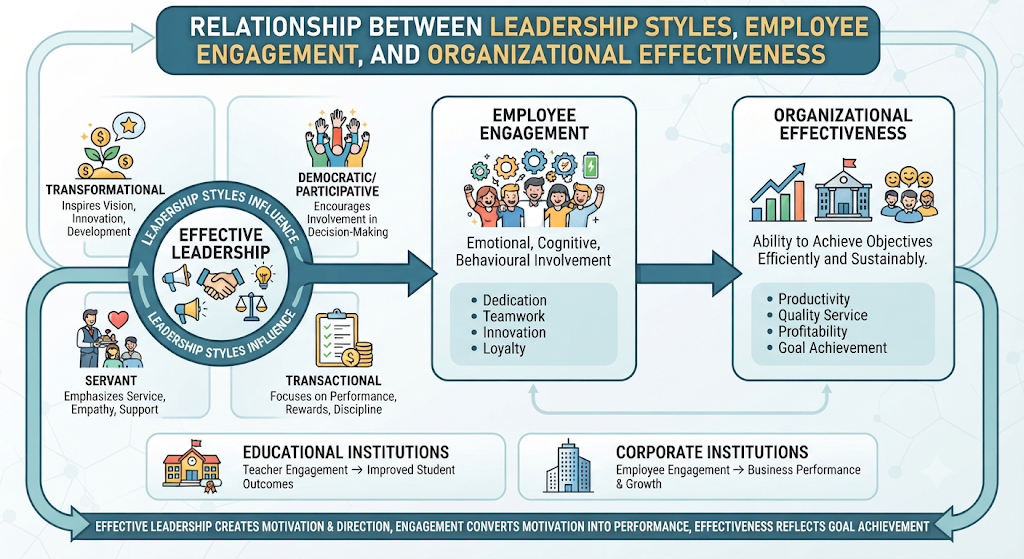
Employee engagement is closely related to leadership. Employee engagement refers to the emotional, cognitive, and behavioural involvement of employees in their work. Engaged employees are enthusiastic, committed, responsible, and willing to contribute extra effort for organizational success. They feel connected with the organization and believe that their work has value. Employee engagement is reflected in dedication, teamwork, innovation, punctuality, loyalty, and positive workplace behaviour.
In educational institutions, employee engagement is especially important because teachers, administrators, and support staff directly influence students’ learning and institutional development. Engaged teachers show greater commitment toward teaching, student guidance, curriculum planning, assessment, and school improvement. They are more likely to adopt innovative teaching methods, cooperate with colleagues, and contribute to institutional quality.
In corporate institutions, employee engagement affects productivity, customer service, innovation, teamwork, and organizational growth. Engaged employees are more likely to perform efficiently, support organizational goals, and remain loyal to the company. They also contribute to a positive workplace culture and help reduce absenteeism and employee turnover.
Organizational effectiveness refers to the ability of an organization to achieve its objectives efficiently and sustainably. It includes productivity, quality of service, employee satisfaction, goal achievement, innovation, adaptability, resource utilization, and stakeholder satisfaction. In educational institutions, organizational effectiveness may include academic outcomes, teaching quality, administrative efficiency, student satisfaction, staff morale, and institutional reputation. In corporate institutions, it may include profitability, market performance, employee productivity, customer satisfaction, and innovation.
Leadership styles influence organizational effectiveness both directly and indirectly. A leader who communicates clearly, supports employees, recognizes performance, encourages participation, and provides vision can improve employee engagement. In turn, engaged employees contribute to better organizational performance. Therefore, employee engagement may act as an important link between leadership style and organizational effectiveness.
The relationship between leadership styles, employee engagement, and organizational effectiveness is important in the present competitive and changing environment. Educational institutions face challenges such as quality education, digital learning, student performance, teacher motivation, accountability, and institutional improvement. Corporate institutions face challenges such as competition, technological change, customer expectations, employee retention, and innovation. In both sectors, effective leadership and engaged employees are necessary for long-term success. The present study is significant because it provides a comparative understanding of how leadership affects employee behaviour and institutional performance. It helps identify which leadership styles are more effective in promoting engagement and improving organizational outcomes. The findings of the study may be useful for school principals, college administrators, corporate managers, HR professionals, policy planners, and leadership trainers. By understanding the relationship among these variables, institutions can develop leadership training programmes, employee engagement strategies, participative management practices, and supportive organizational cultures. Thus, leadership styles, employee engagement, and organizational effectiveness are interrelated dimensions of institutional success. Effective leadership creates motivation and direction, employee engagement converts motivation into performance, and organizational effectiveness reflects the achievement of institutional goals.
Leadership Styles in Educational and Corporate Institutions#
Leadership style refers to the way a leader guides, motivates, communicates, supervises, and influences employees. In both educational and corporate institutions, leadership style plays an important role in shaping organizational culture, employee behaviour, decision-making, and overall performance. A leader is not only responsible for giving instructions but also for creating vision, building trust, solving problems, and encouraging employees to work toward common goals.
In educational institutions, leaders may include principals, vice-principals, heads of departments, coordinators, deans, directors, and administrators. Their leadership affects teachers, non-teaching staff, students, parents, and the overall academic environment. A good educational leader supports teachers, encourages innovation in teaching, maintains discipline, promotes academic excellence, and creates a healthy school or college culture.
In corporate institutions, leaders may include managers, team leaders, supervisors, department heads, human resource managers, and executives. Their leadership affects productivity, teamwork, customer satisfaction, employee morale, innovation, and organizational growth. Corporate leaders must manage targets, deadlines, competition, technology, and employee performance. Different leadership styles influence employees in different ways. Transformational leadership inspires employees through vision, motivation, encouragement, and personal development. Such leaders motivate employees to perform beyond routine expectations. Transactional leadership focuses on rules, rewards, performance targets, and supervision. Democratic leadership allows employees to participate in decision-making. Autocratic leadership gives more power to the leader and allows less participation from employees. Servant leadership focuses on employee welfare, support, empathy, and development.
In educational institutions, transformational and democratic leadership styles are often useful because teachers need encouragement, freedom, and professional respect. When leaders involve teachers in planning, curriculum activities, and institutional decisions, teachers feel valued and motivated. This improves teaching quality and institutional commitment. In corporate institutions, leadership style depends on organizational goals and work conditions. In some situations, transactional leadership may be useful for meeting targets and maintaining discipline. However, transformational and participative leadership can improve creativity, teamwork, innovation, and employee satisfaction. Leadership style also affects communication. Supportive leaders encourage open communication, feedback, and problem-solving. Employees feel comfortable sharing ideas and concerns. On the other hand, rigid and authoritarian leadership may create fear, low morale, and lack of initiative among employees. Thus, leadership styles are central to institutional success. The way leaders behave directly influences employee engagement and organizational effectiveness. A balanced leadership style that combines vision, discipline, support, participation, and fairness can create a productive and positive work environment.
Employee Engagement and Work Motivation#
Employee engagement refers to the emotional, mental, and behavioural involvement of employees in their work and organization. Engaged employees are committed, enthusiastic, responsible, and willing to contribute to organizational goals. They do not work only for salary; they feel connected with their institution and take pride in their work.
In educational institutions, employee engagement is reflected in teachers’ dedication, classroom preparation, student support, participation in school activities, innovation in teaching, and cooperation with colleagues. Engaged teachers show interest in student learning, attend duties sincerely, and contribute to academic improvement. They are more likely to guide students, adopt new teaching methods, and participate in institutional development.
In corporate institutions, employee engagement is reflected in productivity, teamwork, punctuality, customer service, creativity, loyalty, and willingness to take responsibility. Engaged employees work with energy and commitment. They contribute ideas, support team goals, and help improve organizational performance.
Leadership plays a major role in employee engagement. Employees become more engaged when leaders provide clear goals, appreciation, support, fair treatment, growth opportunities, and positive communication. A leader who recognizes employees’ efforts and listens to their problems can increase motivation and trust.
Work motivation is closely connected with engagement. Motivation may be internal or external. Internal motivation comes from interest, achievement, responsibility, and personal growth. External motivation comes from salary, promotion, rewards, recognition, and job security. Effective leaders understand both types of motivation and create conditions where employees feel inspired to work.
Employee engagement also depends on organizational culture. A positive culture promotes respect, cooperation, fairness, learning, and trust. In such an environment, employees feel safe and valued. Negative culture, poor communication, excessive workload, discrimination, and lack of recognition can reduce engagement.
In educational institutions, engagement can be improved through professional development, teacher autonomy, supportive leadership, recognition, manageable workload, and involvement in academic decisions. In corporate institutions, engagement can be improved through training, career growth, incentives, teamwork, feedback, flexible work policies, and employee welfare.
Engaged employees contribute to lower absenteeism, better performance, higher job satisfaction, and stronger organizational commitment. Disengaged employees may show low productivity, poor cooperation, lack of interest, and intention to leave the organization.
Therefore, employee engagement is a key factor in organizational success. It connects leadership practices with employee performance and institutional effectiveness. Strong leadership can create high engagement, and high engagement can improve organizational outcomes.
Organizational Effectiveness in Educational and Corporate Institutions#
Organizational effectiveness refers to the ability of an institution to achieve its goals, use resources properly, satisfy stakeholders, and maintain long-term growth. It reflects how successfully an organization performs its functions. In educational and corporate institutions, organizational effectiveness is measured differently, but its basic meaning remains the same: achieving desired outcomes efficiently and sustainably.In educational institutions, organizational effectiveness includes quality teaching, student achievement, teacher satisfaction, discipline, academic planning, administrative efficiency, parent satisfaction, infrastructure use, and institutional reputation. An effective school, college, or university provides a healthy learning environment, supports teachers, develops students, and maintains academic standards.
In corporate institutions, organizational effectiveness includes productivity, profitability, customer satisfaction, employee performance, innovation, market growth, teamwork, quality service, and employee retention. An effective company achieves business targets, satisfies customers, uses resources efficiently, and adapts to market changes. Leadership style directly affects organizational effectiveness. Leaders set goals, guide employees, manage resources, solve conflicts, and create work culture. If leadership is supportive and goal-oriented, employees are more likely to work efficiently. If leadership is weak, unclear, or unfair, organizational performance may decline. Employee engagement is also an important factor in organizational effectiveness. Engaged employees are more productive, creative, loyal, and committed. They contribute to better service quality and institutional improvement. In educational institutions, engaged teachers improve student learning and school performance. In corporate institutions, engaged employees improve productivity and customer satisfaction. Organizational effectiveness also depends on communication, teamwork, planning, monitoring, innovation, and employee development. Institutions that encourage feedback and participation are more likely to improve performance. Employees should understand institutional goals and their role in achieving them.
In educational institutions, effectiveness requires coordination between administration, teachers, students, parents, and community. In corporate institutions, effectiveness requires coordination between management, employees, customers, suppliers, and stakeholders. In both sectors, leadership and engagement are essential for smooth functioning. Challenges to organizational effectiveness include poor leadership, lack of motivation, weak communication, employee dissatisfaction, excessive workload, resistance to change, lack of training, and unclear goals. These challenges can reduce performance and create workplace stress. To improve effectiveness, institutions should develop strong leadership, employee engagement programmes, performance feedback systems, training opportunities, fair policies, and supportive work environments. Effectiveness is not achieved only through rules and targets; it also requires human motivation, trust, and cooperation. Thus, organizational effectiveness is the final outcome of good leadership and engaged employees. When leaders guide effectively and employees remain committed, institutions become more productive, adaptive, and successful.
Relationship between Leadership Styles, Employee Engagement, and Organizational Effectiveness#
Leadership styles, employee engagement, and organizational effectiveness are closely related to one another. Leadership style influences employee behaviour, employee engagement influences work performance, and work performance contributes to organizational effectiveness. Therefore, these three variables form an important chain in both educational and corporate institutions.
Effective leadership creates the foundation for employee engagement. When leaders are supportive, fair, inspiring, and communicative, employees feel valued and motivated. Transformational leaders encourage employees to grow, think creatively, and work with commitment. Democratic leaders involve employees in decision-making, which increases ownership and responsibility. Servant leaders support employee welfare and build trust. These styles generally increase engagement.
On the other hand, autocratic or unsupportive leadership may reduce engagement. If employees feel ignored, controlled, or unfairly treated, they may lose interest in work. Poor leadership can create stress, conflict, dissatisfaction, and low productivity. Therefore, leadership behaviour has a direct effect on employee morale and engagement.
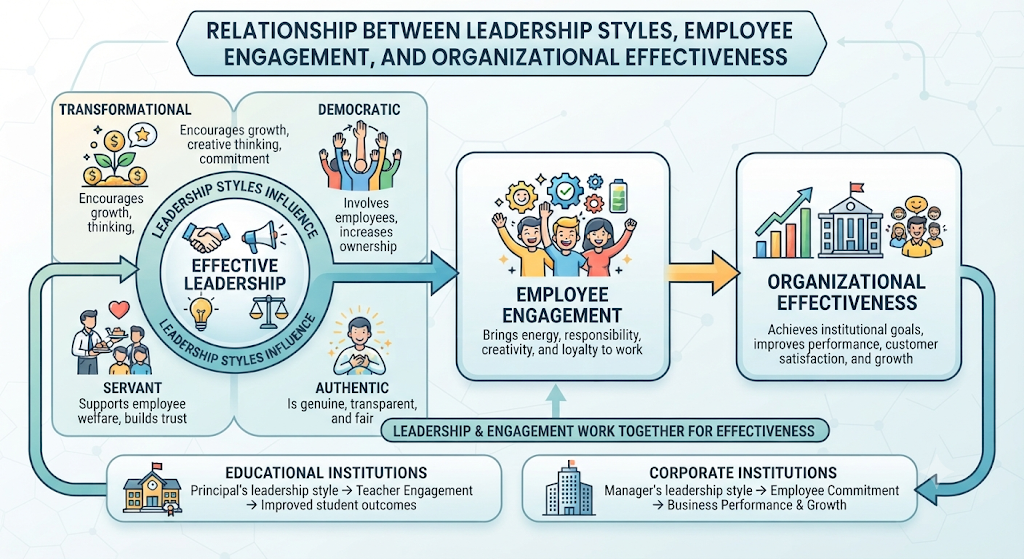
Employee engagement acts as a bridge between leadership and organizational effectiveness. Even if leaders create good plans, organizational success depends on how employees implement those plans. Engaged employees bring energy, responsibility, creativity, and loyalty to their work. They help institutions achieve goals more effectively.
In educational institutions, a principal’s leadership style can influence teachers’ motivation and engagement. Engaged teachers improve classroom teaching, student learning, discipline, and institutional reputation. Thus, leadership indirectly affects student outcomes through teacher engagement.
In corporate institutions, managers’ leadership styles influence employee commitment, teamwork, customer service, innovation, and productivity. Engaged employees help improve business performance, customer satisfaction, and organizational growth. Thus, leadership indirectly affects corporate success through employee engagement.
The relationship among these variables also shows that one leadership style may not be suitable for all situations. Leaders should be flexible and adopt styles according to employee needs, organizational goals, and work conditions. For example, during crisis situations, a more directive style may be needed, while during innovation and planning, participative leadership may be more effective.
Organizational effectiveness improves when leadership and engagement work together. Supportive leadership increases employee trust, engagement increases performance, and performance improves effectiveness. Therefore, institutions should invest in leadership development, employee welfare, communication systems, training, and participative management.
Conclusion#
The study concludes that leadership styles, employee engagement, and organizational effectiveness are closely interrelated in both educational and corporate institutions. Effective leadership provides direction, motivation, communication, support, and vision to employees. Leadership styles such as transformational, democratic, participative, and servant leadership generally create a positive work environment and increase employee commitment.
Employee engagement acts as an important link between leadership and organizational effectiveness. When employees feel valued, respected, motivated, and involved in decision-making, they show higher dedication, creativity, teamwork, loyalty, and performance. In educational institutions, engaged teachers improve teaching quality, student learning, and institutional reputation. In corporate institutions, engaged employees improve productivity, customer satisfaction, innovation, and organizational growth.
The study further concludes that organizational effectiveness depends not only on policies and resources but also on human motivation, leadership behaviour, and employee participation. Poor leadership may reduce engagement, increase dissatisfaction, and weaken institutional performance. Therefore, institutions should promote leadership training, fair communication, employee recognition, professional development, and participative management practices. The effective leadership and strong employee engagement are essential for achieving organizational goals and ensuring long-term institutional success.
Works Cited#
- Bass, Bernard M. Leadership and Performance beyond Expectations. Free Press, 1985.
- Bass, Bernard M., and Ronald E. Riggio. Transformational Leadership. 2nd ed., Lawrence Erlbaum Associates, 2006.
- Burns, James MacGregor. Leadership. Harper & Row, 1978.
- Greenleaf, Robert K. Servant Leadership: A Journey into the Nature of Legitimate Power and Greatness. Paulist Press, 1977.
- House, Robert J. “A Path Goal Theory of Leader Effectiveness.” Administrative Science Quarterly, vol. 16, no. 3, 1971, pp. 321–339.
- Kahn, William A. “Psychological Conditions of Personal Engagement and Disengagement at Work.” Academy of Management Journal, vol. 33, no. 4, 1990, pp. 692–724.
- Kouzes, James M., and Barry Z. Posner. The Leadership Challenge. 6th ed., Wiley, 2017.
- Lewin, Kurt, Ronald Lippitt, and Ralph K. White. “Patterns of Aggressive Behavior in Experimentally Created Social Climates.” Journal of Social Psychology, vol. 10, no. 2, 1939, pp. 271–301.
- Likert, Rensis. New Patterns of Management. McGraw-Hill, 1961.
- Luthans, Fred. Organizational Behavior: An Evidence-Based Approach. 12th ed., McGraw-Hill, 2011.
- Macey, William H., and Benjamin Schneider. “The Meaning of Employee Engagement.” Industrial and Organizational Psychology, vol. 1, no. 1, 2008, pp. 3–30.
- Northouse, Peter G. Leadership: Theory and Practice. 9th ed., SAGE Publications, 2021.
- Robbins, Stephen P., and Timothy A. Judge. Organizational Behavior. 18th ed., Pearson, 2019.
- Saks, Alan M. “Antecedents and Consequences of Employee Engagement.” Journal of Managerial Psychology, vol. 21, no. 7, 2006, pp. 600–619.
- Schaufeli, Wilmar B., and Arnold B. Bakker. “Job Demands, Job Resources, and Their Relationship with Burnout and Engagement.” Journal of Organizational Behavior, vol. 25, no. 3, 2004, pp. 293–315.
- Schein, Edgar H. Organizational Culture and Leadership. 5th ed., Wiley, 2016.
- Senge, Peter M. The Fifth Discipline: The Art and Practice of the Learning Organization. Doubleday, 1990.
- Stogdill, Ralph M. Handbook of Leadership: A Survey of Theory and Research. Free Press, 1974.
- Yukl, Gary. Leadership in Organizations. 8th ed., Pearson, 2013.
- Zhu, Weichun, Bruce J. Avolio, and Fred O. Walumbwa. “Moderating Role of Follower Characteristics with Transformational Leadership and Follower Work Engagement.” Group & Organization Management, vol. 34, no. 5, 2009, pp. 590–619.