Abstract
Narrative magic represents the imaginative and symbolic dimensions of storytelling that transform ordinary experiences into meaningful journeys of learning, emotional growth, and self-discovery. Within Indian English literature, narrative magic is deeply rooted in folklore, mythology, oral traditions, and cultural symbolism, making it an effective literary approach for engaging children with diverse learning needs. For children with special needs, magical and symbolic narratives create safe imaginative spaces where differences are accepted, emotions are explored, and challenges are approached with hope rather than fear. Unlike conventional instructional methods, narrative-based learning encourages active participation through imagination, dialogue, visual imagery, and symbolic interpretation, thereby supporting cognitive, emotional, linguistic, and social development (Cremin et al., 2013) . Inclusive literary narratives portray children with special needs as capable individuals with unique strengths, aspirations, and identities instead of defining them through disability or limitation. Such representations promote self-esteem, resilience, empathy, and a sense of belonging while encouraging non-disabled readers to appreciate diversity and social inclusion. Furthermore, narrative magic enhances educational experiences by integrating creativity with literacy, communication, and emotional learning. Teachers, parents, and therapists can employ magical narratives to facilitate inclusive classroom practices, therapeutic interventions, and collaborative learning experiences. This chapter explores the conceptual foundations of narrative magic, storytelling traditions in Indian English literature, literary representations of children with special needs, the psychological and educational impact of magical narratives, and their pedagogical significance. It argues that narrative magic serves as a transformative literary and educational resource that fosters inclusive learning, emotional well-being, creativity, and holistic development among children with special needs.
- Narrative Magic
- Inclusive Learning
- Indian English Literature
- Children with Special Needs
- Storytelling
- Inclusive Education
- Children's Literature
- Disability Representation
- Emotional Development
- Psychological Well-being
- Narrative-Based Learning
- Magical Realism
- Educational Inclusion
- Therapeutic Storytelling
- Social Inclusion
Introduction#
Narratives have always occupied a central position in human civilization, serving as powerful instruments for preserving culture, transmitting knowledge, shaping identity, and promoting emotional understanding. For children, storytelling is more than a source of entertainment; it is a medium through which language, imagination, values, relationships, and problem-solving skills are developed (Reese et al., 2010). Indian English literature possesses a particularly rich storytelling tradition that combines mythology, folklore, oral narratives, spirituality, and contemporary social realities. These diverse literary traditions have evolved to address modern educational concerns, including diversity, inclusion, disability, and child development. As societies increasingly recognize the importance of inclusive education, literary narratives have become valuable resources for supporting the learning and emotional
well-being of children with special needs. The concept of narrative magic extends beyond supernatural events or fantasy. It refers to the imaginative, symbolic, and emotionally engaging qualities of stories that enable readers to interpret ordinary experiences through creativity and wonder. Magical narratives transform familiar situations into meaningful explorations of courage, friendship, hope, resilience, and self-discovery (Stephens, 2011). Unlike fantasy, which often creates entirely separate imaginary worlds, narrative magic integrates extraordinary elements within recognizable social and cultural settings, allowing children to relate imaginative experiences to real-life challenges. This literary approach is particularly beneficial for children with special needs because it presents difficult emotions, social experiences, and personal struggles through symbolic and accessible forms. Children with special needs often encounter barriers related to communication, learning, emotional regulation, and social participation. Traditional educational approaches sometimes emphasize deficits rather than strengths, limiting opportunities for creative engagement and self-expression. Narrative magic offers an alternative educational framework by presenting learning as an imaginative and participatory process (Egan, 2005). Stories encourage children to interpret symbols, empathize with characters, solve problems, and imagine alternative possibilities while developing confidence and emotional resilience. Such experiences contribute to both academic learning and psychological development without placing excessive emphasis on disability.
Indian English literature provides an ideal context for exploring narrative magic because of its integration of ancient storytelling traditions with contemporary literary innovation. Stories inspired by the Panchatantra, Jataka Tales, Ramayana, Mahabharata, and regional folklore naturally incorporate magical elements such as talking animals, enchanted forests, miraculous transformations, and symbolic journeys (Grenby, 2008). Contemporary Indian English authors have adapted these narrative traditions to address present-day concerns, including inclusion, equality, identity, and emotional well-being. Consequently, magical narratives have become important literary tools for representing children with special needs in ways that emphasize dignity, participation, and human potential rather than limitation.
The educational significance of narrative magic extends to inclusive learning environments where literature supports cognitive, linguistic, emotional, and social development simultaneously. Story-based learning encourages active participation through discussion, dramatization, visual interpretation, creative writing, digital storytelling, and collaborative activities. Such approaches accommodate diverse learning styles while promoting communication, empathy, creativity, and critical thinking (Rowsell & Walsh, 2011). Inclusive narratives also reduce prejudice by helping children understand and appreciate differences through emotionally engaging experiences rather than abstract instruction.
Psychologically, narrative magic contributes to emotional healing and resilience by allowing children to explore fear, loneliness, anxiety, friendship, and hope within safe imaginative spaces. Symbolic storytelling enables children to recognize emotions, develop coping strategies, and construct positive identities through meaningful literary experiences (Betzalel & Shechtman, 2010). These narratives strengthen self-esteem by presenting children with special needs as capable individuals who actively contribute to their families, schools, and communities.
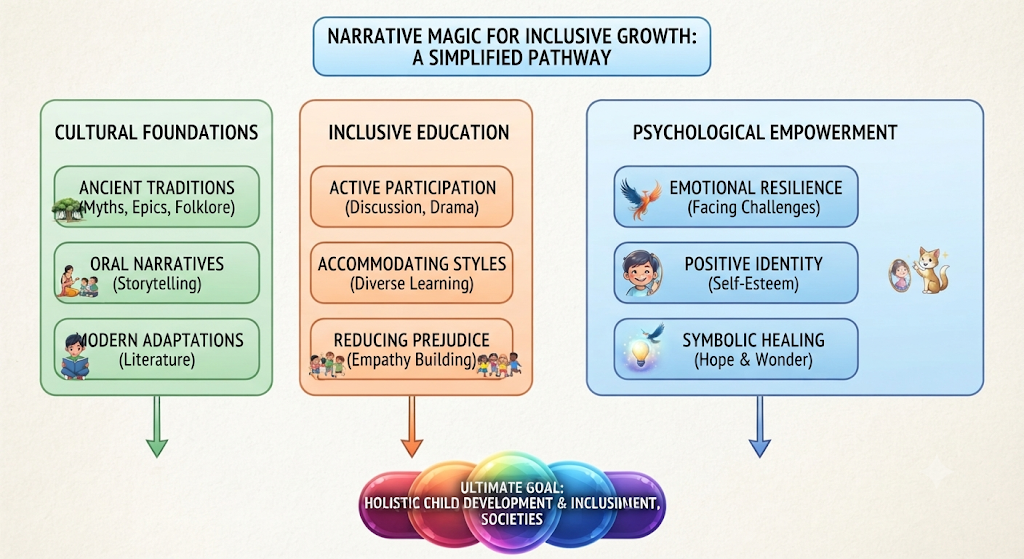
This chapter examines the relationship between narrative magic and inclusive learning in Indian English literature for children with special needs. It explores the conceptual foundations of narrative-based learning, storytelling traditions, literary representations of disability, psychological development, and educational implications. Through this discussion, the chapter demonstrates that narrative magic serves as an effective literary and pedagogical framework for fostering inclusion, creativity, emotional well-being, and holistic child development (Clark & Rossiter, 2008).
Conceptual Framework Of Narrative Magic And Inclusive Learning#
Narrative magic is a literary concept that refers to the imaginative, symbolic, and emotionally engaging qualities of storytelling that transform ordinary experiences into meaningful journeys of learning, self-discovery, and personal growth. Unlike fantasy, which often separates readers from reality by creating entirely fictional worlds, narrative magic remains closely connected to everyday life while introducing symbolic or extraordinary elements that deepen understanding. Within Indian English literature, narrative magic is influenced by folklore, mythology, oral traditions, and cultural beliefs, allowing stories to communicate educational and emotional messages through imaginative experiences. When combined with inclusive learning, narrative magic becomes an effective framework for supporting the cognitive, emotional, linguistic, and social development of children with special needs (Abbott, 2008).
Inclusive learning is based on the principle that every child, regardless of physical, sensory, intellectual, or developmental differences, has the right to participate meaningfully in educational experiences. Rather than expecting children to adapt to rigid educational systems, inclusive learning encourages teaching methods that accommodate diverse abilities, interests, and communication needs. Storytelling naturally supports these principles because narratives can be presented through spoken language, illustrations, role-play, puppetry, digital media, animation, music, and interactive activities. This flexibility enables children with different learning styles to participate actively while developing confidence and a sense of belonging (Ainscow, 2005).
The conceptual relationship between narrative magic and inclusive learning is founded on imagination as a medium for understanding reality. Magical events in stories function symbolically, helping children interpret emotions, relationships, and life experiences that may otherwise appear confusing or overwhelming. A magical forest may represent personal growth, a talking bird may symbolize friendship, or an enchanted journey may reflect the process
of overcoming emotional challenges. These symbolic representations simplify complex ideas without reducing their emotional significance. For children with special needs, such imaginative structures create safe spaces where fears, anxieties, and social difficulties can be explored indirectly while promoting emotional security and resilience (Greene, 2001).
Another important aspect of this framework is identity formation. Inclusive narratives encourage children to recognize themselves as capable individuals with unique strengths, interests, and aspirations rather than defining themselves through disability or limitation. Magical storytelling reinforces this perspective by presenting characters who achieve personal growth through courage, creativity, cooperation, and perseverance instead of physical perfection or extraordinary abilities. Children with special needs therefore encounter literary models that validate their experiences while encouraging self-acceptance and confidence. At the same time, non-disabled readers develop greater appreciation for diversity and learn to value differences as natural aspects of human life (Hall, 2010).
Narrative magic also strengthens communication and language development. Storytelling exposes children to vocabulary, dialogue, sequencing, symbolism, and narrative structure in engaging contexts that stimulate listening, speaking, reading, and creative expression. Interactive storytelling activities such as questioning, dramatization, picture interpretation, collaborative storytelling, and digital story creation further encourage participation among children with diverse communication abilities. Such experiences improve comprehension while simultaneously developing imagination, critical thinking, and social interaction (Zins et al., 2004).
The conceptual framework further recognizes emotional learning as an essential component of inclusive education. Magical narratives allow children to identify emotions through fictional characters, symbolic situations, and imaginative conflicts. Characters experiencing fear, loneliness, friendship, courage, disappointment, or hope provide opportunities for children to understand emotional responses and consider constructive ways of addressing challenges. Through guided discussion and reflective activities, storytelling supports emotional regulation, empathy, resilience, and positive interpersonal relationships. These emotional competencies contribute significantly to children's overall psychological well-being and social participation (Ramanujan, 2004).
Within Indian English literature, narrative magic is strengthened by the country's rich cultural heritage of myths, folktales, epics, and oral storytelling traditions. Stories inspired by the Panchatantra, Jataka Tales, Ramayana, Mahabharata, and regional folklore naturally integrate symbolic imagination with moral and educational themes. Contemporary Indian English authors continue this tradition by adapting magical narratives to address modern concerns such as disability, inclusion, equality, environmental awareness, and emotional health. Consequently, narrative magic serves not only as a literary technique but also as an educational philosophy that combines cultural continuity with inclusive values (UNESCO, 2020).
Overall, the conceptual framework of narrative magic and inclusive learning highlights the interconnected relationship between imagination, education, emotional development, and social inclusion. It demonstrates that storytelling is far more than a recreational activity; it is a multidimensional educational resource capable of supporting language development, identity formation, creativity, empathy, resilience, and meaningful participation for children with special needs. By integrating symbolic imagination with inclusive educational practices, Indian English literature offers a powerful framework for promoting holistic child development and creating learning environments where every child is valued, respected, and empowered (Archibald, 2008).
Storytelling Traditions In Indian English Literature#
Storytelling has been an integral part of Indian culture for centuries, functioning as a means of preserving knowledge, transmitting moral values, strengthening cultural identity, and fostering emotional and intellectual growth. Long before the emergence of written literature, stories were shared through oral traditions in homes, temples, schools, and community gatherings. Elders, teachers, and storytellers narrated tales that entertained while simultaneously teaching lessons about courage, honesty, compassion, cooperation, and justice. These oral traditions later evolved into written literature and significantly influenced the development of Indian English literature. Today, storytelling continues to serve as a bridge between India's rich cultural heritage and contemporary educational and social concerns, including inclusion, diversity, and the representation of children with special needs (Bauman, 2004).
One of the most distinctive features of Indian storytelling is its integration of mythology, folklore, spirituality, and everyday life. Ancient texts such as the Panchatantra, Jataka Tales, Hitopadesha, Ramayana, and Mahabharata present narratives that combine realistic human experiences with symbolic and magical elements. Talking animals, wise sages, enchanted forests, divine intervention, magical objects, and extraordinary journeys are common narrative devices that communicate ethical principles and life lessons. These imaginative elements encourage children to interpret emotions, relationships, and challenges through symbolic thinking while maintaining strong connections with cultural traditions. Such storytelling naturally supports the concept of narrative magic, where imagination becomes a meaningful tool for understanding reality (Thompson, 2008).
Indian English literature inherited these storytelling traditions while adapting them to contemporary themes and audiences. Modern authors retain the symbolic richness of traditional narratives but increasingly address issues such as identity, education, social justice, environmental awareness, inclusion, and emotional well-being. Rather than presenting stories solely for moral instruction, contemporary narratives explore children's everyday experiences within families, schools, and communities. This evolution has created opportunities to represent children from diverse social, cultural, and educational backgrounds, including those with special needs, in more authentic and inclusive ways (Hunt, 2001).
Storytelling in Indian English literature is also characterized by its emphasis on collective relationships. Unlike many individual-centered narratives, Indian stories frequently highlight the importance of family, friendship, community, and shared responsibility. Children learn that personal growth occurs through cooperation, empathy, guidance, and mutual support rather than isolated achievement. This perspective is especially valuable for children with special needs because it reinforces the role of inclusive families, supportive teachers, understanding peers, and accessible learning environments in promoting confidence and participation. The narrative focus shifts from individual limitations to collective acceptance and social belonging (Rogoff, 2003).
Another defining characteristic of Indian storytelling is its flexibility across multiple forms of expression. Traditional oral narratives have expanded into children's novels, illustrated storybooks, picture books, comics, graphic novels, theatre, puppetry, animation, audiobooks, and digital storytelling platforms. These varied formats increase accessibility for children with different learning preferences and communication abilities. Visual illustrations, rhythmic language, repetition, interactive dialogue, and multimedia presentations help children understand complex ideas while encouraging active participation. For children with special needs, these diverse storytelling methods support language development, attention, memory, imagination, and social interaction in engaging and meaningful ways (Sipe, 2008).
Storytelling traditions in Indian English literature also encourage creativity and critical thinking. Instead of providing direct solutions to every problem, narratives often invite readers to interpret symbols, predict outcomes, analyze characters' decisions, and imagine alternative possibilities. Such literary engagement develops problem- solving abilities while nurturing curiosity and independent thinking. Narrative magic further enriches this process by allowing children to explore extraordinary situations that symbolize real-life emotional and social experiences. Consequently, stories become powerful educational tools that promote both intellectual growth and emotional understanding (Paris & Paris, 2001).
In recent decades, Indian English literature has increasingly embraced inclusive storytelling that reflects the principles of equality, dignity, and respect for diversity. Authors are moving beyond stereotypical portrayals of disability and instead presenting children with special needs as active participants in family, school, and community life. These narratives recognize children's talents, aspirations, friendships, and emotional experiences while acknowledging the barriers created by inaccessible environments and social prejudice. Such representations align with contemporary approaches to inclusive education by emphasizing participation rather than exclusion (Ware, 2002).
Representation Of Children With Special Needs In Indian English#
LITERATURE
The representation of children with special needs in Indian English literature has evolved considerably over the past few decades, reflecting changing perspectives on disability, childhood, and inclusive education. Earlier literary
works frequently portrayed children with disabilities through medical or charitable perspectives, where they appeared as helpless individuals dependent on the support of parents, caregivers, or society. Such narratives often emphasized suffering, isolation, or miraculous recovery, reducing disability to a symbol of tragedy or inspiration. As a result, children's personalities, aspirations, and everyday experiences remained overshadowed by their impairments, limiting readers' understanding of disability as a natural aspect of human diversity (Quayson, 2007).
Contemporary Indian English literature has gradually shifted toward more inclusive and realistic portrayals that recognize children with special needs as multidimensional individuals. Modern narratives no longer define children solely by their disabilities; instead, they present them as active participants in family, school, and community life. These characters possess unique interests, talents, emotions, ambitions, and relationships that shape their identities beyond physical, cognitive, or developmental differences. Such representation reflects the understanding that disability is only one aspect of a child's life and should not determine personal worth or social participation (Linton, 2006).
A notable development in recent literature is the emphasis on individuality and agency. Children with special needs are increasingly portrayed as decision-makers, problem-solvers, creative thinkers, and contributors to their communities rather than passive recipients of care. They actively participate in classroom activities, friendships, family responsibilities, and imaginative adventures while overcoming challenges through perseverance, creativity, and collaboration. This narrative shift encourages readers to appreciate children's strengths and capabilities instead of focusing solely on their limitations. It also promotes the idea that every child has the potential to learn, grow, and contribute meaningfully when provided with appropriate support and inclusive opportunities (Wehmeyer, 2005).
Narrative voice plays an equally important role in authentic representation. Earlier literary works often described children with special needs from the perspectives of parents, teachers, doctors, or caregivers, limiting opportunities for children to express their own experiences. Contemporary Indian English literature increasingly adopts first- person narration, internal monologue, and close focalization, allowing children to articulate their emotions, dreams, fears, and interpretations of the world. This shift strengthens self-representation and enables readers to understand disability from the child's perspective rather than through external observation. Such narrative techniques promote dignity, empathy, and respect by recognizing children as individuals capable of expressing their own identities and experiences (Lejeune, 2009).
Indian English literature also increasingly highlights the importance of inclusive social environments. Contemporary stories recognize that many of the challenges experienced by children with special needs arise from inaccessible schools, negative attitudes, social exclusion, and discrimination rather than from disability itself. Consequently, narratives emphasize the role of supportive families, compassionate teachers, inclusive classrooms, and understanding peer groups in fostering children's emotional well-being and educational success. By presenting inclusion as a shared social responsibility, literature encourages readers to understand that meaningful participation depends on removing barriers and creating welcoming environments for all children (Slee, 2011).
Narrative magic further enriches these representations by introducing symbolic and imaginative elements that illuminate children's emotional and psychological experiences. Magical journeys, talking animals, enchanted landscapes, dreams, and symbolic transformations become literary devices through which children explore friendship, courage, identity, belonging, and hope. These magical experiences do not eliminate disability or suggest unrealistic solutions; rather, they provide imaginative spaces where children discover confidence, resilience, and self-acceptance. Through symbolism, narrative magic enables readers to appreciate the emotional depth of children's experiences while reinforcing positive messages about diversity and inclusion (Morrison, 2012).
Another important aspect of contemporary representation is the rejection of stereotypes. Inclusive narratives increasingly avoid portraying children with special needs as either helpless victims or extraordinary heroes. Instead, they present balanced characters who experience ordinary childhood emotions such as joy, curiosity, disappointment, fear, affection, frustration, and achievement. These realistic portrayals encourage readers to recognize shared human experiences while respecting individual differences. Such literary representation contributes to reducing prejudice, challenging misconceptions, and promoting empathy among children, educators, parents, and society (Sherry, 2008).
Overall, Indian English literature has made significant progress in portraying children with special needs through narratives that celebrate individuality, participation, and human dignity. By integrating realistic characterization with imaginative storytelling, contemporary authors create literary spaces where diversity is valued and inclusion becomes a natural part of childhood experience. These representations not only enrich children's literature but also contribute to broader educational and social efforts aimed at fostering equality, empathy, and respect for all children. Through authentic and inclusive storytelling, Indian English literature demonstrates the transformative power of narratives in shaping positive attitudes toward disability and creating more compassionate and inclusive communities (Wendell, 2006).
Narrative Magic And Its Impact On Inclusive Learning And Psychological Development#
Narrative magic plays a significant role in promoting inclusive learning and psychological development by transforming storytelling into an engaging process that combines imagination, emotion, and meaningful learning experiences. Unlike conventional teaching methods that often rely on direct instruction, narrative magic encourages children to explore ideas through symbolic events, imaginative characters, and emotionally rich situations. In Indian English literature, magical elements are naturally integrated with realistic settings, allowing children to connect fictional experiences with everyday life. For children with special needs, this literary approach creates safe and inclusive environments where learning becomes enjoyable, accessible, and emotionally meaningful (Gallas, 2003).
One of the primary contributions of narrative magic is its ability to enhance inclusive learning. Children with special needs often demonstrate diverse learning styles and communication preferences, making flexible educational approaches essential. Stories that incorporate magical journeys, talking animals, enchanted objects, symbolic dreams, or extraordinary adventures stimulate curiosity and sustain attention while presenting educational concepts in engaging ways. Such narratives encourage active participation through listening, questioning, discussion, dramatization, drawing, and creative storytelling. As children interpret symbols, predict events, and analyze characters’ actions, they develop comprehension, vocabulary, critical thinking, and problem-solving skills. Consequently, narrative magic supports learning by accommodating cognitive diversity and encouraging every child to participate according to individual abilities (Gambrell, 2011).
Narrative magic also contributes significantly to psychological development by creating opportunities for emotional exploration and self-expression. Children frequently encounter emotions such as fear, loneliness, disappointment, hope, friendship, and courage within magical narratives. Because these emotions are represented symbolically rather than directly, children can understand and express their own feelings without experiencing emotional discomfort. Magical experiences become metaphors for personal struggles, enabling children to recognize emotional challenges and imagine positive ways of responding to them. This symbolic engagement strengthens emotional awareness, self- regulation, and confidence while reducing anxiety associated with difficult experiences (Hoffman, 2000).
Identity formation is another important psychological outcome of narrative magic. Children with special needs often face social barriers, low expectations, or negative stereotypes that may influence their self-perception. Inclusive magical narratives counter these experiences by presenting children as capable, creative, and resilient individuals who actively shape their own journeys. Magical elements do not eliminate disability or suggest miraculous cures; instead, they emphasize courage, imagination, perseverance, and meaningful participation. Such representation helps children develop positive self-esteem and encourages them to recognize their abilities rather than focusing exclusively on limitations. At the same time, these stories promote acceptance among peers by highlighting shared human emotions and experiences (Eccles, 2009).
The impact of narrative magic extends beyond individual development to social and emotional learning. Stories encourage empathy by inviting readers to understand the perspectives, emotions, and experiences of diverse characters. Children learn the importance of kindness, cooperation, patience, fairness, and mutual respect as they observe relationships within the narrative. Inclusive magical stories challenge stereotypes by portraying children with special needs as valued members of families, schools, and communities rather than passive recipients of assistance. Such literary experiences foster positive attitudes toward diversity and encourage inclusive behaviour in real-life educational settings (Eisenberg et al., 2010).
Indian English literature provides a culturally rich foundation for narrative magic through its integration of mythology, folklore, spirituality, and oral storytelling traditions. Symbolic motifs such as sacred trees, magical
rivers, wise animals, protective spirits, and transformative journeys are familiar elements within Indian cultural narratives. Contemporary authors adapt these traditional motifs to explore modern issues including disability, inclusion, emotional well-being, and educational equality. This cultural continuity enables children to relate more deeply to stories while appreciating both traditional values and contemporary inclusive perspectives. As a result, narrative magic strengthens cultural identity alongside emotional and intellectual development (Jain, 2004).
Digital storytelling has further expanded the influence of narrative magic in inclusive learning. Interactive e-books, animated stories, audiobooks, multimedia presentations, and digital storytelling applications provide alternative ways for children with diverse sensory, linguistic, and communication needs to engage with narratives. Features such as audio narration, subtitles, visual sequencing, voice recording, and interactive illustrations improve accessibility while encouraging creativity and self-expression. Digital platforms also allow children to create their own stories, giving them opportunities to communicate personal experiences and construct positive identities through narrative (Sadik, 2008).
Overall, narrative magic serves as a powerful educational and psychological resource that promotes inclusive learning, emotional resilience, creativity, and social participation. By integrating imagination with realistic human experiences, Indian English literature enables children with special needs to develop confidence, empathy, communication skills, and a sense of belonging. More importantly, narrative magic demonstrates that learning becomes most meaningful when every child is empowered to imagine, participate, and grow within an environment that values diversity, inclusion, and human dignity (Nussbaum, 2010).
Educational, Therapeutic And Pedagogical Implications Of Narrative-Based Learning#
Narrative-based learning has become an important educational approach because it integrates storytelling with cognitive, emotional, social, and linguistic development. Unlike traditional teaching methods that primarily emphasize memorization and direct instruction, narrative-based learning encourages children to acquire knowledge through meaningful experiences, imagination, and active participation. In Indian English literature, stories enriched with cultural traditions, symbolism, and narrative magic provide valuable opportunities for children with special needs to engage with learning in inclusive and emotionally supportive environments. These narratives foster not only academic achievement but also confidence, creativity, empathy, and psychological well-being, making storytelling an effective educational and therapeutic resource (Lauritzen & Jaeger, 2002).
From an educational perspective, narrative-based learning enhances language and literacy skills by exposing children to meaningful vocabulary, sentence structures, dialogue, sequencing, and descriptive expression. Listening to and discussing stories strengthens comprehension, speaking ability, reading fluency, and creative writing. Interactive storytelling activities such as questioning, dramatization, role-play, picture interpretation, puppet theatre, and collaborative story creation encourage children to participate according to their individual abilities and learning preferences. For children with special needs, these flexible approaches reduce learning anxiety while promoting sustained attention, memory, imagination, and communication. Consequently, storytelling supports differentiated instruction that accommodates diverse cognitive, linguistic, and sensory needs within inclusive classrooms (Justice et al., 2005). The therapeutic value of narrative-based learning is equally significant. Stories provide emotionally safe spaces where children can explore feelings, fears, hopes, and personal experiences through fictional characters and symbolic situations. Instead of discussing sensitive issues directly, children identify with characters who experience friendship, rejection, courage, disappointment, or success. This indirect engagement enables them to express emotions more comfortably and develop healthier coping strategies. Narrative activities such as storytelling circles, bibliotherapy, creative writing, drawing, dramatic performance, and guided discussion further encourage self-expression and emotional regulation. For children with communication difficulties, symbolic storytelling provides alternative ways to understand and communicate feelings that may otherwise remain difficult to express (Shechtman, 2009).
Narrative-based learning also contributes significantly to inclusive pedagogy. Inclusive education recognizes that every child possesses unique strengths, interests, and learning needs. Storytelling naturally supports this philosophy because narratives can be adapted through oral narration, visual illustrations, tactile materials, sign language, digital media, audio support, and collaborative learning activities. Teachers can modify stories to accommodate different developmental levels while ensuring that every learner actively participates. Such flexibility encourages equal
opportunities for engagement, strengthens classroom interaction, and creates learning environments where diversity is respected and valued. Inclusive narratives also challenge stereotypes by portraying children with special needs as capable, creative, and socially connected individuals, thereby promoting positive attitudes among peers (Loreman et al., 2010).
Another important pedagogical implication is the development of higher-order thinking skills. Narrative-based learning encourages children to interpret symbols, analyze characters' decisions, identify causes and consequences, predict future events, and imagine alternative solutions to problems. These activities strengthen critical thinking, reasoning, creativity, and reflective learning while connecting academic concepts with real-life experiences. Narrative magic further enhances these processes by introducing imaginative situations that stimulate curiosity and encourage children to explore multiple perspectives. Such educational experiences promote independent thinking and lifelong learning rather than passive memorization (Brookfield, 2012).
Parents, teachers, special educators, therapists, and caregivers play an essential role in maximizing the benefits of narrative-based learning. The selection of culturally relevant, age-appropriate, and inclusive literature ensures that children encounter positive and authentic representations of disability instead of pity-oriented stereotypes or unrealistic heroic portrayals. Guided reading sessions, collaborative storytelling, creative arts, digital story creation, and reflective discussions help children connect literary experiences with their own lives. Such collaborative practices strengthen home-school partnerships while supporting children's academic, emotional, and social development (Dettori & Paiva, 2009).
Advancements in digital technology have further expanded the educational possibilities of narrative-based learning. Audiobooks, interactive e-books, animation, multimedia storytelling, augmented reality, and digital storytelling platforms increase accessibility for children with diverse sensory, cognitive, and communication needs. Features such as text-to-speech, subtitles, enlarged fonts, visual sequencing, and voice recording enable children to engage with stories according to their individual abilities. Digital storytelling also empowers children to create and share their own narratives, fostering creativity, confidence, communication, and self-expression. However, educators should ensure that technological features enhance rather than distract from meaningful engagement with the narrative (Sylvester & Greenidge, 2009).
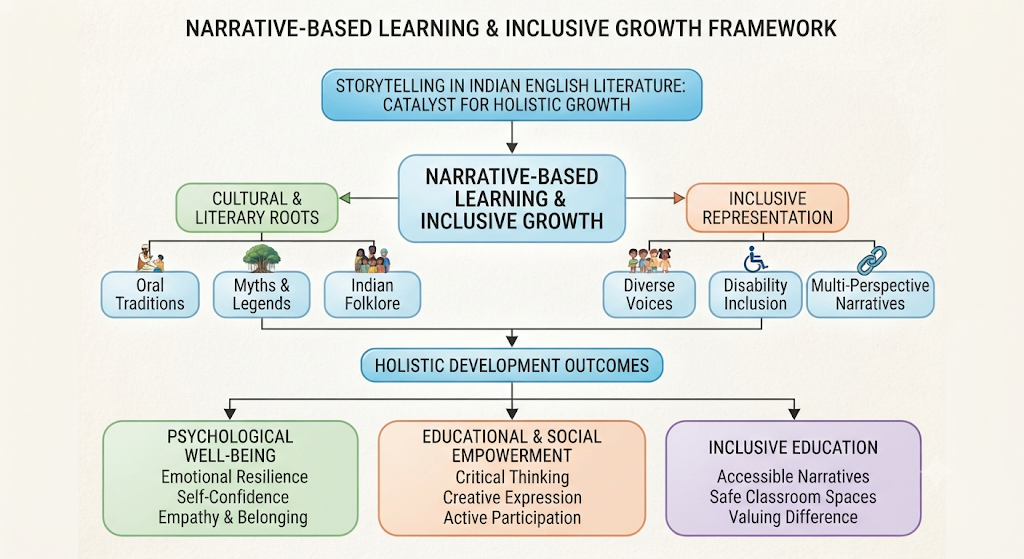
In conclusion, narrative-based learning represents a comprehensive educational and therapeutic approach that supports the holistic development of children with special needs. By integrating storytelling, imagination, cultural traditions, and inclusive pedagogical practices, Indian English literature creates meaningful opportunities for language development, emotional well-being, creativity, resilience, and social participation. More importantly, narrative-based learning promotes educational equity by recognizing that every child can learn successfully when provided with accessible, engaging, and inclusive literary experiences (Lindner & Schwab, 2020). As schools increasingly adopt learner-centred educational practices, narrative-based learning continues to demonstrate its value as a transformative framework for fostering inclusive education, psychological growth, and lifelong learning.
Conclusion#
Narrative magic and narrative-based learning represent powerful literary, educational, and therapeutic approaches for advancing the inclusion and holistic development of children with special needs. The discussion demonstrates that storytelling extends far beyond entertainment because it provides meaningful structures through which children interpret emotions, relationships, cultural values, social experiences, and personal challenges. Within Indian English literature, narrative magic acquires particular significance because it draws upon the country’s rich traditions of mythology, folklore, spirituality, epics, and oral narration. Magical forests, talking animals, enchanted objects, symbolic dreams, and transformative journeys connect imagination with recognizable human experiences, enabling children to explore difficult ideas in accessible and emotionally secure ways. By integrating extraordinary elements into familiar settings, narrative magic creates safe spaces where children can confront fear, loneliness, anxiety, exclusion, and uncertainty without being overwhelmed. Such narratives encourage emotional expression, strengthen coping abilities, and support psychological resilience and positive identity formation. They also challenge traditional representations that define children primarily through disability, dependency, tragedy, or exceptional heroism. Contemporary inclusive narratives instead portray children with special needs as multidimensional individuals who possess talents, aspirations, emotions, relationships, creativity, and agency. These balanced representations promote dignity and self-acceptance among children with special needs while encouraging other readers to appreciate difference as a natural and valuable aspect of human diversity. Narrative magic therefore contributes to both individual empowerment and wider social transformation by reducing prejudice and fostering empathy, cooperation, fairness, and mutual respect. Its educational significance is equally substantial. Story-based learning supports vocabulary development, listening comprehension, reading, speaking, creative writing, critical thinking, problem- solving, and symbolic interpretation. Because stories can be communicated through oral narration, illustrations, dramatization, puppetry, sign language, tactile materials, audiobooks, animation, and digital platforms, they accommodate diverse cognitive, linguistic, sensory, and communication needs. This flexibility makes narrative- based learning compatible with inclusive pedagogy, which recognizes that children learn through different methods and should receive multiple opportunities for engagement, representation, and expression. Interactive activities such as role-play, collaborative storytelling, drawing, reflective discussion, and digital story creation transform children from passive listeners into active participants in learning. Narrative practices also possess therapeutic value by allowing children to identify with fictional characters, externalize difficult emotions, reconstruct personal experiences, and imagine constructive responses to challenges (Shechtman, 2009). Teachers, parents, therapists, caregivers, and special educators consequently have an important responsibility to select culturally relevant, age- appropriate, and non-stereotypical narratives and to facilitate meaningful discussions and creative activities. Digital storytelling further expands accessibility and self-expression, although technology must enhance rather than distract from narrative understanding. Overall, Indian English literature provides a culturally grounded framework through which narrative magic can connect heritage with contemporary principles of equality and inclusion. By combining imagination, emotional engagement, authentic representation, and flexible pedagogy, narrative-based learning enables children with special needs to develop confidence, creativity, resilience, communication skills, and a strong sense of belonging. It ultimately demonstrates that inclusive education becomes most meaningful when every child is recognized as capable, respected as an individual, and empowered to participate fully in literary, educational, and social life.
Works Cited#
- Bettelheim, B. (1976). The Uses of Enchantment: The Meaning and Importance of Fairy Tales. Alfred A. Knopf.
- Bishop, R. S. (1990). Mirrors, windows, and sliding glass doors. Perspectives, 6(3), ix–xi.
- Bowers, M. A. (2004). Magic(al) Realism. Routledge.
- Faris, W. B. (2004). Ordinary Enchantments: Magical Realism and the Remystification of Narrative. Vanderbilt University Press.
- Florian, L. (2014). The SAGE Handbook of Special Education (2nd ed.). Sage Publications.
- Garland-Thomson, R. (1997). Extraordinary Bodies: Figuring Physical Disability in American Culture and Literature. Columbia University Press.
- Gray, C. (2010). The New Social Story Book (10th Anniversary ed.). Future Horizons.
- Hunt, P. (Ed.). (2004). International Companion Encyclopedia of Children's Literature (2nd ed.). Routledge.
- Isbell, R., Sobol, J., Lindauer, L., & Lowrance, A. (2004). The effects of storytelling and story reading on the oral language complexity and story comprehension of young children. Early Childhood Education Journal, 32(3), 157–163.
- Justice, L. M., Meier, J., & Walpole, S. (2005). Learning new words from storybooks: An efficacy study with at-risk kindergarteners. Language, Speech, and Hearing Services in Schools, 36(1), 17–32.
- Lukens, R. J., Smith, J. J., & Coffel, C. M. (2018). A Critical Handbook of Children's Literature (10th ed.). Pearson.
- Mayer, R. E. (2009). Multimedia Learning (2nd ed.). Cambridge University Press.
- Mitchell, D. T., & Snyder, S. L. (2000). Narrative Prosthesis: Disability and the Dependencies of Discourse. University of Michigan Press.
- Nussbaum, M. C. (2010). Not for Profit: Why Democracy Needs the Humanities. Princeton University Press.
- Pardeck, J. T. (1995). Bibliotherapy: An innovative approach for helping children. Early Child Development and Care, 110(1), 83–88.
- Robin, B. R. (2008). Digital storytelling: A powerful technology tool for the 21st-century classroom. Theory Into Practice, 47(3), 220–228.