Abstract
The present study examines gender equality, women’s empowerment, and socio-economic development in contemporary society through a multidisciplinary perspective. Gender equality is essential for ensuring equal rights, opportunities, participation, and dignity for all individuals, while women’s empowerment strengthens women’s decision-making power, education, employment, health, leadership, and social status. The study explores how gender equality and women’s empowerment contribute to socio-economic development by improving family welfare, workforce participation, income generation, education, health outcomes, and community progress. It also highlights existing challenges such as gender discrimination, unequal access to resources, wage gaps, domestic responsibilities, violence, limited political participation, and socio-cultural barriers. The study emphasizes that sustainable development cannot be achieved without inclusive policies, women’s education, economic independence, legal awareness, social justice, and equal participation in all spheres of life. Therefore, promoting gender equality and women’s empowerment is necessary for building a fair, progressive, and economically developed society.
- Gender Equality
- Women’s Empowerment
- Socio-Economic Development
- Contemporary Society
- Women’s Rights
- Social Justice
- Inclusive Development
Introduction#
Gender equality and women’s empowerment are among the most important concerns of contemporary society. In every society, development is meaningful only when all individuals receive equal rights, opportunities, dignity and freedom to participate in social, economic, political and cultural life. Gender equality refers to a condition in which women and men enjoy equal status, equal opportunities and equal access to resources, education, employment, health care, decision-making and justice. Women’s empowerment refers to the process through which women gain confidence, awareness, independence, decision-making power and control over their own lives. Together, gender equality and women’s empowerment form the foundation of inclusive and sustainable socio-economic development.
Contemporary society has witnessed significant progress in the status of women. Women are now participating in education, employment, politics, entrepreneurship, science, technology, administration, healthcare and social leadership. However, despite these achievements, gender-based inequalities continue to exist in many forms. Women still face discrimination in education, wage payment, property rights, workplace opportunities, household decision-making, political representation and social freedom. Issues such as gender stereotypes, domestic violence, child marriage, unpaid care work, limited mobility and unequal access to resources continue to affect women’s development. Therefore, the study of gender equality and women’s empowerment remains highly relevant.
A multidisciplinary investigation of gender equality and women’s empowerment is important because the issue is not limited to one field. It is connected with sociology, economics, education, political science, law, health, psychology, development studies and human rights. From a sociological perspective, gender equality is related to social norms, family structure, culture and social roles. From an economic perspective, women’s empowerment is linked with employment, income, entrepreneurship, financial independence and poverty reduction. From an educational perspective, it is associated with literacy, skill development and awareness. From a legal and political perspective, it involves rights, representation, justice and participation in decision-making.
Women’s empowerment plays a crucial role in socio-economic development. Educated and empowered women contribute to family welfare, children’s education, health improvement, income generation and community development. When women participate in the workforce, household income increases and poverty decreases. When women are involved in decision-making, development becomes more inclusive and balanced. Women’s economic participation strengthens national productivity and supports sustainable development. Thus, empowering women is not only a matter of justice but also a requirement for economic growth and social progress.
Gender equality is also essential for achieving social justice. A society cannot be considered developed if half of its population is denied equal opportunities and dignity. Equal access to education, health, employment and leadership enables women to realize their potential. Gender equality also benefits men and society as a whole by reducing rigid gender roles and promoting shared responsibilities. It encourages cooperation, respect, fairness and balanced social relations.
In the contemporary global context, gender equality has been recognized as a major goal of development. The Sustainable Development Goals emphasize gender equality and women’s empowerment as essential for achieving inclusive growth, poverty reduction, good health, quality education and peaceful societies. In India also, constitutional provisions, legal reforms, women’s education programmes, self-help groups, reservation policies, skill development schemes and financial inclusion initiatives have contributed to women’s empowerment. However, implementation gaps and socio-cultural barriers continue to restrict the full realization of equality.
The present study is significant because it examines the relationship among equality, empowerment and development from a broad perspective. It attempts to understand how women’s education, economic participation, legal awareness, health, leadership and social status contribute to socio-economic progress. It also highlights the barriers that prevent women from achieving equal status and full participation in society.
Thus, gender equality and women’s empowerment are essential for building a progressive, just and developed society. They promote human dignity, economic independence, social participation and inclusive development. A multidisciplinary approach helps in understanding the complex nature of gender issues and provides a wider framework for policy, education, social reform and development planning. Therefore, the study of gender equality, women’s empowerment and socio-economic development is highly important in contemporary society.
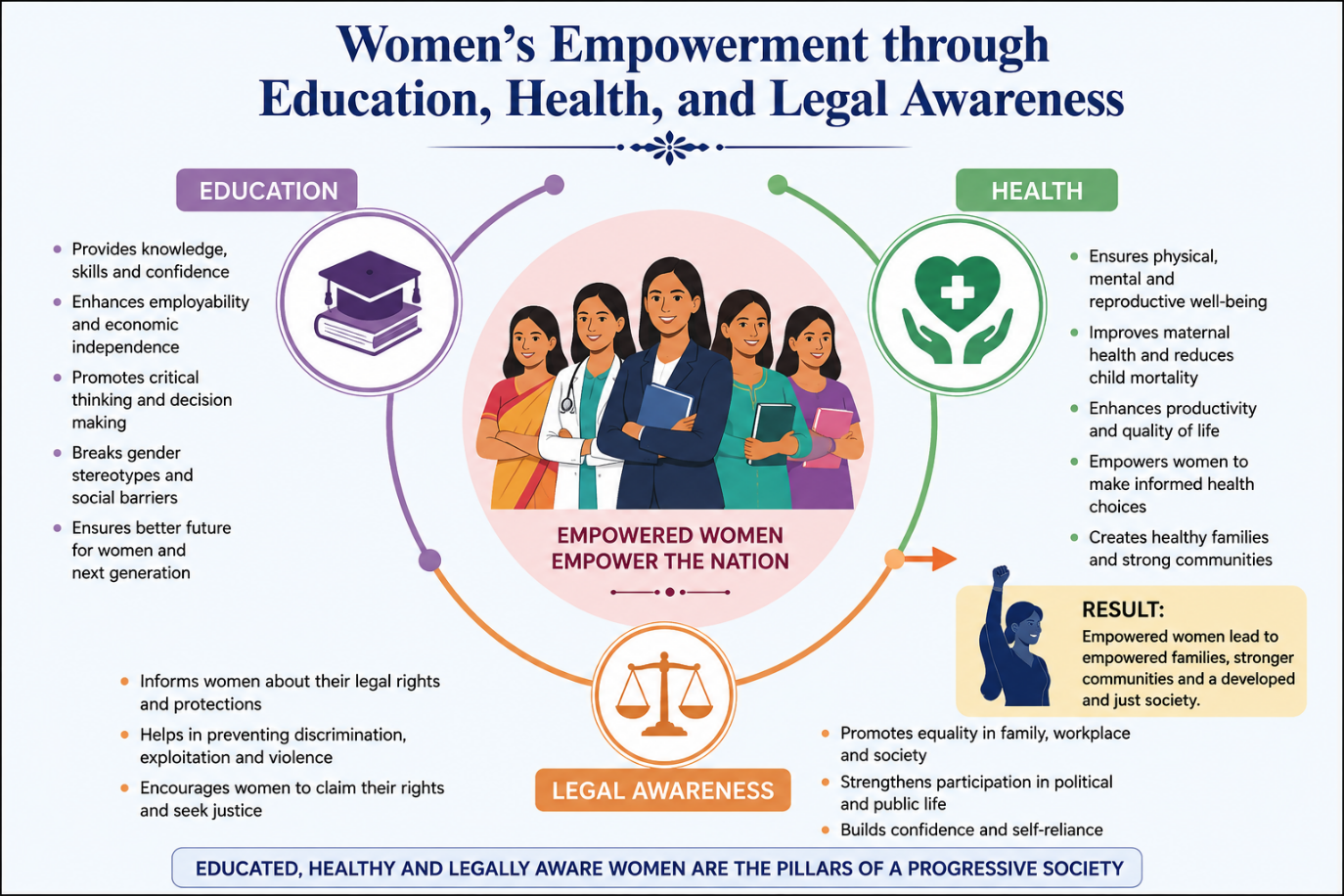
Women’s Empowerment through Education, Health, and Legal Awareness#
Women’s empowerment is a multidimensional process that enables women to gain control over their lives, exercise their rights, participate in decision-making, and contribute actively to social, economic, and political development. Empowerment involves enhancing women’s capabilities, confidence, autonomy, and access to opportunities and resources. Among the various dimensions of empowerment, education, health, and legal awareness are considered the most fundamental because they provide women with the knowledge, capacity, and freedom necessary to achieve equality and self-reliance. These dimensions are closely interconnected and collectively contribute to improving the status of women in contemporary society.
Education is widely recognized as the most powerful instrument for women’s empowerment. It equips women with knowledge, skills, critical thinking abilities, and awareness that enable them to make informed decisions regarding their personal, social, and economic lives. Educated women are more likely to participate in employment, exercise their rights, access healthcare services, and contribute effectively to family and community development. According to UNESCO (2020), education enhances women’s capabilities and creates opportunities for social mobility, economic independence, and active citizenship.
The significance of education in women’s empowerment extends beyond literacy acquisition. Education develops self-confidence, leadership abilities, communication skills, and decision-making capacities among women. It enables women to challenge traditional gender norms, discriminatory practices, and social inequalities. Educated women are more likely to delay marriage, make informed reproductive choices, and ensure better educational opportunities for their children. Consequently, women’s education generates intergenerational benefits that contribute to broader social development.
Education also plays an essential role in promoting economic empowerment. Women who possess educational qualifications and professional skills have greater access to employment opportunities, entrepreneurship, and income-generating activities. Economic independence strengthens women’s bargaining power within households and enhances their participation in decision-making processes. The World Bank (2022) emphasized that increasing educational opportunities for girls and women contributes significantly to poverty reduction and economic growth. Therefore, ensuring equal access to quality education remains crucial for achieving gender equality and sustainable development.
Despite substantial progress, educational disparities continue to affect women in many parts of the world. Socio-cultural norms, poverty, child marriage, gender stereotypes, and inadequate educational infrastructure often limit girls’ educational attainment. In rural and marginalized communities, girls frequently encounter barriers related to school accessibility, safety concerns, household responsibilities, and economic constraints. Addressing these challenges requires comprehensive policy interventions, scholarship programmes, community awareness initiatives, and gender-sensitive educational environments.
Health constitutes another critical dimension of women’s empowerment. Good health is essential for enabling women to participate fully in educational, economic, social, and political activities. Women's health encompasses physical, mental, reproductive, and emotional well-being. Access to quality healthcare services enables women to maintain healthy lives, prevent diseases, and manage health-related challenges effectively. Healthy women are better positioned to pursue education, engage in productive employment, and contribute to family and community welfare.
Reproductive health is particularly important in the context of women’s empowerment. Access to reproductive healthcare services, family planning, maternal healthcare, and health information enables women to make informed choices regarding their reproductive lives. Such autonomy contributes significantly to women’s overall well-being and empowerment. The World Health Organization (WHO, 2021) emphasizes that reproductive health rights are fundamental human rights essential for achieving gender equality and women’s empowerment.
Maternal health remains a major concern in many developing societies. Inadequate healthcare facilities, poor nutrition, limited access to medical services, and insufficient health awareness contribute to maternal morbidity and mortality. Improving maternal healthcare services, ensuring institutional deliveries, promoting antenatal and postnatal care, and enhancing nutritional support are therefore essential strategies for empowering women and improving family health outcomes.
Mental health also represents an increasingly important aspect of women’s empowerment. Women often experience psychological stress arising from discrimination, domestic violence, unequal responsibilities, social expectations, and economic dependence. Mental health support services, counselling facilities, and awareness programmes can help women address emotional challenges and strengthen their resilience. Empowered women who enjoy psychological well-being are more likely to participate confidently in various spheres of life.
Legal awareness constitutes the third major pillar of women’s empowerment. Legal awareness refers to women’s knowledge and understanding of their constitutional rights, legal protections, and available institutional mechanisms for seeking justice. Awareness of legal rights enables women to challenge discrimination, violence, exploitation, and other forms of injustice. It empowers women to claim their rights related to education, property ownership, inheritance, employment, marriage, divorce, and political participation.
In democratic societies, constitutional and legal frameworks provide important safeguards for protecting women’s rights and promoting gender equality. The Constitution of India guarantees equality before law, prohibits discrimination on the basis of sex, and ensures equal opportunities for all citizens. Various legislative measures, including the Protection of Women from Domestic Violence Act (2005), the Sexual Harassment of Women at Workplace Act (2013), the Dowry Prohibition Act (1961), and the Prohibition of Child Marriage Act (2006), seek to protect women from discrimination and violence.
However, the mere existence of legal provisions does not automatically ensure women’s empowerment. Many women remain unaware of their legal rights and available support mechanisms. Limited legal literacy, socio-cultural constraints, fear of social stigma, economic dependence, and inadequate access to legal institutions often discourage women from seeking justice. Consequently, legal awareness programmes, legal aid services, and community-based advocacy initiatives play crucial roles in enhancing women’s access to justice.
Legal awareness also contributes to political empowerment by encouraging women to participate actively in democratic processes. Women who understand their political rights are more likely to vote, contest elections, participate in local governance institutions, and engage in community decision-making. Political participation enables women to influence policies and advocate for issues affecting their lives and communities.
The interrelationship among education, health, and legal awareness is particularly significant for women’s empowerment. Education enhances women’s ability to access health information and understand legal rights. Good health enables women to pursue educational and economic opportunities effectively. Legal awareness protects women’s rights to education, healthcare, and equal treatment. Together, these dimensions create a comprehensive framework for empowerment that enhances women’s agency, autonomy, and participation.
A multidisciplinary perspective is essential for understanding women’s empowerment because empowerment processes are influenced by social, economic, political, cultural, and psychological factors. Sociology examines gender relations and social norms; economics analyzes labour force participation and resource access; public health focuses on health outcomes; law investigates rights and justice; and psychology explores self-efficacy and identity. Such interdisciplinary analysis facilitates comprehensive understanding and effective policy interventions.
Economic Participation and Leadership Role of Women in Development#
Women’s economic participation and leadership have emerged as crucial determinants of socio-economic development in contemporary society. Development cannot be inclusive or sustainable if women, who constitute nearly half of the global population, are excluded from economic activities and decision-making processes. Economic participation provides women with income, financial independence, and social recognition, while leadership enables them to influence policies, institutions, and developmental priorities. Together, these dimensions strengthen women’s empowerment and contribute significantly to national progress, poverty reduction, and social transformation.
Economic participation refers to the involvement of women in productive activities such as wage employment, entrepreneurship, self-employment, agriculture, business, and the informal sector. Traditionally, women’s economic contributions were often undervalued because a substantial portion of their work, particularly domestic labour and caregiving, remained unpaid and unrecognized. However, contemporary perspectives increasingly acknowledge that women’s participation in economic activities is essential for enhancing household welfare, increasing productivity, and promoting inclusive growth.
Women’s participation in the workforce contributes directly to economic development. When women engage in income-generating activities, household income increases, poverty levels decline, and living standards improve. The World Bank (2022) reported that greater female labour force participation significantly enhances economic productivity and national income. Economically active women invest a substantial proportion of their earnings in children's education, nutrition, healthcare, and family welfare, thereby creating long-term developmental benefits for future generations.
Education and skill development play a critical role in enhancing women’s economic participation. Access to quality education equips women with knowledge, technical competencies, and professional skills necessary for entering the labour market. Skill-based education and vocational training further strengthen employability and entrepreneurial capabilities. Educated women are more likely to secure formal employment, establish enterprises, and participate effectively in economic decision-making. Therefore, investment in women’s education is widely regarded as an investment in national development.
Entrepreneurship represents another important dimension of women’s economic participation. Women entrepreneurs contribute significantly to employment generation, innovation, and local economic development. Through micro-enterprises, small businesses, self-help groups, and start-up ventures, women create livelihood opportunities for themselves and others. Government initiatives, microfinance programmes, and self-help groups have facilitated women's entrepreneurship, particularly in rural areas. Such initiatives have enhanced financial inclusion and promoted economic self-reliance among women.
Financial inclusion is closely associated with women’s economic empowerment. Access to banking services, credit facilities, savings mechanisms, insurance, and digital financial platforms enables women to participate more effectively in economic activities. Financial independence strengthens women’s bargaining power within households and enhances their autonomy in decision-making. In recent years, digital banking, microfinance institutions, and self-help group movements have expanded financial opportunities for women, particularly in developing countries.
Despite notable progress, women continue to face numerous barriers to economic participation. Gender wage gaps, occupational segregation, unequal access to resources, limited property rights, inadequate childcare support, and discriminatory workplace practices remain significant challenges. Women are often concentrated in low-paying, informal, or insecure occupations with limited opportunities for advancement. Additionally, unpaid domestic responsibilities and caregiving obligations frequently restrict women’s labour force participation. Addressing these structural inequalities is essential for achieving gender-equitable economic development.
The leadership role of women is equally important for development. Leadership refers to the capacity to influence decisions, mobilize resources, guide institutions, and inspire social change. Women’s leadership extends across political, economic, educational, social, and organizational domains. Inclusive leadership ensures that women’s perspectives, experiences, and priorities are incorporated into decision-making processes, resulting in more equitable and responsive policies.
Political leadership represents a significant dimension of women’s participation in development. Women's representation in legislative bodies, local governance institutions, and public administration enhances democratic governance and strengthens social justice. Research indicates that women leaders often prioritize issues related to education, healthcare, sanitation, social welfare, and community development. Consequently, increasing women’s political participation contributes to more inclusive and people-centered governance.
In India, constitutional provisions and reservation policies have facilitated women’s participation in local self-governance institutions such as Panchayati Raj Institutions. The reservation of seats for women in local bodies has increased female representation and enabled women to participate actively in grassroots governance. Such participation has contributed to improved service delivery, community development, and women’s empowerment at the local level.
Women’s leadership in business and corporate sectors also contributes significantly to economic development. Female leaders bring diverse perspectives, innovative ideas, and collaborative approaches to organizational management. Studies have shown that organizations with gender-diverse leadership often demonstrate improved decision-making, enhanced creativity, and better organizational performance. Consequently, promoting women’s representation in managerial and executive positions has become an important objective of contemporary organizations.
Leadership opportunities also foster personal empowerment among women. Women who occupy leadership positions often serve as role models, inspiring other women and girls to pursue education, careers, and public engagement. Such role models challenge traditional gender stereotypes and demonstrate women’s capabilities across diverse fields. The visibility of successful women leaders contributes to changing societal attitudes regarding gender roles and leadership.
The relationship between economic participation and leadership is mutually reinforcing. Economic independence enhances women’s confidence, autonomy, and capacity to assume leadership roles. Conversely, women leaders can advocate for policies that promote gender equality, economic opportunities, and social inclusion. Together, economic participation and leadership create a virtuous cycle that strengthens women’s empowerment and contributes to broader socio-economic development.
A multidisciplinary perspective is essential for understanding women’s economic participation and leadership because these issues intersect with sociology, economics, political science, management, psychology, and development studies. Sociological perspectives examine gender norms and social structures; economic analyses focus on labour markets and productivity; political science explores representation and governance; and psychology investigates leadership behaviour and self-efficacy. Such interdisciplinary understanding facilitates comprehensive policy responses and effective interventions.
Governments, international organizations, civil society institutions, and the private sector all play important roles in promoting women’s economic participation and leadership. Policy measures such as equal pay legislation, maternity benefits, childcare support, skill development programmes, financial inclusion initiatives, entrepreneurship promotion schemes, and leadership training programmes can significantly enhance women’s opportunities. Additionally, organizational practices that promote diversity, inclusion, and work-life balance contribute to women’s advancement in leadership positions.
Socio-Cultural Barriers and Policy Measures for Gender-Just Society#
Despite significant progress in the fields of education, employment, health, and political participation, gender inequality continues to persist in contemporary society due to various socio-cultural barriers. These barriers are deeply embedded in social structures, cultural traditions, customs, beliefs, and institutional practices that influence the status and opportunities available to women and men. Such barriers often limit women’s access to resources, decision-making, education, employment, and leadership opportunities. Therefore, the creation of a gender-just society requires not only social transformation but also effective policy interventions aimed at promoting equality, inclusion, and social justice.
Socio-cultural barriers refer to the social norms, values, traditions, customs, and attitudes that create unequal treatment and opportunities for individuals based on gender. In many societies, patriarchal social systems continue to dominate social relations. Patriarchy is a system in which men hold greater authority and control over social, economic, and political institutions. Within patriarchal structures, women are often assigned subordinate roles, while men are viewed as primary decision-makers and breadwinners. Such gendered expectations reinforce inequality and restrict women’s autonomy and empowerment.
One of the most significant socio-cultural barriers is gender stereotyping. Gender stereotypes are generalized beliefs regarding the roles, behaviours, and characteristics considered appropriate for women and men. Traditionally, women have been associated with caregiving, domestic responsibilities, and emotional roles, whereas men have been linked with leadership, economic activities, and public life. These stereotypes influence educational choices, career opportunities, occupational segregation, and social expectations. Girls may be discouraged from pursuing higher education, science and technology fields, or leadership positions because of prevailing social norms. Consequently, gender stereotypes continue to perpetuate inequalities in various spheres of life.
Another major barrier is the unequal distribution of unpaid domestic and caregiving responsibilities. Limited access to education and economic resources also contributes significantly to gender inequality. In many communities, girls continue to face barriers in accessing quality education due to poverty, discriminatory attitudes, inadequate infrastructure, and safety concerns. Similarly, women frequently encounter difficulties in accessing land ownership, property rights, credit facilities, and productive resources. Economic dependence reduces women’s autonomy and limits their ability to participate fully in social and economic life.
The persistence of discriminatory cultural practices and social norms highlights the need for comprehensive policy measures aimed at establishing a gender-just society. A gender-just society is one in which all individuals enjoy equal rights, opportunities, dignity, and participation irrespective of gender. Achieving such a society requires coordinated efforts involving governments, educational institutions, civil society organizations, communities, and individuals.
One of the most important policy measures is the establishment and effective implementation of legal frameworks that protect women’s rights and prohibit discrimination. Constitutional guarantees of equality, anti-discrimination laws, and legislation addressing gender-based violence provide essential legal protections. Laws related to domestic violence, workplace harassment, child marriage, dowry prohibition, inheritance rights, and equal remuneration are crucial for safeguarding women’s rights. However, legal provisions alone are insufficient unless accompanied by effective enforcement mechanisms and accessible justice systems.
Educational policies play a critical role in promoting gender justice. Ensuring universal access to quality education for girls and women contributes significantly to empowerment and social transformation. Gender-sensitive curricula, scholarship programmes, safe school environments, and awareness campaigns can help eliminate educational disparities. Education also challenges discriminatory attitudes and promotes values of equality, respect, and human rights.
Conclusion#
Gender equality, women’s empowerment and socio-economic development are closely interrelated in contemporary society. A society cannot achieve true progress if women are denied equal rights, opportunities, dignity and participation. Gender equality ensures fairness and justice, while women’s empowerment strengthens confidence, education, health, economic independence, legal awareness and leadership.
The study highlights that empowered women contribute significantly to family welfare, children’s education, community development, workforce participation and national economic growth. However, socio-cultural barriers such as patriarchy, gender stereotypes, violence, wage gaps, unpaid domestic work and limited decision-making continue to restrict women’s full participation.
Thus, gender equality and women’s empowerment are essential for inclusive and sustainable development. Effective policies, education, legal protection, economic opportunities and social awareness are necessary to build a gender-just society. A truly developed society is one where women and men participate equally and contribute together to social and economic progress.
Works Cited#
- Beauvoir, Simone de. The Second Sex. Vintage Books, 1989.
- Boserup, Ester. Woman’s Role in Economic Development. Earthscan, 2007.
- Butler, Judith. Gender Trouble: Feminism and the Subversion of Identity. Routledge, 1990.
- Connell, R. W. Gender and Power: Society, the Person and Sexual Politics. Stanford UP, 1987.
- Kabeer, Naila. Reversed Realities: Gender Hierarchies in Development Thought. Verso, 1994.
- Kabeer, Naila. “Resources, Agency, Achievements: Reflections on the Measurement of Women’s Empowerment.” Development and Change, vol. 30, no. 3, 1999, pp. 435–464.
- Sen, Amartya. Development as Freedom. Oxford UP, 1999.
- Nussbaum, Martha C. Women and Human Development: The Capabilities Approach. Cambridge UP, 2000.
- United Nations. Transforming Our World: The 2030 Agenda for Sustainable Development. United Nations, 2015.
- UN Women. Progress of the World’s Women 2019–2020: Families in a Changing World. UN Women, 2019.
- UNESCO. Global Education Monitoring Report 2020: Inclusion and Education: All Means All. UNESCO, 2020.
- World Bank. World Development Report 2012: Gender Equality and Development. World Bank, 2011.
- World Bank. Women, Business and the Law 2022. World Bank, 2022.
- World Health Organization. Violence against Women Prevalence Estimates, 2018. WHO, 2021.
- Government of India. The Constitution of India. Ministry of Law and Justice, 1950.
- Government of India. National Policy for the Empowerment of Women. Ministry of Women and Child Development, 2001.
- Government of India. Protection of Women from Domestic Violence Act, 2005. Ministry of Law and Justice, 2005.
- Government of India. Sexual Harassment of Women at Workplace Act, 2013. Ministry of Law and Justice, 2013.
- Government of India. Beti Bachao Beti Padhao Scheme Guidelines. Ministry of Women and Child Development, 2015.