Abstract
The present study examines the impact of remote and hybrid work arrangements on employee productivity, organizational culture, and psychological well-being. Remote and hybrid work models have transformed traditional workplace practices by providing flexibility, reducing commuting time, and enabling technology-based collaboration. The study explores how these arrangements influence work efficiency, task performance, communication patterns, teamwork, employee engagement, and work-life balance. It also analyses challenges such as social isolation, digital fatigue, blurred work-life boundaries, reduced informal interaction, supervision difficulties, and weakened organizational belongingness. The study highlights that remote and hybrid work can enhance productivity and psychological well-being when supported by clear policies, effective digital tools, trust-based leadership, regular communication, and employee-centred organizational practices. It concludes that flexible work arrangements can contribute to modern workplace effectiveness if balanced with collaboration, cultural integration, and mental health support.
- Remote Work
- Hybrid Work
- Employee Productivity
- Organizational Culture
- Psychological Well-Being
- Work-Life Balance
- Digital Workplace
Introduction#
Remote and hybrid work arrangements have become important features of the modern workplace. Remote work refers to a system in which employees perform their duties from locations outside the traditional office, usually with the help of digital technologies. Hybrid work combines office-based work and remote work, allowing employees to divide their working time between the workplace and home or any other suitable location. These arrangements have changed the traditional understanding of work, supervision, communication and organizational participation.
The growth of remote and hybrid work has been influenced by technological advancement, internet connectivity, digital communication tools, cloud-based platforms and changing employee expectations. Video conferencing, online project management systems, digital attendance tools, shared documents and instant messaging applications have made it possible for employees to remain connected with organizations without being physically present in the office. As a result, many organizations have adopted flexible work models to improve efficiency, reduce operational costs and support employee work-life balance.
Employee productivity is one of the major concerns associated with remote and hybrid work. Flexible work arrangements can improve productivity by reducing commuting time, allowing focused work, increasing autonomy and supporting better time management. Employees may perform better when they work in a comfortable environment and have greater control over their work schedule. However, productivity may also be affected by distractions at home, lack of supervision, poor internet connectivity, communication delays and difficulty in coordinating team tasks. Therefore, the impact of remote and hybrid work on productivity depends on job nature, technology support, employee discipline and organizational management.
Organizational culture is also influenced by remote and hybrid work arrangements. Organizational culture refers to the shared values, beliefs, communication patterns, work practices and behavioural norms within an organization. In traditional workplaces, culture is developed through face-to-face interaction, teamwork, informal communication, meetings and shared experiences. Remote work may reduce informal interaction and weaken employees’ sense of belonging. Hybrid work, if properly managed, can balance flexibility with in-person collaboration. Organizations need to create digital culture, trust-based leadership and regular communication to maintain teamwork and employee engagement.
Psychological well-being is another important dimension of remote and hybrid work. Flexible work can reduce stress by saving travel time, improving work-life balance and allowing employees to manage personal responsibilities more effectively. It can also increase job satisfaction and autonomy. However, remote work may create loneliness, digital fatigue, overwork, blurred boundaries between work and personal life and emotional disconnection from colleagues. Continuous online meetings and pressure to remain always available may negatively affect mental health. Therefore, psychological well-being in remote and hybrid work depends on workload management, social support, communication quality and healthy digital practices.
Evolution of Remote and Hybrid Work in the Digital Workplace#
The nature of work has undergone significant transformation over the past few decades due to rapid technological advancements, globalization, and changing organizational practices. Traditional workplace models, characterized by fixed office locations, standardized working hours, and face-to-face interactions, are increasingly being replaced by more flexible and technology-driven work arrangements. Among these emerging models, remote and hybrid work have gained substantial prominence, particularly in the digital era. These work arrangements have fundamentally altered how employees perform tasks, communicate, collaborate, and engage with organizations. Consequently, understanding the evolution of remote and hybrid work is essential for comprehending contemporary workplace dynamics.
Remote work, also referred to as telework, telecommuting, virtual work, or distributed work, refers to a work arrangement in which employees perform organizational tasks from locations outside the traditional office environment, typically utilizing information and communication technologies (ICTs). Employees may work from home, co-working spaces, satellite offices, or other remote locations while remaining connected to organizational systems through digital technologies. Hybrid work, in contrast, combines remote and office-based work by allowing employees to divide their working time between physical workplace settings and remote locations. Hybrid arrangements provide flexibility while maintaining opportunities for face-to-face collaboration and organizational interaction.
The origins of remote work can be traced to the 1970s, when concerns regarding traffic congestion, energy consumption, and urban commuting costs stimulated interest in alternative work arrangements. The concept of telecommuting was first popularized by Jack Nilles, who proposed that telecommunications technologies could substitute physical commuting and reduce transportation-related challenges. However, the widespread adoption of remote work remained limited during the early stages due to technological constraints and organizational reliance on traditional management practices.
The development of information and communication technologies significantly accelerated the evolution of remote work. During the 1980s and 1990s, advancements in personal computing, electronic mail, telecommunications infrastructure, and internet technologies created new possibilities for flexible work arrangements. Organizations increasingly utilized computers and digital communication systems for administrative functions, facilitating limited forms of teleworking. Nevertheless, remote work remained relatively uncommon because technological capabilities were still developing and organizational cultures largely favoured physical presence within workplaces.
The advent of the internet and digital transformation during the late twentieth and early twenty-first centuries profoundly changed work environments. Broadband internet connectivity, cloud computing, mobile technologies, virtual private networks, collaborative software platforms, and digital communication tools enabled employees to access organizational resources and perform tasks from virtually any location. These technological innovations substantially reduced geographical barriers and expanded opportunities for remote work across diverse sectors and industries.
Globalization further contributed to the growth of remote work by increasing organizational reliance on geographically dispersed teams and international collaboration. Multinational corporations increasingly coordinated operations across multiple locations, requiring sophisticated digital communication systems and virtual teamwork capabilities. Advances in video conferencing, project management platforms, and collaborative technologies enabled organizations to manage distributed workforces more effectively.
The emergence of the knowledge economy also facilitated the expansion of remote work arrangements. Contemporary economies increasingly depend upon knowledge-intensive occupations involving information processing, creative problem-solving, and digital communication. Such occupations often require limited physical presence and can be effectively performed through digital technologies. Consequently, sectors such as information technology, finance, consulting, education, research, marketing, and professional services have experienced significant growth in remote work adoption.
A major turning point in the evolution of remote and hybrid work occurred during the COVID-19 pandemic. The global health crisis compelled organizations worldwide to adopt remote work arrangements on an unprecedented scale. Government-imposed lockdowns, social distancing measures, and workplace restrictions necessitated rapid transitions from traditional office environments to virtual work settings. Organizations across public and private sectors implemented remote work strategies to ensure business continuity while protecting employee health and safety.
The pandemic demonstrated that many organizational activities could be effectively performed remotely using digital technologies. Employees and organizations adapted rapidly to virtual collaboration, online meetings, cloud-based workflows, and digital communication platforms. Tools such as video conferencing applications, project management systems, instant messaging platforms, and collaborative document-sharing technologies became essential components of daily work activities. The widespread adoption of remote work during the pandemic significantly altered perceptions regarding workplace flexibility and productivity.
Following the pandemic, many organizations recognized the benefits associated with remote work and began exploring more sustainable flexible work arrangements. Hybrid work emerged as a preferred model because it combines the advantages of remote flexibility with opportunities for in-person interaction and collaboration. Hybrid work arrangements vary considerably across organizations, with some requiring employees to attend offices on designated days, while others provide greater autonomy regarding workplace selection.
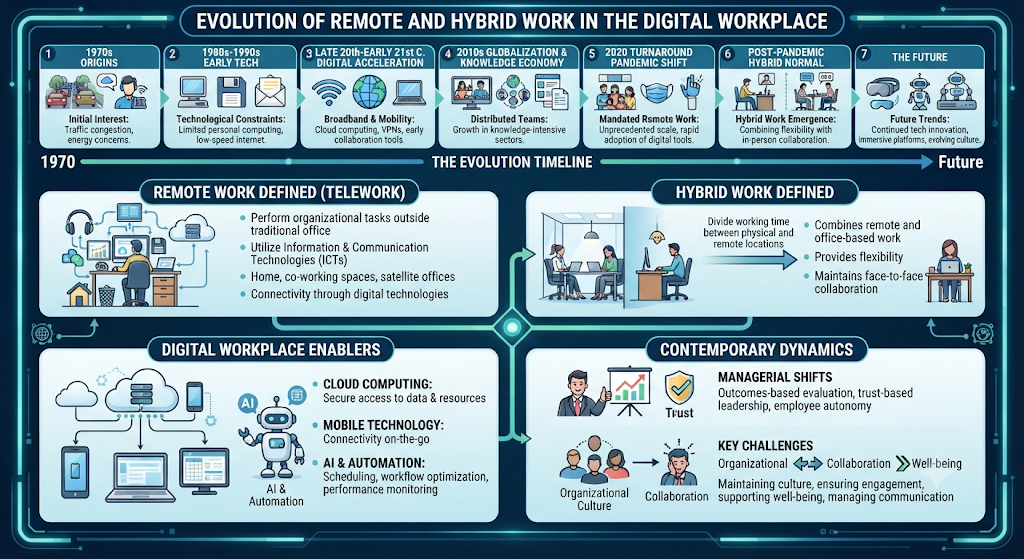
The digital workplace concept has become central to understanding contemporary remote and hybrid work environments. A digital workplace refers to an integrated virtual environment that utilizes digital technologies to facilitate communication, collaboration, knowledge sharing, and task performance. Digital workplaces encompass various technological tools and platforms, including cloud computing systems, enterprise collaboration platforms, video conferencing applications, artificial intelligence tools, and digital workflow management systems.
Cloud computing has played a particularly important role in enabling remote and hybrid work. Cloud-based platforms provide employees with secure access to organizational data, applications, and resources regardless of geographical location. Such technologies facilitate real-time collaboration, document sharing, and information accessibility, thereby supporting flexible work arrangements.
Mobile technologies have further enhanced workplace flexibility by enabling employees to remain connected through smartphones, tablets, and portable computing devices. Mobile applications facilitate communication, task management, and access to organizational systems, allowing employees to work efficiently while maintaining mobility.
Artificial intelligence and automation technologies are increasingly influencing the evolution of remote and hybrid work environments. AI-driven tools support scheduling, workflow optimization, performance monitoring, communication analysis, and decision-making processes. Such technologies enhance organizational efficiency and facilitate management of distributed workforces.
The evolution of remote and hybrid work has also transformed managerial practices and leadership approaches. Traditional management models emphasizing direct supervision and physical presence have gradually shifted toward outcomes-based performance evaluation, trust-based leadership, and employee autonomy. Managers increasingly focus on results, communication effectiveness, employee engagement, and collaborative performance rather than physical attendance.
Despite its numerous advantages, remote and hybrid work also presents significant challenges. Maintaining organizational culture, facilitating collaboration, ensuring employee engagement, managing communication, addressing technological inequalities, and supporting employee well-being remain important concerns. Organizations must therefore develop effective strategies to balance flexibility with organizational cohesion and performance objectives.
Theoretical perspectives provide valuable insights into understanding remote and hybrid work evolution. Socio-technical systems theory emphasizes the interdependence between technological systems and social structures within organizations. Media richness theory explains how communication technologies influence information exchange and collaboration effectiveness. Boundary theory examines how employees manage transitions between work and personal domains in flexible work environments.
The future of remote and hybrid work is likely to be characterized by continued technological innovation, increased workplace flexibility, and evolving organizational practices. Emerging technologies such as virtual reality, augmented reality, artificial intelligence, and immersive collaboration platforms may further transform digital workplaces and redefine employee experiences.
A multidisciplinary perspective is essential for understanding remote and hybrid work because these phenomena intersect with management, psychology, sociology, information technology, and organizational behaviour. Management studies examine organizational strategies and leadership practices; psychology explores employee motivation and well-being; sociology investigates social relationships and workplace dynamics; and information technology focuses on digital infrastructure and communication systems.
Influence of Flexible Work Arrangements on Employee Productivity#
Flexible work arrangements, particularly remote and hybrid work models, have significantly transformed the contemporary workplace and reshaped traditional perceptions of employee productivity. Employee productivity refers to the efficiency and effectiveness with which employees utilize their time, skills, knowledge, and resources to achieve organizational goals and objectives. In recent years, organizations across the world have increasingly adopted flexible work arrangements to improve operational efficiency, enhance employee satisfaction, and respond to changing workforce expectations. Consequently, understanding the influence of flexible work arrangements on employee productivity has become an important area of organizational research and practice.
Flexible work arrangements refer to employment practices that provide employees with greater autonomy regarding when, where, and how work is performed. These arrangements include remote work, hybrid work, flexible working hours, compressed workweeks, and telecommuting. Unlike traditional workplace models characterized by fixed schedules and physical office attendance, flexible work models emphasize employee autonomy, digital collaboration, and outcomes-based performance evaluation.
One of the most significant advantages of flexible work arrangements is the reduction of commuting time. Traditional office-based work often requires employees to spend considerable time travelling between home and workplace. Long commuting hours may contribute to fatigue, stress, reduced personal time, and lower job satisfaction. Remote and hybrid work arrangements eliminate or substantially reduce commuting requirements, allowing employees to allocate additional time and energy to productive work activities. The time saved from commuting can be utilized for task completion, professional development, family responsibilities, or personal well-being, thereby contributing positively to productivity.
Flexible work arrangements also enhance employee autonomy and control over work activities. Autonomy refers to employees’ ability to make decisions regarding work schedules, task execution, and workplace selection. Research consistently demonstrates that autonomy positively influences motivation, job satisfaction, and performance. Employees who possess greater control over their work environment and schedules often experience increased intrinsic motivation, responsibility, and commitment. Flexible work arrangements enable employees to organize their tasks according to individual preferences, peak performance periods, and personal circumstances, thereby enhancing productivity.
Another important factor influencing productivity in flexible work environments is the reduction of workplace distractions. Traditional office settings frequently involve interruptions arising from meetings, informal conversations, noise, and other environmental disturbances. Remote work environments may provide opportunities for focused and uninterrupted work, particularly for tasks requiring concentration, creativity, and analytical thinking. Employees working remotely can often create personalized workspaces that support individual productivity preferences and facilitate deep work.
Flexible work arrangements also contribute to improved work-life balance, which indirectly influences employee productivity. Work-life balance refers to the effective management of professional and personal responsibilities. Employees experiencing better balance between work and personal life generally report lower stress levels, higher job satisfaction, and improved psychological well-being. Flexible schedules enable employees to accommodate family obligations, healthcare needs, educational pursuits, and personal commitments more effectively. Such balance reduces role conflict and enhances overall employee engagement and productivity.
Technological advancements have played a crucial role in supporting productivity within flexible work arrangements. Digital communication platforms, cloud computing systems, project management software, collaborative applications, and virtual meeting tools facilitate efficient coordination and information sharing among geographically dispersed employees. Technologies such as video conferencing, shared digital workspaces, instant messaging systems, and cloud-based document management enable employees to collaborate effectively regardless of physical location. Consequently, organizations can maintain operational continuity and productivity while supporting flexible work arrangements.
Despite these advantages, flexible work arrangements may also present challenges affecting employee productivity. One major challenge involves the presence of home-based distractions. Employees working remotely may encounter interruptions arising from household responsibilities, family members, caregiving obligations, domestic activities, and environmental disturbances. Such distractions may reduce concentration and interfere with task completion, particularly when employees lack dedicated workspaces.
Communication and coordination challenges represent another important concern. Effective collaboration often depends upon timely communication, information sharing, and interpersonal interaction. Remote and hybrid work arrangements may create communication barriers due to reduced face-to-face interaction, technological limitations, delayed responses, and misunderstandings. Inadequate communication may negatively affect teamwork, decision-making, and productivity. Organizations must therefore establish clear communication protocols and utilize appropriate digital tools to facilitate effective collaboration.
Performance monitoring and supervision constitute additional challenges in flexible work environments. Traditional management approaches often rely upon direct observation and physical presence to monitor employee performance. Remote work requires managers to adopt alternative performance management strategies emphasizing outcomes, trust, accountability, and measurable objectives. Organizations that fail to establish clear expectations, performance indicators, and feedback mechanisms may experience difficulties in maintaining productivity.
The availability and quality of technological infrastructure significantly influence productivity in flexible work arrangements. Reliable internet connectivity, appropriate hardware, secure access to organizational systems, and technical support are essential for effective remote work. Technological disruptions, inadequate equipment, cybersecurity concerns, and insufficient digital competencies may hinder employee performance and reduce productivity. Consequently, organizations must invest in robust technological infrastructure and employee training to support flexible work arrangements.
Employee self-discipline and time management skills also play important roles in determining productivity outcomes. Flexible work environments require employees to manage tasks independently, prioritize responsibilities, and maintain work routines without direct supervision. Individuals possessing strong self-regulation, organizational skills, and intrinsic motivation generally perform more effectively in remote and hybrid work settings. Conversely, employees experiencing difficulties with time management or self-discipline may encounter productivity challenges.
Hybrid work arrangements introduce additional productivity considerations because employees alternate between office and remote environments. Hybrid models offer opportunities to balance independent work with collaborative activities. Employees may perform focused tasks remotely while utilizing office attendance for meetings, brainstorming sessions, and team collaboration. However, hybrid arrangements require careful coordination to avoid scheduling conflicts, communication difficulties, and inconsistencies in employee experiences.
The influence of flexible work arrangements on productivity may also vary according to job characteristics and occupational roles. Knowledge-intensive occupations involving information processing, creative problem-solving, and digital communication often adapt effectively to remote work. In contrast, occupations requiring physical presence, direct customer interaction, or specialized equipment may experience limitations in productivity under remote arrangements. Therefore, organizational decisions regarding flexible work implementation should consider job-specific requirements and operational needs.
Organizational culture and leadership practices significantly affect productivity in flexible work environments. Trust-based leadership, supportive management, employee empowerment, and effective communication contribute positively to remote and hybrid work productivity. Leaders who provide clear expectations, regular feedback, emotional support, and recognition foster employee engagement and performance. Conversely, excessive monitoring, micromanagement, and inadequate support may reduce motivation and productivity.
Theoretical perspectives provide valuable insights into understanding productivity within flexible work arrangements. Self-determination theory suggests that autonomy, competence, and relatedness influence employee motivation and performance. Job characteristics theory emphasizes the importance of autonomy, task significance, and feedback in enhancing work outcomes. Social exchange theory highlights reciprocal relationships between organizational support and employee commitment.
Empirical research regarding flexible work productivity has produced mixed findings. Many studies report positive productivity outcomes associated with remote and hybrid work due to increased autonomy, reduced commuting, and improved work-life balance. However, productivity gains are not universal and depend upon individual, organizational, technological, and contextual factors. Consequently, organizations must adopt evidence-based approaches when designing flexible work policies.
A multidisciplinary perspective is essential for understanding productivity in flexible work environments. Organizational behaviour examines employee attitudes and performance; psychology investigates motivation and self-regulation; information technology focuses on digital infrastructure; sociology explores social interactions and workplace relationships; and management studies analyze organizational strategies and leadership practices.
Remote Work, Hybrid Culture, and Organizational Communication#
Remote and hybrid work arrangements have significantly changed organizational culture and communication patterns. In traditional office settings, employees develop culture through face-to-face meetings, informal conversations, teamwork, shared routines, celebrations and daily interaction. However, in remote and hybrid work models, many of these interactions take place through digital platforms such as video meetings, emails, messaging applications and project management tools.
Organizational culture refers to the shared values, beliefs, norms, practices and behaviour patterns followed within an organization. A strong organizational culture creates belongingness, trust, teamwork and commitment among employees. Remote work may weaken culture if employees feel isolated, disconnected or less involved in organizational activities. New employees may also find it difficult to understand organizational values and informal practices when they are not physically present in the workplace.
Hybrid work offers a balanced approach by combining remote flexibility with office-based collaboration. Employees can perform focused tasks from home while attending the office for meetings, training, team discussions and cultural activities. This model can help maintain organizational culture if properly planned. However, if some employees are frequently present in the office while others work remotely, communication gaps and feelings of exclusion may arise.
Communication is one of the most important challenges in remote and hybrid work. In physical offices, many issues are solved through quick conversations and informal discussions. In digital workspaces, communication becomes more structured and dependent on technology. Poor communication may lead to misunderstanding, delay, duplication of work and reduced coordination. Therefore, organizations need clear communication channels, regular meetings and proper digital collaboration tools.
Trust-based leadership is essential in remote and hybrid culture. Managers cannot depend only on physical supervision; they must focus on outcomes, accountability and employee support. Regular feedback, transparent communication and recognition help employees feel valued and connected. Leaders must also ensure that remote employees receive equal information, opportunities and participation in decision-making.
Team bonding is also affected by remote and hybrid work. Employees may miss informal office interactions that create friendship and emotional connection. To maintain bonding, organizations can arrange virtual team activities, hybrid meetings, mentoring sessions and occasional in-person gatherings. Such practices help strengthen belongingness and organizational identity.
Psychological Well-Being, Work-Life Balance, and Digital Fatigue among Employees#
Psychological well-being has become an important concern in contemporary organizations, particularly with the widespread adoption of remote and hybrid work arrangements. Psychological well-being refers to an individual's overall emotional, mental, and social health, including life satisfaction, positive functioning, emotional stability, self-acceptance, and the ability to cope effectively with everyday challenges. In modern workplaces, employee well-being is increasingly recognized as a critical factor influencing productivity, job satisfaction, organizational commitment, and long-term organizational success. Remote and hybrid work arrangements have introduced both opportunities and challenges for employee psychological well-being, making it essential to examine their impact on work-life balance and digital fatigue.
One of the most frequently cited advantages of remote and hybrid work arrangements is the improvement in work-life balance. Work-life balance refers to the effective management and integration of professional responsibilities and personal life roles in ways that minimize conflict and promote overall well-being. Traditional office-based work often requires employees to spend considerable time commuting, adhere to rigid schedules, and maintain physical presence at designated workplaces. Such arrangements may create conflicts between professional obligations and personal responsibilities.
Remote and hybrid work models provide employees with greater flexibility regarding when and where work is performed. Flexible schedules allow employees to allocate time more efficiently between work activities, family responsibilities, childcare, household duties, and personal interests. Reduced commuting requirements provide additional time that can be utilized for family interactions, recreation, physical exercise, and self-care activities. Consequently, many employees report improved quality of life and enhanced satisfaction with flexible work arrangements.
The autonomy associated with remote work also contributes positively to psychological well-being. Employees who possess greater control over their work schedules and environments often experience increased motivation, self-efficacy, and job satisfaction. Autonomy enables individuals to organize work according to personal preferences, energy levels, and family commitments. Such flexibility may reduce stress and improve emotional well-being, particularly among employees with caregiving responsibilities.
However, despite these benefits, remote and hybrid work arrangements may also create significant psychological challenges. One of the most important concerns is the blurring of boundaries between work and personal life. In traditional work settings, physical separation between workplace and home naturally delineates professional and personal domains. Remote work eliminates this spatial distinction, making it difficult for employees to disengage from work activities after official working hours.
The absence of clear boundaries may result in longer working hours, continuous availability, and increased work intensity. Employees may experience pressure to remain constantly connected through emails, messaging applications, and virtual communication platforms. Such expectations contribute to work-family conflict, role overload, and psychological strain. The inability to psychologically detach from work may eventually lead to exhaustion, reduced well-being, and burnout.
Social isolation represents another significant psychological challenge associated with remote work. Human beings are inherently social, and workplace interactions provide important opportunities for social connection, emotional support, collaboration, and relationship development. Traditional office environments facilitate informal conversations, spontaneous interactions, and social engagement among colleagues. Remote work substantially reduces face-to-face interactions, potentially leading to feelings of loneliness, isolation, and disconnection.
Employees working remotely for extended periods may experience reduced sense of belonging and weakened organizational identification. Social isolation may adversely affect emotional well-being, motivation, and engagement. New employees and individuals living alone may be particularly vulnerable to isolation-related challenges because they have limited opportunities to establish meaningful workplace relationships.
The emergence of digital fatigue, often referred to as "technostress" or "Zoom fatigue," constitutes another important concern in remote and hybrid work environments. Digital fatigue refers to physical, cognitive, and emotional exhaustion resulting from prolonged and intensive use of digital technologies. Remote work environments depend heavily upon video conferencing platforms, instant messaging systems, emails, and collaborative digital tools. Continuous engagement with digital technologies may create cognitive overload and psychological strain.
Video conferencing fatigue has attracted considerable attention in recent years. Virtual meetings require sustained concentration, continuous visual attention, and interpretation of limited nonverbal cues. Employees often experience increased cognitive demands because they must simultaneously process verbal communication, observe visual information, manage technological issues, and monitor their own on-screen appearance. Frequent virtual meetings may therefore contribute to mental exhaustion and reduced attentional capacity.
Excessive screen time also affects physical and psychological well-being. Prolonged exposure to digital devices may result in eye strain, headaches, musculoskeletal discomfort, sleep disturbances, and physical inactivity. Such physical symptoms often interact with psychological factors, contributing to stress, irritability, and reduced well-being.
Technological challenges further exacerbate digital fatigue. Poor internet connectivity, software malfunctions, cybersecurity concerns, and technical difficulties may create frustration and anxiety among employees. Continuous adaptation to evolving digital tools and technological demands may increase cognitive burden and stress levels, particularly among employees with limited digital competencies.
Burnout constitutes another significant psychological risk associated with remote and hybrid work arrangements. Burnout is characterized by emotional exhaustion, depersonalization, and reduced personal accomplishment resulting from prolonged occupational stress. Factors such as excessive workload, blurred work boundaries, social isolation, and continuous digital engagement may increase burnout risk in flexible work environments. Employees experiencing burnout often demonstrate reduced productivity, decreased job satisfaction, and poorer mental health outcomes.
Nevertheless, several organizational and individual factors can mitigate these negative consequences and promote psychological well-being. Organizational support represents a critical protective factor. Organizations that prioritize employee well-being by providing flexible policies, mental health resources, counselling services, and supportive leadership contribute significantly to positive psychological outcomes. Open communication regarding mental health and encouragement of work-life balance further strengthen employee well-being.
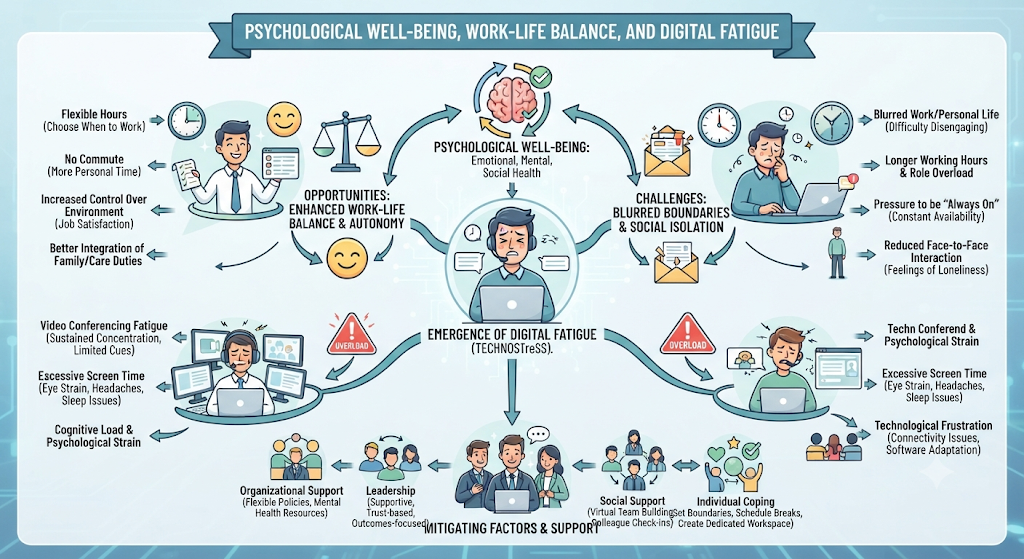
Leadership practices also influence employee psychological experiences in remote and hybrid environments. Supportive leaders who demonstrate empathy, provide regular feedback, recognize employee contributions, and maintain effective communication foster trust and emotional security. Trust-based leadership approaches emphasizing outcomes rather than constant monitoring reduce stress and promote employee autonomy.
Social support from colleagues, supervisors, family members, and peer networks serves as another important protective factor. Strong social relationships provide emotional assistance, practical guidance, and opportunities for meaningful interaction, thereby reducing feelings of isolation and stress. Virtual social activities, team-building initiatives, and collaborative projects can strengthen interpersonal connections within remote and hybrid work settings.
Individual coping strategies are equally important for maintaining psychological well-being. Employees can promote work-life balance by establishing clear boundaries between work and personal life, maintaining structured routines, creating dedicated workspaces, scheduling regular breaks, and engaging in physical activity. Mindfulness practices, relaxation techniques, and effective time management strategies further contribute to psychological resilience.
Theoretical perspectives provide valuable insights into understanding psychological well-being in remote work contexts. Boundary theory explains how individuals manage transitions between work and personal domains. Conservation of resources theory suggests that stress occurs when individuals perceive threats to valued resources such as time, energy, and social support. Self-determination theory emphasizes the importance of autonomy, competence, and relatedness for psychological well-being.
A multidisciplinary perspective is essential for understanding employee well-being in remote and hybrid work environments. Organizational psychology examines employee attitudes and mental health; sociology explores social relationships and work-family interactions; management studies investigate organizational practices and leadership; and information technology focuses on digital work environments and technostress.
Conclusion#
Remote and hybrid work arrangements have significantly transformed modern organizational practices. These flexible models provide employees with greater autonomy, reduced commuting time, improved work-life balance and better opportunities for focused work. As a result, they can enhance employee productivity when supported by proper digital tools, clear goals and trust-based leadership.
The study also highlights that remote and hybrid work influence organizational culture and communication. While flexibility improves satisfaction, reduced face-to-face interaction may weaken teamwork, belongingness and informal communication. Similarly, psychological well-being may improve through flexibility, but challenges such as isolation, blurred work-life boundaries, overwork and digital fatigue must be carefully managed.
Thus, remote and hybrid work arrangements can be effective only when organizations create balanced policies, maintain regular communication, support employee mental health and strengthen digital collaboration. A well-planned flexible work model can improve productivity, preserve organizational culture and promote employee well-being in the digital workplace.
Works Cited#
- Allen, Tammy D., et al. “How Effective Is Telecommuting? Assessing the Status of Our Scientific Findings.” Psychological Science in the Public Interest, vol. 16, no. 2, 2015, pp. 40–68.
- Bailey, Diane E., and Nancy B. Kurland. “A Review of Telework Research.” Journal of Organizational Behavior, vol. 23, no. 4, 2002, pp. 383–400.
- Bloom, Nicholas, et al. “Does Working from Home Work? Evidence from a Chinese Experiment.” Quarterly Journal of Economics, vol. 130, no. 1, 2015, pp. 165–218.
- Cascio, Wayne F. “Managing a Virtual Workplace.” Academy of Management Executive, vol. 14, no. 3, 2000, pp. 81–90.
- Choudhury, Prithwiraj, et al. “Work-from-Anywhere: The Productivity Effects of Geographic Flexibility.” Strategic Management Journal, vol. 42, no. 4, 2021, pp. 655–683.
- Cooper, Cecily D., and Nancy B. Kurland. “Telecommuting, Professional Isolation, and Employee Development.” Journal of Organizational Behavior, vol. 23, no. 4, 2002, pp. 511–532.
- Eurofound and International Labour Organization. Working Anytime, Anywhere: The Effects on the World of Work. Publications Office of the European Union, 2017.
- Golden, Timothy D., and John F. Veiga. “The Impact of Extent of Telecommuting on Job Satisfaction.” Journal of Management, vol. 31, no. 2, 2005, pp. 301–318.
- Gajendran, Ravi S., and David A. Harrison. “The Good, the Bad, and the Unknown about Telecommuting.” Journal of Applied Psychology, vol. 92, no. 6, 2007, pp. 1524–1541.
- Grant, Christine A., Louise M. Wallace, and Peter C. Spurgeon. “An Exploration of the Psychological Factors Affecting Remote E-Worker’s Job Effectiveness.” Employee Relations, vol. 35, no. 5, 2013, pp. 527–546.
- Hill, E. Jeffrey, et al. “Does It Matter Where You Work? A Comparison of How Three Work Venues Influence Aspects of Work and Personal/Family Life.” Journal of Vocational Behavior, vol. 63, no. 2, 2003, pp. 220–241.
- Kossek, Ellen Ernst, Brenda A. Lautsch, and Susan C. Eaton. “Telecommuting, Control, and Boundary Management.” Journal of Vocational Behavior, vol. 68, no. 2, 2006, pp. 347–367.
- Messenger, Jon C. Telework in the 21st Century: An Evolutionary Perspective. Edward Elgar, 2019.
- Nilles, Jack M. The Telecommunications-Transportation Tradeoff: Options for Tomorrow. Wiley, 1976.
- Oakman, Jodi, et al. “A Rapid Review of Mental and Physical Health Effects of Working at Home.” BMC Public Health, vol. 20, 2020, article 1825.
- Olson, Margrethe H. “Remote Office Work: Changing Work Patterns in Space and Time.” Communications of the ACM, vol. 26, no. 3, 1983, pp. 182–187.
- Parker, Sharon K., et al. “Designing Work for the Future.” Annual Review of Organizational Psychology and Organizational Behavior, vol. 7, 2020, pp. 1–28.
- Wang, Bin, et al. “Achieving Effective Remote Working during the COVID-19 Pandemic.” Applied Psychology, vol. 70, no. 1, 2021, pp. 16–59.
- World Health Organization and International Labour Organization. Healthy and Safe Telework: Technical Brief. WHO and ILO, 2021.
- Yang, Longqi, et al. “The Effects of Remote Work on Collaboration among Information Workers.” Nature Human Behaviour, vol. 6, 2022, pp. 43–54.