Abstract
Women's rights and workplace equality have emerged as fundamental components of human rights, social justice, and sustainable economic development. Despite considerable legal advancements over recent decades, women across the world continue to experience gender discrimination, unequal pay, occupational segregation, workplace harassment, limited leadership opportunities, and inadequate work-life balance. Globalization, technological transformation, and changing employment patterns have further complicated existing legal frameworks, requiring governments and international organizations to adopt more comprehensive and inclusive policies. International legal instruments such as the Convention on the Elimination of All Forms of Discrimination against Women (CEDAW), International Labour Organization (ILO) Conventions, and the Sustainable Development Goals (SDGs), particularly Goal 5 and Goal 8, provide important legal foundations for promoting gender equality and decent work. National constitutions and labour laws increasingly recognize equal opportunity, maternity protection, anti-discrimination measures, and workplace safety as essential rights. Nevertheless, implementation gaps, cultural barriers, informal employment, digital workplace discrimination, and persistent gender stereotypes continue to undermine effective realization of workplace equality. This paper critically examines the legal framework governing women's rights in employment through a comparative analysis of international standards and selected national legal systems. It explores contemporary challenges relating to equal pay, sexual harassment, maternity benefits, leadership representation, gig economy employment, and digital workplaces. The study further evaluates recent legislative reforms, judicial developments, and policy initiatives designed to strengthen workplace equality. It concludes that meaningful gender equality requires stronger legal enforcement, institutional accountability, inclusive workplace policies, technological regulation, and sustained collaboration among governments, employers, trade unions, and civil society to create safe, equitable, and discrimination-free workplaces for women.
- Women's Rights
- Workplace Equality
- Gender Discrimination
- Equal Pay
- Sexual Harassment
- Labour Law
- CEDAW
- ILO
- Employment Rights
- Gender Justice
Introduction#
Women's participation in the workforce has increased significantly over the past century, contributing substantially to economic growth, innovation, social development, and national productivity. However, despite remarkable progress in educational attainment and labour market participation, women continue to face systemic inequalities that limit their opportunities for equal employment, career advancement, fair remuneration, and workplace dignity. Gender discrimination remains deeply embedded in many employment systems through unequal hiring practices, wage disparities, occupational segregation, glass ceiling barriers, unpaid care responsibilities, workplace harassment, and underrepresentation in leadership positions. These inequalities not only violate fundamental human rights but also reduce economic efficiency and hinder sustainable development. Rapid globalization, technological innovation, digital employment platforms, remote work arrangements, and the expansion of the gig economy have created new opportunities for women's employment while simultaneously generating complex legal challenges that existing labour laws often struggle to address. Consequently, workplace equality has become a central concern within international human rights law, labour law, constitutional governance, and corporate responsibility. Governments, international organizations, employers, and civil society increasingly recognize that achieving gender equality requires not only legal prohibition of discrimination but also proactive measures that promote equal opportunity, diversity, inclusion, and safe working environments.
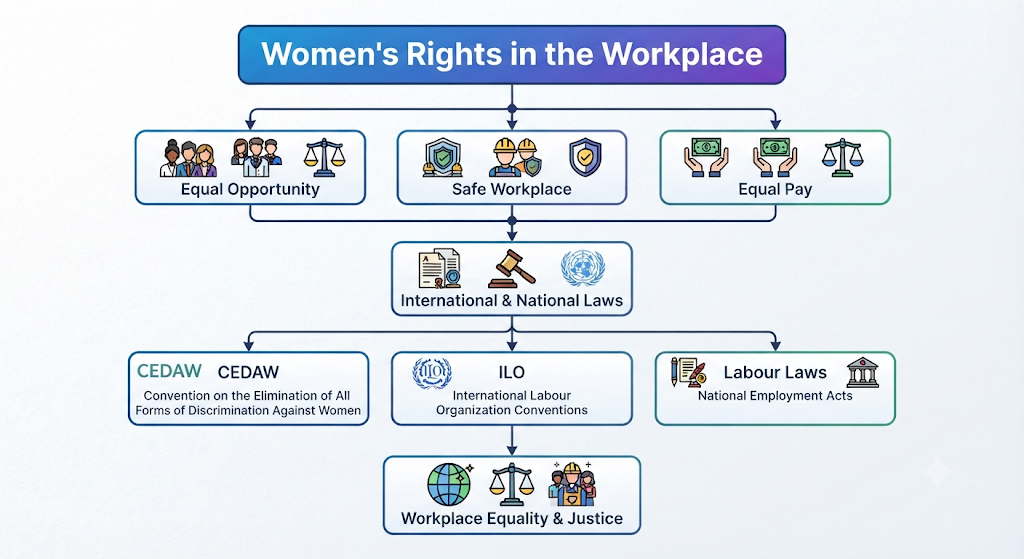
Figure: Conceptual Background
International law has played a transformative role in advancing women's workplace rights through legally binding treaties, labour standards, and human rights instruments. The Convention on the Elimination of All Forms of Discrimination against Women (CEDAW), adopted by the United Nations in 1979, requires States to eliminate discrimination against women in employment and ensure equal opportunities in recruitment, promotion, vocational training, remuneration, and social security. Similarly, the International Labour Organization (ILO) has adopted several conventions addressing equal remuneration, discrimination in employment, maternity protection, violence and harassment at work, and workers' rights. National constitutions across many countries increasingly guarantee equality before the law, prohibit gender discrimination, and recognize equal employment opportunities as constitutional rights. In India, constitutional provisions under Articles 14, 15, 16, 39, 42, and 51A support gender equality, while legislation such as the Equal Remuneration Act, the Code on Wages, the Maternity Benefit Act, and the Sexual Harassment of Women at Workplace (Prevention, Prohibition and Redressal) Act provide statutory protection for working women. Nevertheless, implementation challenges persist due to weak enforcement, inadequate institutional capacity, informal employment, intersectional discrimination, and evolving workplace structures. This paper critically examines contemporary legal challenges affecting women's rights and workplace equality through a comparative legal analysis of international standards and national legal systems. It further evaluates recent legislative reforms, judicial developments, corporate governance initiatives, and policy recommendations aimed at creating inclusive, equitable, and gender-sensitive workplaces capable of meeting the demands of an increasingly digital and globalized economy.
2. Contemporary Legal Framework for Women's Rights and Workplace EqualityThe legal framework governing women's rights and workplace equality has evolved considerably through international conventions, constitutional guarantees, labour legislation, and judicial interventions that collectively seek to eliminate gender discrimination and promote equal employment opportunities. At the international level, the Convention on the Elimination of All Forms of Discrimination against Women (CEDAW), 1979 serves as the primary treaty requiring States Parties to eliminate discrimination against women in political, economic, social, and employment spheres. Article 11 of CEDAW specifically obligates States to ensure equal rights in employment, including equal opportunities, equal remuneration for work of equal value, social security benefits, maternity protection, vocational training, and protection against dismissal due to pregnancy or marital status. Complementing CEDAW, the International Labour Organization (ILO) has adopted several important conventions, including the Equal Remuneration Convention, 1951 (No. 100), the Discrimination (Employment and Occupation) Convention, 1958 (No. 111), the Maternity Protection Convention, 2000 (No. 183), and the Violence and Harassment Convention, 2019 (No. 190), which collectively establish global labour standards aimed at ensuring equal treatment, workplace dignity, and protection from discrimination and harassment. The Universal Declaration of Human Rights (1948) and the International Covenant on Economic, Social and Cultural Rights (1966) further recognize the right to work, just and favourable working conditions, equal pay for equal work, and protection against discrimination as fundamental human rights. At the national level, many constitutions expressly guarantee equality before the law and prohibit discrimination based on sex or gender. In India, Articles 14, 15, and 16 of the Constitution guarantee equality before the law, prohibit discrimination on the grounds of sex, and ensure equal opportunity in public employment, while the Directive Principles under Articles 39(d), 42, and 43 encourage equal pay, humane working conditions, and maternity relief. These constitutional principles are implemented through legislation such as the Code on Wages, 2019, which incorporates the principle of equal remuneration, the Maternity Benefit Act, 1961 (as amended in 2017) providing paid maternity leave and childcare provisions, and the Sexual Harassment of Women at Workplace (Prevention, Prohibition and Redressal) Act, 2013, which mandates Internal Committees, complaint mechanisms, and employer responsibilities for maintaining safe workplaces. Similar legislative frameworks exist in jurisdictions such as the United States through the Equal Pay Act (1963) and Title VII of the Civil Rights Act (1964), the United Kingdom through the Equality Act (2010), and the European Union through various Equal Treatment Directives promoting gender equality in employment. Courts have also played a transformative role by interpreting constitutional equality provisions expansively, recognizing workplace dignity, reproductive rights, and protection against sexual harassment as integral components of fundamental human rights. Despite these comprehensive legal protections, practical implementation remains inconsistent due to inadequate enforcement, limited awareness, informal employment, cultural stereotypes, unequal caregiving responsibilities, and institutional barriers that disproportionately affect women. Consequently, strengthening workplace equality requires not only robust legal frameworks but also effective enforcement mechanisms, employer accountability, judicial vigilance, gender-sensitive workplace policies, and continuous institutional reforms capable of addressing emerging employment challenges in increasingly digital, globalized, and flexible work environments.
Contemporary Legal Challenges to Women's Rights and Workplace Equality#
Despite the existence of comprehensive international conventions and national labour laws, women continue to encounter numerous legal and structural barriers that prevent the realization of genuine workplace equality. One of the most persistent challenges is the gender pay gap, where women frequently receive lower wages than men for work of equal value because of occupational segregation, limited promotional opportunities, career interruptions associated with caregiving responsibilities, and unconscious gender bias in recruitment and compensation practices. Another significant issue is the glass ceiling phenomenon, which restricts women's advancement into senior management, executive leadership, and corporate board positions despite possessing comparable qualifications and experience. Workplace harassment, particularly sexual harassment, remains a serious concern affecting women's dignity, mental health, productivity, and career progression. Although many countries have enacted legislation requiring employers to establish complaint mechanisms and preventive measures, fear of retaliation, inadequate implementation, social stigma, and lengthy legal procedures often discourage victims from reporting incidents. The growth of the gig economy, remote work, and digital employment platforms has introduced additional legal complexities. Many women engaged in platform-based or contractual employment lack access to maternity benefits, paid leave, social security, health insurance, and legal protection available to permanent employees. Moreover, remote working arrangements have blurred the distinction between professional and domestic responsibilities, increasing unpaid care work and intensifying work-life balance challenges for women. Digital workplaces have also given rise to cyber harassment, online discrimination, algorithmic bias, and AI-driven recruitment inequalities, where automated hiring systems may unintentionally reinforce gender stereotypes through biased datasets or discriminatory decision-making processes. Women belonging to marginalized communities often experience intersectional discrimination, facing multiple disadvantages based on gender combined with race, ethnicity, caste, disability, religion, age, or socioeconomic background. Such overlapping forms of discrimination significantly reduce access to employment opportunities, equal remuneration, workplace accommodations, and career advancement. Another contemporary challenge involves inadequate implementation of maternity and parental leave policies. While maternity protection laws have expanded globally, many employers perceive maternity-related benefits as financial burdens, leading to discriminatory hiring practices or reduced promotional opportunities for women of childbearing age. Furthermore, insufficient childcare facilities, inflexible working hours, and unequal distribution of caregiving responsibilities continue to affect women's long-term participation in the labour force. In developing countries, a substantial proportion of women remain employed in the informal sector, where labour protections, minimum wages, workplace safety standards, and legal remedies are often absent or poorly enforced. Weak labour inspection systems, limited awareness of legal rights, inadequate access to justice, and lengthy litigation procedures further undermine effective enforcement of workplace equality laws. Globalization has also intensified cross-border employment, creating jurisdictional challenges concerning labour standards, migrant workers' rights, and multinational corporate accountability. Addressing these complex issues requires legal reforms that extend employment protections to emerging forms of work, strengthen enforcement mechanisms, regulate artificial intelligence and digital employment practices, promote equal parental responsibilities, expand social security coverage, encourage women's leadership representation, and establish inclusive workplace cultures free from discrimination and harassment. Only through a combination of effective legislation, judicial oversight, employer accountability, technological regulation, and social transformation can meaningful workplace equality and women's economic empowerment be fully achieved in the contemporary world.
Contemporary Legal Reforms and Future Directions for Workplace Equality#
In response to persistent gender inequalities in employment, governments, international organizations, and private enterprises have introduced significant legal and policy reforms aimed at creating more inclusive, equitable, and gender-responsive workplaces. Internationally, the International Labour Organization (ILO) has strengthened labour standards through conventions addressing equal remuneration, discrimination, maternity protection, and workplace violence, while the Convention on the Elimination of All Forms of Discrimination against Women (CEDAW) continues to guide national legislative reforms by requiring States to eliminate gender-based discrimination in employment. The adoption of the ILO Violence and Harassment Convention, 2019 (No. 190) represents a major advancement by recognizing every worker's right to a workplace free from violence and harassment, including gender-based violence. Similarly, the United Nations Sustainable Development Goals (SDGs), particularly Goal 5 (Gender Equality) and Goal 8 (Decent Work and Economic Growth), have encouraged countries to integrate gender equality into labour policies and economic development strategies. Many jurisdictions have introduced pay transparency laws requiring employers to disclose salary structures and report gender pay gaps, thereby promoting accountability and reducing wage discrimination. Corporate governance reforms increasingly mandate greater female representation on company boards and in senior management positions through gender diversity targets or quotas, as implemented in several European countries. In India, legislative initiatives such as the Code on Wages, 2019, the Maternity Benefit (Amendment) Act, 2017, and the Sexual Harassment of Women at Workplace (Prevention, Prohibition and Redressal) Act, 2013 have strengthened legal protections relating to equal remuneration, maternity leave, childcare facilities, and workplace safety. Judicial decisions have further expanded constitutional interpretations of equality by recognizing workplace dignity, reproductive autonomy, and protection against discrimination as integral aspects of fundamental rights. At the organizational level, employers are increasingly adopting diversity, equity, and inclusion (DEI) policies, flexible working arrangements, gender-sensitive recruitment practices, unconscious bias training, mentorship programs, and transparent promotion systems to improve women's participation and leadership opportunities. The rapid digital transformation of workplaces has also prompted legal discussions concerning artificial intelligence, algorithmic fairness, remote work regulations, digital privacy, and protection against online harassment. Future legal reforms must therefore address emerging challenges associated with platform-based employment, gig workers, remote working environments, and AI-driven recruitment systems by ensuring that technological innovation does not reinforce gender bias or exclude women from employment opportunities. Strengthening labour inspection systems, improving access to legal remedies, enhancing whistleblower protection, expanding parental leave policies to include both parents, and increasing investment in affordable childcare infrastructure are equally essential for reducing structural inequalities.
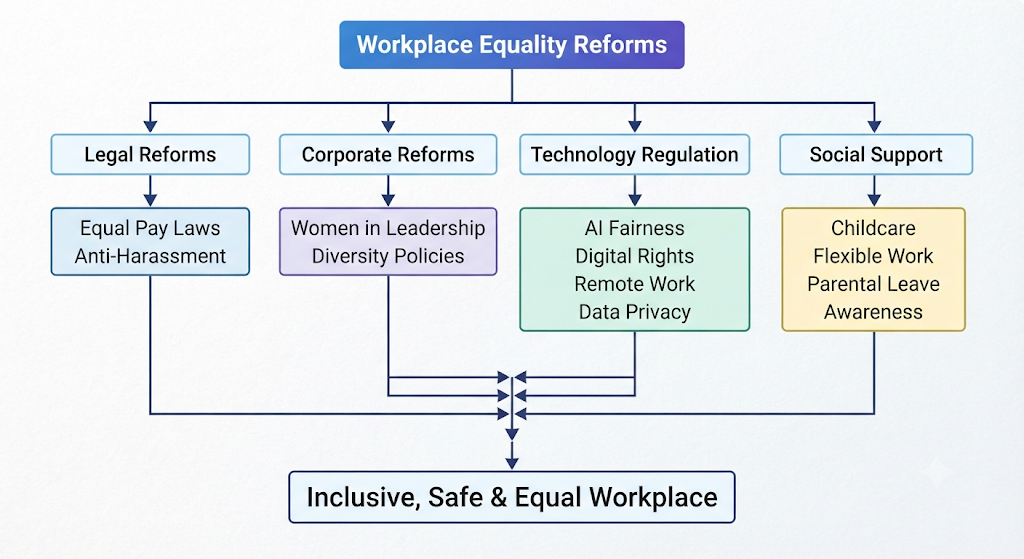
Figure: Contemporary Legal Reforms and Future Directions for Workplace Equality
Greater collaboration between governments, employers, labour unions, academic institutions, and civil society organizations can further promote gender-sensitive workplace cultures and ensure effective implementation of legal standards. Ultimately, sustainable workplace equality requires not only comprehensive legislation but also consistent enforcement, institutional accountability, public awareness, corporate commitment, and continuous legal adaptation to evolving social, economic, and technological realities. Such reforms will contribute to building inclusive labour markets where women enjoy equal opportunities, fair treatment, workplace dignity, and meaningful participation in economic development.
Conclusion#
Women's rights and workplace equality have become indispensable pillars of democratic governance, social justice, economic development, and human rights protection. Although remarkable progress has been achieved through international conventions, constitutional guarantees, labour legislation, judicial interpretation, and corporate governance reforms, significant barriers continue to prevent women from enjoying equal opportunities and treatment in the workplace. Persistent challenges such as gender pay disparities, occupational segregation, workplace harassment, underrepresentation in leadership positions, unequal caregiving responsibilities, informal employment, and digital discrimination demonstrate that legal recognition alone is insufficient to achieve substantive equality. Comparative analysis indicates that jurisdictions with comprehensive legal frameworks, effective enforcement mechanisms, independent judicial institutions, and gender-sensitive workplace policies have achieved greater progress in promoting women's economic participation and workplace inclusion. Nevertheless, globalization, technological transformation, artificial intelligence, platform-based employment, and remote working arrangements have introduced new legal complexities that require continuous adaptation of labour laws and regulatory mechanisms. International legal instruments, particularly CEDAW, ILO conventions, and the Sustainable Development Goals, provide valuable guidance for harmonizing national legislation and promoting global standards of workplace equality. However, effective implementation depends upon strong institutional capacity, employer accountability, labour inspections, accessible grievance mechanisms, and widespread awareness of legal rights among employees and employers alike. Governments must strengthen anti-discrimination legislation, expand maternity and parental benefits, promote equal pay transparency, regulate digital employment platforms, and ensure adequate social security for women engaged in both formal and informal sectors. Equally important is the adoption of inclusive organizational practices that encourage diversity, leadership development, flexible work arrangements, and zero tolerance for workplace harassment. Educational institutions, civil society organizations, trade unions, and the private sector also play a vital role in transforming workplace culture by challenging gender stereotypes and promoting respect, inclusion, and equal opportunity. Future reforms should integrate technological regulation with human rights principles to address algorithmic bias, cyber harassment, and emerging challenges associated with artificial intelligence in employment decisions. Ultimately, achieving genuine workplace equality requires a holistic approach that combines strong legal protections, effective enforcement, institutional reforms, social awareness, corporate responsibility, and cultural transformation. By fostering workplaces that value equality, dignity, and diversity, societies can unlock the full potential of women's participation, strengthen economic growth, promote innovation, and advance sustainable development. Ensuring equal rights and opportunities for women is therefore not merely a legal obligation but a fundamental prerequisite for building inclusive, just, and resilient societies capable of meeting the challenges of the twenty-first century.
Works Cited#
- Convention on the Elimination of All Forms of Discrimination against Women. (1979). United Nations.
- International Labour Organization. (1951). Equal Remuneration Convention (No. 100).
- International Labour Organization. (1958). Discrimination (Employment and Occupation) Convention (No. 111).
- International Labour Organization. (2000). Maternity Protection Convention (No. 183).
- International Labour Organization. (2019). Violence and Harassment Convention (No. 190).
- United Nations. (1948). Universal Declaration of Human Rights.
- United Nations. (1966). International Covenant on Economic, Social and Cultural Rights.
- United Nations. (2015). Transforming Our World: The 2030 Agenda for Sustainable Development.
- Government of India. (1950). The Constitution of India.
- Government of India. (2013). The Sexual Harassment of Women at Workplace (Prevention, Prohibition and Redressal) Act.
- Government of India. (2017). The Maternity Benefit (Amendment) Act.
- Government of India. (2019). The Code on Wages.
- Fredman, S. (2016). Discrimination Law (2nd ed.). Oxford University Press.
- MacKinnon, C. A. (1979). Sexual Harassment of Working Women. Yale University Press.
- Hepple, B. (2014). Equality: The Legal Framework. Hart Publishing.
- Barnard, C. (2012). EU Employment Law (4th ed.). Oxford University Press.
- OECD. (2023). Gender Equality at Work: Progress and Challenges.
- World Bank. (2022). Women, Business and the Law.
- International Labour Organization. (2022). Global Wage Report.
- United Nations Entity for Gender Equality and the Empowerment of Women (UN Women). (2023). Progress on the Sustainable Development Goals: The Gender Snapshot.