Abstract
The present study examines the influence of social networking platforms on consumer behaviour, brand perception, and online purchasing decisions in the digital era. Social networking platforms such as Facebook, Instagram, YouTube, X, WhatsApp, and LinkedIn have transformed the way consumers search for information, interact with brands, compare products, read reviews, and make purchase decisions. The study explores how online advertisements, influencer marketing, customer reviews, brand engagement, social media content, peer recommendations, and digital promotions affect consumer preferences and buying behaviour. It also analyses how social networking platforms shape brand perception by influencing trust, awareness, loyalty, credibility, and emotional connection with consumers. The study highlights that social media has become a powerful marketing tool that affects every stage of the consumer decision-making process, from awareness to final purchase. It concludes that effective social media strategies can enhance brand image, strengthen consumer relationships, and increase online purchasing intention in the digital marketplace.
- Social Networking Platforms
- Consumer Behaviour
- Brand Perception
- Online Purchasing Decisions
- Digital Marketing
- Social Media
- Influencer Marketing
Introduction#
Social networking platforms have become powerful tools of communication, marketing and consumer engagement in the digital era. Platforms such as Facebook, Instagram, YouTube, WhatsApp, X, LinkedIn and other digital communities have changed the way consumers receive information, interact with brands and make purchasing decisions. Earlier, consumers mainly depended on television, newspapers, shopkeepers, family members and personal experience for product information. In the present digital marketplace, consumers can easily compare products, read reviews, watch promotional videos, follow influencers and communicate directly with brands through social media.
Consumer behaviour refers to the actions, preferences, attitudes and decision-making processes of individuals while selecting, purchasing and using products or services. Social networking platforms influence consumer behaviour by providing continuous exposure to advertisements, product recommendations, user-generated content, brand stories and peer opinions. Consumers are no longer passive receivers of marketing messages; they actively participate by liking, sharing, commenting, reviewing and discussing products online.
Brand perception is also strongly shaped by social networking platforms. Brand perception refers to how consumers view, understand and feel about a brand. Positive online content, attractive visuals, customer testimonials, influencer endorsements and quick brand responses can create trust and favourable image. On the other hand, negative reviews, poor customer service, misleading advertisements and online complaints can damage brand reputation. Thus, social media has made brand image more dynamic and publicly visible.
Online purchasing decisions are closely connected with social media influence. Consumers often discover products through social networking platforms and then move to e-commerce websites or brand pages for purchase. Digital advertisements, discounts, influencer promotions, product demonstrations and customer reviews can strongly affect purchase intention. Social proof, such as ratings, likes, comments and recommendations, increases consumer confidence in online buying.
The digital era has also changed the relationship between consumers and brands. Brands now use social networking platforms for direct communication, personalized marketing, customer support, feedback collection and community building. This interaction strengthens brand engagement and loyalty. Consumers feel more connected to brands that respond quickly, share meaningful content and maintain transparency.
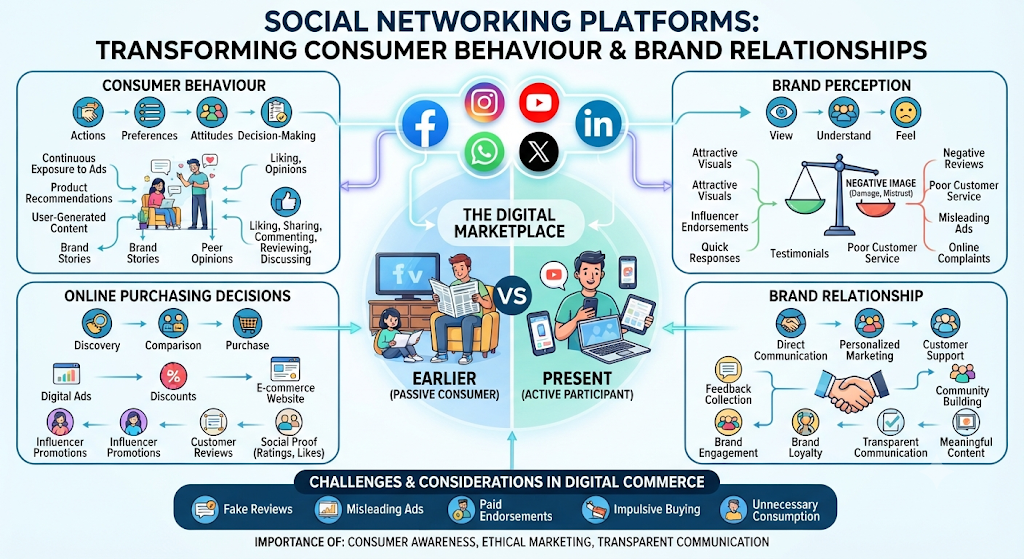
However, social networking platforms also create challenges. Consumers may be influenced by fake reviews, misleading advertisements, paid endorsements and impulsive buying behaviour. Excessive exposure to digital promotions may encourage unnecessary consumption. Therefore, consumer awareness, ethical marketing and transparent communication are important in digital commerce.
Online Purchasing Decisions and the Role of Reviews, Influencers, and Digital Promotions#
Online purchasing decisions refer to the process through which consumers identify needs, search for information, evaluate alternatives, and finally purchase products or services through digital platforms. In the digital era, social networking platforms have become important sources of information and influence during the consumer decision-making process. Reviews, influencer recommendations, and digital promotions significantly shape consumers’ attitudes, preferences, and purchasing intentions. These factors affect every stage of the online buying process, from product awareness to post-purchase evaluation.
Consumer decision-making traditionally involved need recognition, information search, evaluation of alternatives, purchase decision, and post-purchase behaviour. However, digital technologies and social networking platforms have transformed this process by providing consumers with immediate access to product information, customer experiences, and promotional content. Consumers now actively utilize online resources before making purchasing decisions, thereby increasing the importance of digital influence.
One of the most influential factors affecting online purchasing decisions is online reviews and ratings. Online reviews are evaluations, opinions, and experiences shared by consumers regarding products and services. Ratings provide numerical assessments that summarize consumer satisfaction levels. These forms of electronic word-of-mouth significantly influence purchasing behaviour because they are often perceived as authentic and trustworthy sources of information.
Consumers frequently read reviews before purchasing products online to reduce uncertainty and perceived risk. Positive reviews increase confidence in product quality, reliability, and performance, thereby enhancing purchase intentions. Conversely, negative reviews may discourage consumers from purchasing products or motivate them to seek alternatives. Research consistently demonstrates that review quantity, quality, credibility, and recency significantly affect consumer decision-making.
Online reviews also influence brand trust and credibility. Products receiving consistently favourable evaluations are generally perceived as more trustworthy and reliable. Detailed reviews containing personal experiences, photographs, and practical information often have stronger persuasive effects than brief comments. Consequently, organizations increasingly encourage satisfied customers to provide feedback and testimonials to strengthen brand reputation and influence potential buyers.
Social proof constitutes another important mechanism through which reviews influence purchasing decisions. Social proof refers to individuals' tendency to rely on the opinions and behaviours of others when making decisions under conditions of uncertainty. Indicators such as ratings, comments, likes, shares, and recommendations signal product popularity and acceptance. Consumers often assume that products preferred by many others are likely to be satisfactory, thereby increasing purchase probability.
Influencer marketing has emerged as another powerful determinant of online purchasing decisions. Social media influencers are individuals who possess substantial online followings and can affect audience attitudes, perceptions, and behaviours through content creation and recommendations. Influencers may include celebrities, industry experts, bloggers, vloggers, and ordinary consumers who have established credibility within specific communities.
Digital promotions constitute another important factor influencing online purchasing decisions. Digital promotions refer to online marketing activities designed to stimulate consumer interest and encourage purchases. Common digital promotional strategies include discounts, coupons, promotional codes, cashback offers, flash sales, limited-time offers, contests, giveaways, and personalized advertisements.
Price promotions significantly influence online purchasing behaviour because consumers are highly responsive to economic incentives. Discounts and promotional offers create perceptions of value and savings, motivating consumers to make purchases. Limited-time promotions often create urgency and scarcity perceptions, encouraging immediate purchasing decisions and reducing decision delays.
Flash sales and time-limited offers are particularly effective because they utilize psychological principles associated with scarcity and fear of missing out (FOMO). Consumers frequently accelerate purchasing decisions when they perceive that promotional opportunities are temporary or available in limited quantities. Social networking platforms facilitate rapid dissemination of promotional information, thereby enhancing the effectiveness of such strategies.
Personalized digital promotions have become increasingly important in contemporary online marketing. Advances in data analytics, artificial intelligence, and consumer profiling enable organizations to deliver customized promotional messages based on individual preferences, browsing behaviour, purchase history, and demographic characteristics. Personalized promotions enhance relevance, improve consumer experiences, and increase conversion rates.
Retargeting advertisements represent another influential digital promotional strategy. Retargeting involves displaying advertisements to consumers who have previously visited websites or expressed interest in products. Such advertisements remind consumers about products they considered earlier and often encourage completion of purchasing decisions. Retargeting reduces cart abandonment and enhances online sales effectiveness.
Social networking platforms have also facilitated the growth of social commerce, which integrates social interaction and e-commerce functionalities. Consumers can now discover, evaluate, and purchase products directly through social media applications without visiting separate e-commerce websites. Features such as shoppable posts, live-stream shopping, integrated payment systems, and in-app purchasing simplify purchasing processes and increase convenience.
Conclusion#
Social networking platforms have become powerful tools for shaping consumer behaviour, brand perception and online purchasing decisions in the digital era. They influence consumers through advertisements, reviews, influencer content, peer recommendations, user-generated posts and digital promotions. The study highlights that social media helps consumers discover products, compare alternatives, develop brand trust and make purchase decisions. Positive reviews, engaging content and authentic influencer recommendations strengthen brand image and consumer confidence, while misleading content or negative feedback may reduce trust. Thus, social networking platforms play an important role in modern digital marketing. Businesses must use transparent, ethical and consumer-focused social media strategies to build strong brand perception, increase engagement and encourage informed online purchasing decisions.
Works Cited#
- Kaplan, Andreas M., and Michael Haenlein. “Users of the World, Unite! The Challenges and Opportunities of Social Media.” Business Horizons, vol. 53, no. 1, 2010, pp. 59–68.
- Mangold, W. Glynn, and David J. Faulds. “Social Media: The New Hybrid Element of the Promotion Mix.” Business Horizons, vol. 52, no. 4, 2009, pp. 357–365.
- Kotler, Philip, and Kevin Lane Keller. Marketing Management. 15th ed., Pearson Education, 2016.
- Solomon, Michael R. Consumer Behavior: Buying, Having, and Being. 13th ed., Pearson, 2019.
- Schiffman, Leon G., and Joseph Wisenblit. Consumer Behavior. 12th ed., Pearson, 2019.
- Keller, Kevin Lane. Strategic Brand Management: Building, Measuring, and Managing Brand Equity. 4th ed., Pearson, 2013.
- Aaker, David A. Managing Brand Equity. Free Press, 1991.
- Hennig-Thurau, Thorsten, et al. “Electronic Word-of-Mouth via Consumer-Opinion Platforms.” Journal of Interactive Marketing, vol. 18, no. 1, 2004, pp. 38–52.
- Cheung, Christy M. K., and Dion Hoe-Lian Lee. “A Theoretical Model of Intentional Social Action in Online Social Networks.” Decision Support Systems, vol. 49, no. 1, 2010, pp. 24–30.
- Hajli, Nick. “Social Commerce Constructs and Consumer’s Intention to Buy.” International Journal of Information Management, vol. 35, no. 2, 2015, pp. 183–191.
- Kim, Angella J., and Eunju Ko. “Do Social Media Marketing Activities Enhance Customer Equity?” Journal of Business Research, vol. 65, no. 10, 2012, pp. 1480–1486.
- Erkan, Ismail, and Chris Evans. “The Influence of eWOM in Social Media on Consumers’ Purchase Intentions.” International Journal of Internet Marketing and Advertising, vol. 11, no. 1, 2016, pp. 2–20.
- Chu, Shu-Chuan, and Yoojung Kim. “Determinants of Consumer Engagement in Electronic Word-of-Mouth in Social Networking Sites.” International Journal of Advertising, vol. 30, no. 1, 2011, pp. 47–75.
- De Vries, Lisette, Sonja Gensler, and Peter S. H. Leeflang. “Popularity of Brand Posts on Brand Fan Pages.” Journal of Interactive Marketing, vol. 26, no. 2, 2012, pp. 83–91.
- Ashley, Christy, and Tracy Tuten. “Creative Strategies in Social Media Marketing.” Psychology & Marketing, vol. 32, no. 1, 2015, pp. 15–27.
- Freberg, Karen, et al. “Who Are the Social Media Influencers?” Public Relations Review, vol. 37, no. 1, 2011, pp. 90–92.
- Casaló, Luis V., Carlos Flavián, and Sergio Ibáñez-Sánchez. “Influencers on Instagram.” Journal of Business Research, vol. 117, 2020, pp. 510–519.
- Tuten, Tracy L., and Michael R. Solomon. Social Media Marketing. 4th ed., Sage Publications, 2021.
- Chaffey, Dave, and Fiona Ellis-Chadwick. Digital Marketing. 8th ed., Pearson, 2022.
- Tiago, Maria Teresa Pinheiro Melo Borges, and José Maria C. Veríssimo. “Digital Marketing and Social Media.” Business Horizons, vol. 57, no. 6, 2014, pp. 703–708.
"A Multidisciplinary Study on Climate Change Awareness, Environmental Attitudes, and Sustainable