Abstract
The present study examines how digital technologies are changing human resource functions and organizational practices in modern corporate institutions. Digital transformation refers to the integration of technologies such as artificial intelligence, cloud computing, data analytics, automation, digital communication platforms, HR information systems, e-recruitment, online training, and performance management software into business operations. The study focuses on the impact of digital transformation on human resource management practices such as recruitment, selection, onboarding, training, employee engagement, attendance management, payroll, performance appraisal, and talent development. It also examines how digital HR practices influence employee performance by improving efficiency, communication, skill development, transparency, feedback, and productivity. Further, the study explores the role of digital transformation in organizational sustainability through cost reduction, paperless processes, flexible work systems, innovation, data-based decision-making, and long-term competitiveness. In the contemporary corporate world, digital transformation has become essential for improving speed, accuracy, adaptability, and organizational growth. However, it also creates challenges such as employee resistance, digital skill gaps, data privacy concerns, cybersecurity risks, job insecurity, and technological dependence. Therefore, the study is significant because it highlights the need for balanced digital adoption, employee training, ethical technology use, and sustainable HR policies.
- Digital Transformation
- Human Resource Management
- Employee Performance
- Organizational Sustainability
- Corporate World
- Digital HRM
- HR Analytics
- Automation
- Employee Engagement
- Sustainable Development
Introduction#
Digital transformation has become one of the most important forces shaping the modern corporate world. It refers to the use of digital technologies to change organizational processes, improve efficiency, enhance decision-making, and create value for stakeholders. In business organizations, digital transformation is not limited to the use of computers or software; it involves a complete shift in work culture, communication, management practices, employee behaviour, and organizational strategy.
Human resource management is one of the major areas affected by digital transformation. Traditionally, HRM activities such as recruitment, attendance, payroll, training, performance appraisal, and employee records were managed manually or through basic administrative systems. Today, corporate organizations increasingly use digital platforms, HR information systems, artificial intelligence, data analytics, cloud-based software, online learning systems, and automated tools to manage employees more effectively.
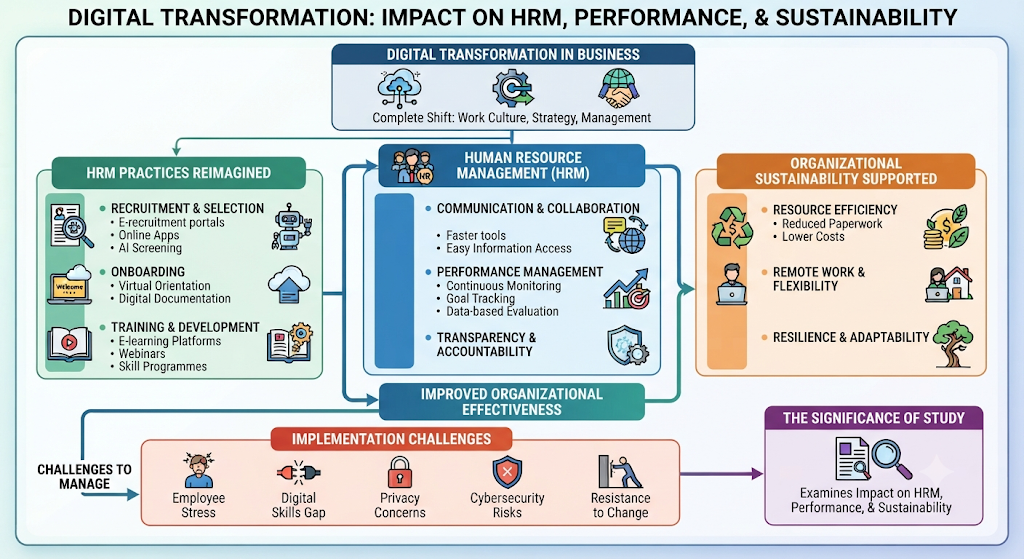
Digital transformation has changed recruitment and selection practices through e-recruitment portals, online applications, digital interviews, applicant tracking systems, and AI-based screening. It has also improved onboarding through virtual orientation, digital documentation, and online employee support. Training and development have become more flexible through e-learning platforms, webinars, virtual classrooms, and digital skill programmes.
Employee performance is also influenced by digital HR practices. Digital tools help employees communicate faster, collaborate better, access information easily, receive timely feedback, and improve productivity. Performance management systems allow continuous monitoring, goal tracking, feedback, and data-based evaluation. These practices can improve transparency and accountability in the workplace.
Digital transformation also supports organizational sustainability. Sustainable organizations focus on long-term growth, responsible resource use, employee well-being, innovation, and adaptability. Digital HR practices reduce paperwork, save time, lower administrative costs, improve remote work possibilities, and support efficient resource management. They also help organizations become more flexible and resilient in changing business environments.
However, digital transformation also creates challenges. Employees may face stress due to rapid technological change, lack of digital skills, fear of job loss, privacy concerns, and increased work monitoring. Organizations may also face cybersecurity risks, high implementation costs, and resistance to change. Therefore, digital transformation must be supported by proper training, ethical policies, employee participation, and strong leadership.
The present study is significant because it examines the impact of digital transformation on HRM practices, employee performance, and organizational sustainability in the corporate world. It highlights how technology can improve organizational effectiveness while also identifying challenges that must be managed carefully.
Digital Transformation and Changing Human Resource Management Practices#
Digital transformation has significantly altered the functioning of organizations across the globe, particularly in the field of Human Resource Management (HRM). In the contemporary corporate world, technological advancement has transformed traditional human resource activities into more efficient, strategic, data-driven, and employee-centric processes. Human Resource Management, which was once primarily administrative and paper-based, has evolved into a technologically integrated function that supports organizational competitiveness and sustainability. Digital transformation refers to the integration of digital technologies into organizational operations, processes, and strategies to improve efficiency, productivity, decision-making, and value creation. In the context of HRM, digital transformation involves the use of technologies such as Human Resource Information Systems (HRIS), artificial intelligence (AI), cloud computing, big data analytics, machine learning, mobile applications, social media platforms, and automation tools to manage human resources effectively.
Traditionally, human resource functions such as recruitment, attendance management, payroll processing, employee record maintenance, performance appraisal, and training were conducted manually. These processes were often time-consuming, labour-intensive, and prone to human errors. With the emergence of digital technologies, organizations have shifted from manual systems to automated and integrated digital platforms that enhance operational efficiency and accuracy.
One of the most significant changes brought about by digital transformation is in the area of recruitment and selection. Modern organizations increasingly utilize digital recruitment platforms, online job portals, social networking sites, and applicant tracking systems (ATS) to attract and select potential employees. E-recruitment enables organizations to reach a larger pool of candidates within a shorter period. Digital recruitment systems streamline the hiring process by automating job postings, application screening, resume analysis, interview scheduling, and candidate communication.
Artificial intelligence has further revolutionized recruitment practices. AI-based systems can screen resumes, identify suitable candidates, predict job performance, and reduce recruitment time. Chatbots are increasingly used to interact with candidates, answer queries, and provide real-time information regarding recruitment procedures. These technological innovations have enhanced the speed, transparency, and effectiveness of recruitment processes. Digital transformation has also transformed employee onboarding practices. Traditionally, onboarding involved extensive paperwork and face-to-face orientation programmes. Contemporary organizations use digital onboarding platforms that facilitate electronic documentation, virtual orientation sessions, online training modules, and automated compliance procedures. Digital onboarding improves employee experience and enables new employees to integrate more quickly into the organization. Training and development constitute another important HR function significantly influenced by digital transformation. Corporate organizations increasingly adopt e-learning platforms, Learning Management Systems (LMS), webinars, virtual classrooms, mobile learning applications, and Massive Open Online Courses (MOOCs) for employee development. Digital learning platforms provide flexibility, accessibility, and personalized learning experiences. Employees can access training materials anytime and anywhere, thereby promoting continuous professional development. The emergence of remote and hybrid work arrangements has further accelerated the digitalization of HRM practices. Organizations use various digital collaboration tools such as video conferencing platforms, project management applications, and virtual communication systems to facilitate employee interaction and teamwork. Digital communication technologies have enabled organizations to maintain productivity and coordination despite geographical dispersion.
Performance management systems have also undergone substantial transformation. Traditional annual performance appraisal systems are increasingly being replaced by continuous performance management platforms. Digital performance management systems enable real-time monitoring, continuous feedback, goal tracking, competency assessment, and performance analytics. Managers can evaluate employee performance more objectively using data-driven indicators, thereby improving fairness and transparency. Human Resource Information Systems (HRIS) represent a major component of digital HR transformation. HRIS integrates multiple HR functions, including employee records, attendance management, payroll processing, leave administration, benefits management, and compliance reporting within a centralized digital platform. Such integration enhances data accuracy, reduces administrative burden, and facilitates informed decision-making.
Data analytics has emerged as a strategic tool in modern HRM. HR analytics, often referred to as people analytics, involves the collection, analysis, and interpretation of employee-related data to support managerial decision-making. Organizations utilize HR analytics to predict employee turnover, assess training effectiveness, measure employee engagement, identify skill gaps, and improve workforce planning. Data-driven HR decisions contribute significantly to organizational effectiveness and strategic planning.
Employee engagement practices have also changed considerably due to digital transformation. Organizations increasingly use digital platforms to conduct employee surveys, monitor engagement levels, facilitate communication, recognize employee achievements, and gather feedback. Digital engagement tools strengthen organizational communication and enhance employee participation in organizational processes. Payroll and compensation management have become highly automated through digital technologies. Automated payroll systems reduce errors, ensure timely salary disbursement, facilitate tax compliance, and improve administrative efficiency. Employees can access salary information, tax documents, leave balances, and benefits information through employee self-service portals, thereby increasing transparency and employee satisfaction. Digital transformation has further promoted employee self-service systems. Through web-based and mobile platforms, employees can independently access personal information, apply for leave, update records, view performance reports, register for training programmes, and communicate with HR departments. Employee self-service reduces administrative workload and empowers employees by increasing autonomy. The use of social media has become increasingly important in HRM practices. Organizations utilize social networking platforms not only for recruitment but also for employer branding, employee engagement, knowledge sharing, and organizational communication. Social media facilitates interaction among employees and strengthens organizational culture.
Despite numerous benefits, digital transformation in HRM also presents several challenges. One major challenge is employee resistance to technological change. Employees may perceive digital systems as complex, threatening, or disruptive to existing work practices. Resistance may arise due to fear of job displacement, technological anxiety, or inadequate digital competencies. Digital skill gaps among employees constitute another challenge. Successful implementation of digital HR systems requires employees and managers to possess adequate technological knowledge and skills. Organizations must therefore invest in digital literacy programmes and continuous skill development initiatives. Data privacy and cybersecurity concerns represent significant issues in digital HRM. HR departments manage sensitive employee information, including personal, financial, and health-related data. Organizations must establish robust cybersecurity measures and ethical guidelines to ensure data protection and maintain employee trust. The successful implementation of digital HR transformation requires effective leadership and change management. Organizational leaders must communicate the benefits of digital transformation, involve employees in decision-making processes, provide necessary training, and create a supportive organizational culture that encourages technological adoption.
Impact of Digital HRM on Employee Performance and Productivity#
Digital Human Resource Management (Digital HRM) has emerged as a transformative force in modern organizations, significantly influencing employee performance and productivity. The integration of digital technologies into HR practices has changed the manner in which employees work, communicate, collaborate, learn, and perform their duties. In the contemporary corporate environment, organizations increasingly rely on digital systems to enhance workforce efficiency, improve employee experiences, and achieve higher levels of organizational performance.
Employee performance refers to the extent to which employees successfully accomplish their assigned tasks and contribute toward organizational goals. It includes aspects such as work quality, efficiency, innovation, commitment, adaptability, and achievement of performance targets. Productivity, on the other hand, refers to the ability of employees to produce desired outputs efficiently by utilizing available resources effectively. Digital HRM plays an important role in improving both performance and productivity through automation, data-driven decision-making, continuous learning, and enhanced employee engagement.
One of the most significant contributions of Digital HRM is the improvement of workplace efficiency. Traditional administrative tasks such as attendance recording, leave management, payroll processing, and documentation consumed considerable time and effort. Digital HR systems automate these repetitive activities, allowing employees and managers to focus on strategic and value-adding activities. Reduced administrative burden enhances overall productivity and enables employees to utilize their time more effectively.
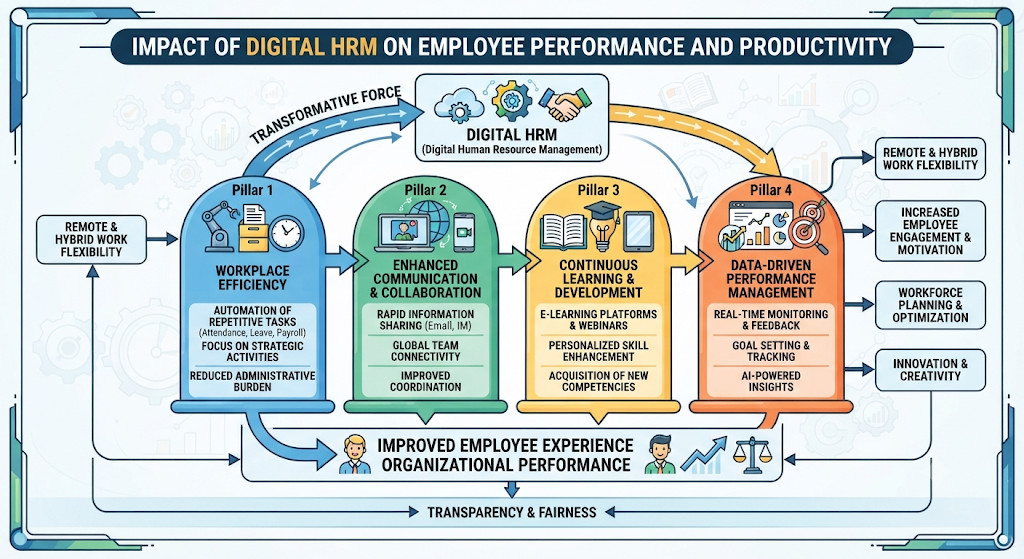
Digital communication tools have substantially improved employee performance by facilitating rapid and efficient communication. Technologies such as email, instant messaging platforms, video conferencing applications, collaborative software, and enterprise social networks enable employees to communicate and collaborate regardless of geographical location. Effective communication reduces misunderstandings, accelerates decision-making, and improves coordination among team members.
The emergence of remote and hybrid work models has further highlighted the importance of digital HRM in maintaining employee productivity. Digital platforms enable employees to perform tasks from various locations while remaining connected with colleagues and supervisors. Cloud-based systems provide employees with access to organizational resources, documents, and applications anytime and anywhere. Such flexibility enhances work continuity and contributes to improved performance.
Digital HRM also supports continuous performance management. Traditional annual performance appraisal systems often provided delayed and limited feedback. Contemporary digital performance management systems facilitate real-time monitoring, continuous feedback, goal setting, and progress tracking. Employees receive timely information regarding their performance, enabling them to identify strengths, address weaknesses, and improve continuously.
Continuous feedback mechanisms positively influence employee motivation and performance. Employees who receive regular feedback develop greater clarity regarding expectations and organizational goals. Constructive feedback encourages self-improvement, enhances accountability, and strengthens employee commitment. Digital platforms also enable managers to recognize employee achievements promptly, thereby increasing morale and motivation.
Learning and development represent another important area where Digital HRM significantly affects employee performance. Organizations increasingly use Learning Management Systems (LMS), online training programmes, webinars, virtual simulations, mobile learning applications, and digital knowledge repositories to facilitate employee development. Digital learning platforms provide flexible, personalized, and accessible learning opportunities that support continuous skill enhancement.
Continuous learning is essential in today's rapidly changing business environment. Technological advancements, market dynamics, and evolving job requirements necessitate ongoing skill development. Digital learning platforms allow employees to acquire new competencies, update existing skills, and remain relevant in their professional roles. Improved competencies directly contribute to enhanced job performance and productivity.
Artificial intelligence and analytics further strengthen employee performance management. AI-driven systems can analyze employee performance data, identify skill gaps, recommend personalized training programmes, and predict future performance trends. Such data-driven insights support evidence-based decision-making and enable organizations to implement targeted developmental interventions.
Digital HRM also promotes employee engagement, which is closely associated with performance and productivity. Employee engagement refers to the emotional and psychological commitment employees demonstrate toward their organization and work. Engaged employees exhibit higher levels of enthusiasm, dedication, and discretionary effort. Digital platforms facilitate employee engagement through communication channels, recognition systems, feedback mechanisms, surveys, and collaborative activities.
Employee self-service systems represent another important feature of Digital HRM that contributes to improved productivity. Through self-service portals, employees can independently access personal information, update records, apply for leave, register for training programmes, and obtain organizational information. Such autonomy reduces dependency on HR personnel, minimizes delays, and enhances employee satisfaction.
Digital HRM also supports effective workforce planning and resource allocation. HR analytics provides valuable insights regarding workforce capabilities, employee availability, performance patterns, and organizational requirements. Managers can utilize these insights to allocate tasks appropriately, optimize workforce utilization, and ensure that employees are assigned roles aligned with their competencies.
The use of digital collaboration tools has transformed teamwork within organizations. Collaborative technologies facilitate information sharing, joint problem-solving, project coordination, and knowledge exchange among employees. Effective collaboration promotes innovation, creativity, and collective performance. Employees working in collaborative environments often demonstrate higher productivity and improved problem-solving capabilities.
Furthermore, digital technologies encourage innovation and creativity among employees. Access to diverse information sources, collaborative platforms, and digital resources stimulates idea generation and experimentation. Employees can explore innovative approaches, share knowledge, and contribute creative solutions to organizational challenges. Innovation significantly enhances organizational competitiveness and long-term sustainability.
Digital HRM also enhances transparency and fairness in organizational processes. Automated systems reduce biases and subjectivity in recruitment, performance appraisal, promotion, and reward management. Employees perceive transparent systems as fair and trustworthy, which positively influences motivation, job satisfaction, and organizational commitment.
Role of Digital Transformation in Organizational Sustainability#
Digital transformation has emerged as a crucial factor in ensuring organizational sustainability in the contemporary corporate world. Organizational sustainability refers to the ability of an organization to achieve long-term economic success while simultaneously maintaining social responsibility, environmental protection, employee well-being, and continuous innovation. In an increasingly competitive and technology-driven business environment, organizations must adapt to rapid changes in markets, customer expectations, technological advancements, and global challenges. Digital transformation provides organizations with the capability to remain resilient, efficient, innovative, and sustainable over time.
Digital transformation refers to the integration of digital technologies into all aspects of organizational operations, strategies, and decision-making processes. Technologies such as artificial intelligence (AI), cloud computing, big data analytics, the Internet of Things (IoT), blockchain, automation, machine learning, and digital communication platforms have fundamentally changed the way organizations function. These technologies enable organizations to optimize resources, improve efficiency, reduce costs, and strengthen sustainability practices.
One of the primary contributions of digital transformation to organizational sustainability is enhanced operational efficiency. Traditional organizational processes often involve manual procedures, redundant tasks, excessive paperwork, and inefficient resource utilization. Digital technologies automate routine operations, streamline workflows, and minimize operational delays. Automation reduces human errors, increases accuracy, and enhances productivity, thereby contributing to long-term organizational effectiveness.
Cost reduction represents another important aspect of organizational sustainability facilitated by digital transformation. Digital systems reduce administrative expenses associated with paperwork, storage, printing, physical meetings, and manual processing. Cloud-based technologies minimize infrastructure costs, while automation decreases labour-intensive activities. Cost savings generated through digital transformation can be reinvested in innovation, employee development, and strategic initiatives, thereby strengthening organizational sustainability.
Digital transformation also promotes environmental sustainability. Organizations are increasingly adopting paperless operations, digital documentation, electronic communication systems, and virtual collaboration platforms. Such practices significantly reduce paper consumption, energy usage, transportation requirements, and carbon emissions. Remote and hybrid work arrangements supported by digital technologies further reduce environmental impacts associated with commuting and office operations.
Resource optimization is another critical contribution of digital transformation to sustainability. Advanced analytics and digital monitoring systems enable organizations to track resource consumption, identify inefficiencies, and optimize utilization. Organizations can monitor energy usage, inventory levels, production processes, and supply chain operations in real time. Efficient resource management reduces waste and supports sustainable business practices.
Innovation constitutes a fundamental pillar of organizational sustainability. Digital transformation encourages continuous innovation by providing access to advanced technologies, information resources, and collaborative platforms. Organizations can develop innovative products, services, business models, and customer experiences using digital technologies. Innovation enhances competitiveness, supports market expansion, and ensures long-term organizational survival.
Data-driven decision-making significantly strengthens organizational sustainability. Traditional decision-making processes often relied heavily on intuition and limited information. Digital transformation enables organizations to collect, analyze, and interpret vast amounts of data from multiple sources. Big data analytics provides valuable insights regarding customer preferences, employee behaviour, market trends, operational performance, and potential risks. Evidence-based decision-making improves organizational agility and strategic effectiveness.
Digital transformation also enhances organizational adaptability and resilience. Modern business environments are characterized by uncertainty, rapid change, and unexpected disruptions such as economic crises, pandemics, and technological shifts. Organizations possessing strong digital capabilities can respond more effectively to such challenges. The COVID-19 pandemic demonstrated that digitally transformed organizations were better able to maintain operations through remote work, digital communication, and online service delivery.
Human resource sustainability is another important dimension supported by digital transformation. Digital technologies facilitate flexible work arrangements, continuous learning, employee engagement, and talent management. Remote and hybrid work models supported by digital infrastructure provide employees with greater flexibility and work-life balance. Employee well-being and satisfaction contribute significantly to long-term organizational sustainability.
Continuous learning and skill development are essential for sustaining organizational competitiveness. Digital learning platforms enable employees to acquire new competencies, adapt to technological changes, and enhance professional capabilities. Organizations that invest in employee development create a highly skilled and adaptable workforce capable of supporting sustainable growth.
Digital transformation further strengthens stakeholder relationships. Organizations increasingly use digital communication channels to engage employees, customers, suppliers, investors, and communities. Enhanced communication improves transparency, trust, and collaboration among stakeholders. Strong stakeholder relationships contribute positively to organizational reputation and sustainability.
Customer sustainability has become increasingly important in the digital era. Digital technologies enable organizations to understand customer needs more effectively and provide personalized experiences. Customer relationship management systems, data analytics, and digital platforms facilitate improved customer service and satisfaction. Satisfied customers contribute to organizational loyalty, market growth, and long-term profitability.
Supply chain sustainability is also enhanced through digital transformation. Technologies such as blockchain, IoT, and advanced analytics improve supply chain visibility, traceability, and efficiency. Organizations can monitor supply chain activities in real time, identify potential disruptions, and ensure responsible sourcing practices. Sustainable supply chain management reduces risks and promotes ethical business operations.
Corporate social responsibility (CSR) initiatives increasingly benefit from digital transformation. Organizations can utilize digital platforms to implement social programmes, communicate sustainability initiatives, monitor social impact, and engage with communities. Digital technologies improve accountability and transparency in CSR activities, thereby strengthening organizational legitimacy.
Despite its numerous benefits, digital transformation also presents several challenges to organizational sustainability. One significant challenge is the substantial financial investment required for technological implementation. Acquiring advanced technologies, upgrading infrastructure, and maintaining digital systems often involve considerable costs. Small and medium-sized enterprises may face particular difficulties in financing digital transformation initiatives.
Cybersecurity risks constitute another major concern. Increased reliance on digital technologies exposes organizations to cyberattacks, data breaches, ransomware, and other security threats. Organizations must invest in robust cybersecurity measures, employee awareness programmes, and risk management strategies to protect sensitive information and maintain stakeholder trust.
Resistance to change among employees may hinder successful digital transformation. Employees may fear job displacement, experience technological anxiety, or resist modifications to established work practices. Effective change management, communication, training, and employee involvement are necessary for overcoming resistance and ensuring successful implementation.
Ethical concerns associated with digital transformation also require careful consideration. Issues related to employee surveillance, data privacy, algorithmic bias, and responsible use of artificial intelligence may affect organizational sustainability. Organizations must establish ethical guidelines and governance frameworks to ensure responsible technology adoption.
Leadership plays a crucial role in driving sustainable digital transformation. Organizational leaders must develop clear digital strategies, allocate adequate resources, promote innovation, and foster a culture supportive of technological change. Strategic leadership ensures that digital initiatives align with organizational goals and sustainability objectives.
Challenges and Strategies for Effective Digital HR Transformation#
Digital HR transformation offers many benefits, but its successful implementation is not free from challenges. In the corporate world, organizations adopt digital tools such as HR information systems, artificial intelligence, cloud platforms, digital recruitment systems, online training portals, performance management software, and HR analytics. These tools can improve speed, accuracy, transparency, and productivity. However, if digital transformation is not properly planned and managed, it may create confusion, resistance, stress, and inefficiency among employees.
One major challenge is resistance to change. Employees and managers who are comfortable with traditional HR practices may hesitate to adopt digital systems. They may feel that new technologies are difficult to use or may increase their workload. Some employees may also fear that automation and artificial intelligence will replace human jobs. This fear can reduce cooperation and create negative attitudes toward digital HR transformation.
Another important challenge is lack of digital skills. Not all employees have the same level of technological knowledge. Some may be highly comfortable with digital platforms, while others may struggle with HR software, online training systems, digital attendance, virtual communication, or self-service portals. If employees do not receive proper training, digital HR systems may not be used effectively.
Data privacy and cybersecurity are also serious concerns. HR departments handle sensitive information such as employee records, salary details, performance reports, health data, identity documents, and personal contact information. If digital systems are not secure, this data may be misused or exposed through cyberattacks. Therefore, organizations must ensure strong data protection and ethical handling of employee information.
High implementation cost is another challenge. Digital HR transformation requires investment in software, hardware, cybersecurity, employee training, system maintenance, and technical support. Small and medium-sized organizations may find it difficult to afford advanced HR technologies. Therefore, cost-effective and need-based digital solutions should be selected.
Technostress is also an emerging issue. Employees may feel pressure due to continuous digital monitoring, frequent software updates, online meetings, digital reporting, and constant connectivity. This can affect mental well-being and work-life balance. Digital transformation should therefore be human-centered and should not create unnecessary stress.
To make digital HR transformation effective, organizations should first develop a clear digital strategy. They should identify HR needs, select suitable technologies, set realistic goals, and align digital tools with organizational objectives. Technology should not be adopted only for fashion; it should solve real HR problems and improve employee experience.
Training and capacity building are essential. Employees and managers should receive regular training on how to use digital HR systems. Training should be simple, practical, and continuous. Digital literacy programmes can reduce fear and increase confidence among employees.
Change management is also necessary. Leaders should communicate the purpose, benefits, and process of digital transformation clearly. Employees should be involved in planning and feedback. When employees understand that technology is meant to support them rather than replace them, they are more likely to accept change.
Organizations should also ensure data security and privacy protection. Strong passwords, secure servers, data encryption, access control, cybersecurity audits, and privacy policies should be implemented. Employees should be educated about safe digital practices and responsible use of HR platforms.
A phased implementation approach can also be useful. Instead of introducing all digital tools at once, organizations may begin with one or two HR functions such as payroll, attendance, recruitment, or training. Gradual implementation helps employees adjust and reduces confusion.
Digital HR transformation should also be employee-friendly. Systems should be easy to use, accessible, and supportive. Employee self-service portals, mobile applications, chatbots, and online helpdesks should be designed in a simple manner. User experience is important for successful adoption.
Leadership support is very important. Senior management and HR leaders must actively support digital transformation by providing resources, motivation, guidance, and monitoring. Without leadership commitment, digital HR initiatives may remain incomplete.
Conclusion#
The study concludes that digital transformation has a significant impact on human resource management practices, employee performance, and organizational sustainability in the corporate world. Digital technologies such as HR information systems, artificial intelligence, cloud computing, automation, HR analytics, e-recruitment platforms, digital learning systems, and performance management software have transformed traditional HR functions into faster, more transparent, and data-driven processes. Digital HRM improves recruitment, onboarding, training, attendance, payroll, employee engagement, performance appraisal, and talent management. It also enhances employee performance by improving communication, feedback, skill development, productivity, collaboration, and workplace flexibility. Through digital tools, employees can work more efficiently and organizations can make better decisions. The study also highlights that digital transformation supports organizational sustainability by reducing paperwork, saving time and cost, improving resource use, supporting remote work, encouraging innovation, and strengthening long-term competitiveness. However, challenges such as employee resistance, digital skill gaps, cybersecurity risks, data privacy concerns, technostress, and high implementation costs must be carefully managed. The digital transformation can create a more efficient, flexible, innovative, and sustainable corporate environment when supported by proper training, ethical policies, employee participation, secure systems, and strong leadership.
Works Cited#
- Armstrong, Michael. Armstrong’s Handbook of Human Resource Management Practice. 15th ed., Kogan Page, 2020.
- Bondarouk, Tanya, and Huub Ruël. “Electronic Human Resource Management: Challenges in the Digital Era.” International Journal of Human Resource Management, vol. 24, no. 21, 2013, pp. 3915–3917.
- Boudreau, John W., and Peter M. Ramstad. Beyond HR: The New Science of Human Capital. Harvard Business School Press, 2007.
- Cascio, Wayne F., and John W. Boudreau. Investing in People: Financial Impact of Human Resource Initiatives. 2nd ed., Pearson, 2011.
- Deloitte. Global Human Capital Trends 2023. Deloitte Insights, 2023.
- Dessler, Gary. Human Resource Management. 16th ed., Pearson, 2020.
- Ehnert, Ina. Sustainable Human Resource Management. Springer, 2009.
- Fenech, Roberta, Peter Baguant, and David Ivanov. “The Changing Role of Human Resource Management in an Era of Digital Transformation.” Journal of Management Information and Decision Sciences, vol. 22, no. 2, 2019, pp. 166–175.
- Gartner. HR Technology Strategy and Management. Gartner Research, 2022.
- Guest, David E. “Human Resource Management and Employee Well-Being.” Human Resource Management Journal, vol. 27, no. 1, 2017, pp. 22–38.
- Kavanagh, Michael J., and Richard D. Johnson, editors. Human Resource Information Systems: Basics, Applications, and Future Directions. 4th ed., SAGE Publications, 2018.
- Marler, Janet H., and Sandra L. Fisher. “An Evidence-Based Review of e-HRM and Strategic Human Resource Management.” Human Resource Management Review, vol. 23, no. 1, 2013, pp. 18–36.
- Noe, Raymond A., et al. Human Resource Management: Gaining a Competitive Advantage. 12th ed., McGraw-Hill Education, 2021.
- Parry, Emma, and Shaun Tyson. “Desired Goals and Actual Outcomes of e-HRM.” Human Resource Management Journal, vol. 21, no. 3, 2011, pp. 335–354.
- Schuler, Randall S., and Susan E. Jackson. “Human Resource Management and Organizational Effectiveness.” Academy of Management Journal, vol. 37, no. 5, 1994, pp. 1416–1426.
- Strohmeier, Stefan. “Research in e-HRM: Review and Implications.” Human Resource Management Review, vol. 17, no. 1, 2007, pp. 19–37.
- Stone, Dianna L., and James H. Dulebohn. “Emerging Issues in Theory and Research on Electronic Human Resource Management.” Human Resource Management Review, vol. 23, no. 1, 2013, pp. 1–5.
- Ulrich, Dave. Human Resource Champions. Harvard Business School Press, 1997.
- Vial, Gregory. “Understanding Digital Transformation.” Journal of Strategic Information Systems, vol. 28, no. 2, 2019, pp. 118–144.
- World Economic Forum. The Future of Jobs Report 2023. World Economic Forum, 2023.
"Role of Social Entrepreneurship in Addressing Community Challenges and Promoting Sustainable