Abstract
The present examines the awareness, perception, preference, and behaviour of consumers regarding eco-friendly products and sustainable lifestyle practices. Green products are goods that are designed, produced, packaged, and consumed with minimum harm to the environment. Sustainable consumption refers to the responsible use of goods and services in a way that reduces waste, saves resources, and protects the needs of future generations. Environmentally responsible behaviour includes actions such as recycling, saving electricity and water, avoiding plastic, using public transport, purchasing eco-friendly products, and supporting environmental protection.
- Green Products
- Sustainable Consumption
- Environmentally Responsible Behaviour
- Consumer Attitudes
- Green Marketing
- Environmental Awareness
- Eco-friendly Products
- Sustainable Lifestyle
- Consumer Behaviour
- Environmental Sustainability
Introduction#
In recent decades, environmental degradation, climate change, global warming, pollution, deforestation, and depletion of natural resources have emerged as major global concerns. Rapid industrialization, urbanization, population growth, and excessive consumption have placed significant pressure on the environment. As a result, there is increasing awareness among governments, industries, researchers, and consumers regarding the need for sustainable development and responsible consumption practices. In this context, green products, sustainable consumption, and environmentally responsible behaviour have gained considerable importance.
Green products are products that are designed, manufactured, packaged, distributed, and disposed of in ways that minimize negative environmental impacts. These products are generally energy-efficient, recyclable, biodegradable, non-toxic, and environmentally friendly. Examples include organic foods, reusable bags, energy-saving appliances, eco-friendly packaging, biodegradable household products, electric vehicles, and products made from recycled materials. The growing demand for such products reflects changing consumer preferences toward environmental sustainability.
Consumer attitude plays a crucial role in determining purchasing behaviour. Consumer attitude refers to the beliefs, feelings, perceptions, and predispositions of individuals toward products, services, or issues. Positive attitudes toward green products may encourage consumers to choose environmentally friendly alternatives over conventional products. However, consumer decisions are influenced by various factors such as price, quality, brand image, environmental concern, social influence, availability, and personal values.
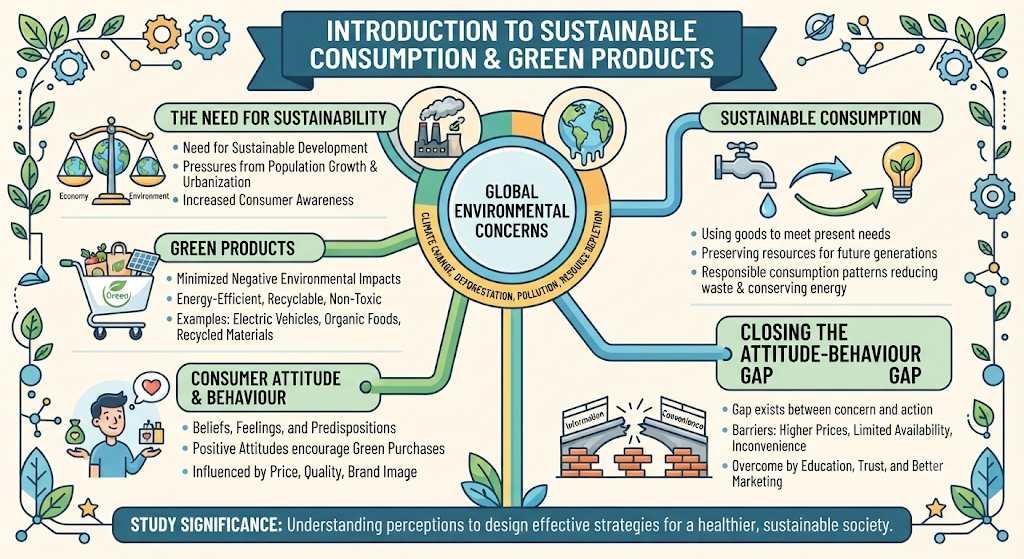
Sustainable consumption refers to the use of goods and services in a manner that meets present needs while minimizing environmental impacts and preserving resources for future generations. It involves conscious and responsible consumption patterns that reduce waste, conserve energy, promote recycling, and support sustainable production systems. Sustainable consumption encourages individuals to think beyond immediate personal benefits and consider the long-term environmental and social consequences of their consumption behaviour.
Environmentally responsible behaviour includes actions undertaken by individuals to protect and preserve the environment. Such behaviour may include recycling waste, conserving water and electricity, reducing plastic usage, purchasing eco-friendly products, using public transportation, supporting environmental campaigns, and adopting sustainable lifestyles. Environmentally responsible consumers actively contribute to environmental protection through their everyday decisions and actions.
Despite increasing environmental awareness, a significant gap often exists between consumer attitudes and actual purchasing behaviour. Many consumers express concern for environmental issues and support sustainable practices; however, they may not consistently purchase green products or adopt environmentally responsible behaviour. Factors such as higher prices of green products, limited availability, lack of information, scepticism regarding environmental claims, and convenience considerations may prevent consumers from translating positive attitudes into actual behaviour.
The comparative analysis of consumer attitudes toward green products and sustainable consumption is important because consumers differ significantly based on demographic and socio-economic characteristics such as age, gender, education, income, occupation, and place of residence. Younger consumers may exhibit greater environmental awareness, while highly educated individuals may demonstrate stronger sustainable consumption practices. Similarly, income levels may influence consumers' ability to purchase green products, particularly when such products are relatively expensive.
In recent years, businesses have increasingly adopted green marketing strategies to respond to changing consumer preferences. Organizations promote eco-labels, sustainable packaging, carbon-neutral production, and environmentally friendly manufacturing processes to attract environmentally conscious consumers. However, the success of these strategies largely depends on consumers' attitudes, trust, and willingness to support sustainable products.
Governments and environmental organizations also play an important role in promoting sustainable consumption by implementing environmental regulations, awareness campaigns, eco-certification programmes, and policies encouraging green production and consumption. Educational institutions and media further contribute to enhancing environmental awareness and shaping responsible consumer behaviour. The present study is significant because it seeks to understand how consumers perceive and respond to environmental issues in their purchasing and consumption decisions. The study aims to compare attitudes and behaviours among different consumer groups and identify factors influencing sustainable consumption practices. The findings of the study may provide valuable insights for marketers, policymakers, environmental organizations, and researchers in designing effective strategies for promoting green products and encouraging sustainable consumer behaviour. Ultimately, fostering environmentally responsible behaviour among consumers can contribute significantly to environmental conservation, sustainable development, and the creation of a healthier and more sustainable society.
Consumer Attitudes towards Green Products#
Consumer attitude toward green products refers to the beliefs, feelings, and preferences of consumers regarding eco-friendly goods and services. Green products are those products that cause less harm to the environment during production, use, and disposal. These may include organic food, biodegradable packaging, recycled products, energy-saving appliances, herbal cosmetics, reusable bags, electric vehicles, and eco-friendly cleaning products. In the present age of environmental awareness, many consumers are becoming more conscious about the impact of their purchasing decisions on nature and society. A positive attitude toward green products is generally developed when consumers understand the importance of environmental protection. Consumers who are aware of pollution, climate change, plastic waste, and resource depletion are more likely to support green products. They may prefer products that are recyclable, energy-efficient, chemical-free, cruelty-free, or made through sustainable methods. Such consumers often believe that their individual choices can contribute to environmental conservation. However, consumer attitude does not always result in actual purchase behaviour. Many consumers may express support for green products but may not buy them regularly. This may happen due to high price, limited availability, lack of trust in green claims, low awareness, or doubts about product quality. Some consumers also feel that green products are less effective than conventional products. Therefore, attitude alone is not enough; affordability, accessibility, and credibility are also important.
Green marketing plays an important role in shaping consumer attitudes. When companies provide clear information about environmental benefits, eco-labels, recyclable packaging, and sustainable production, consumers may develop trust in green products. However, false or exaggerated claims, also known as greenwashing, may create doubt among consumers. Therefore, honest communication is necessary for building positive consumer attitudes. Demographic factors also influence attitudes toward green products. Educated consumers may have better awareness of environmental issues. Young consumers may be more influenced by social media and sustainability campaigns. Higher-income consumers may be more willing to pay extra for eco-friendly products. Urban consumers may have greater exposure to green brands, while rural consumers may follow traditional sustainable practices.
Thus, consumer attitudes toward green products are shaped by awareness, values, income, education, availability, price, trust, and marketing communication. A positive attitude toward green products is necessary for promoting sustainable consumption, but it must be supported by practical conditions that make green products affordable, reliable, and easily available.
Sustainable Consumption Practices among Consumers#
Sustainable consumption means using goods and services in a responsible manner so that present needs are fulfilled without harming the environment or reducing resources for future generations. It is not limited to buying green products only; it includes the overall lifestyle and consumption pattern of individuals. Sustainable consumption involves reducing waste, saving energy, conserving water, avoiding unnecessary purchases, reusing products, recycling materials, and choosing environmentally friendly alternatives.
In modern society, consumerism has increased rapidly. People often purchase more products than they actually need due to advertisements, fashion trends, social pressure, and convenience. This excessive consumption creates environmental problems such as waste generation, pollution, carbon emissions, and overuse of natural resources. Sustainable consumption encourages consumers to think carefully before buying and to consider the environmental impact of their choices.
Consumers can practice sustainable consumption in many ways. They can use cloth bags instead of plastic bags, buy products with less packaging, choose energy-efficient appliances, reduce food waste, use public transport, avoid single-use plastics, repair products instead of replacing them, and support local products. These small actions can collectively reduce environmental pressure and promote responsible living.
Sustainable consumption is influenced by consumer awareness and personal values. Consumers who understand environmental problems are more likely to adopt sustainable habits. Education, media campaigns, family values, community practices, and government policies can also encourage sustainable consumption. For example, awareness about plastic pollution may motivate consumers to use reusable bags and bottles.
However, sustainable consumption faces several challenges. Many consumers find green and sustainable products costly. Some may not have access to sustainable alternatives in local markets. Others may not have sufficient information about which products are truly sustainable. Convenience is another major factor; consumers may choose less sustainable options because they are easier, cheaper, or more familiar. Businesses and governments have an important role in promoting sustainable consumption. Companies should produce affordable and quality green products, reduce packaging waste, and provide accurate information. Governments can promote sustainable practices through policies, awareness programmes, incentives, recycling systems, and strict environmental regulations.
Thus, sustainable consumption is a necessary step toward environmental protection and sustainable development. It requires responsible consumer behaviour, supportive market systems, and strong public awareness. Consumers must understand that every purchase decision has environmental consequences, and responsible choices can contribute to a healthier future.
Environmentally Responsible Behaviour and Consumer Lifestyle#
Environmentally responsible behaviour refers to actions taken by individuals to protect the environment and reduce harm to nature. It includes both purchasing behaviour and daily lifestyle practices. Consumers who behave responsibly toward the environment try to reduce waste, conserve resources, prevent pollution, and support sustainable products and services. Such behaviour reflects environmental concern, moral responsibility, and awareness of ecological problems.
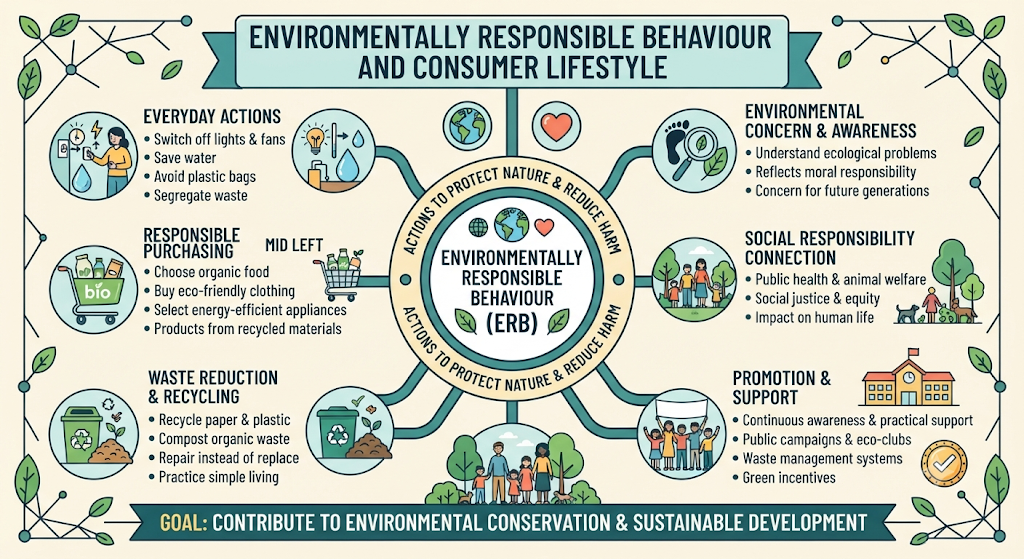
Environmentally responsible behaviour may be seen in everyday actions. For example, switching off lights and fans when not needed, saving water, segregating waste, recycling paper and plastic, using public transport, planting trees, avoiding plastic bags, and purchasing eco-friendly products are common responsible behaviours. These actions may appear small, but when practiced by many people, they can create a significant environmental impact. Consumer lifestyle has a strong connection with environmentally responsible behaviour. People who adopt a sustainable lifestyle usually prefer simple living, responsible buying, reuse of products, and minimum wastage. They are more conscious about how their consumption affects the environment. They may choose organic food, natural products, eco-friendly clothing, energy-efficient appliances, and products made from recycled materials.
Environmental responsibility is also connected with social responsibility. Consumers who care about the environment often care about future generations, public health, animal welfare, and social justice. They understand that pollution, waste, and climate change affect not only nature but also human life. Therefore, environmentally responsible behaviour supports both ecological and social well-being.
However, responsible behaviour is not always easy to practice. Many consumers may know what is good for the environment but may fail to follow it regularly. Lack of time, lack of facilities, low motivation, social habits, and inconvenience may reduce responsible behaviour. For example, a person may want to recycle waste but may not find proper recycling facilities nearby.
To promote environmentally responsible behaviour, continuous awareness and practical support are needed. Schools, colleges, media, NGOs, government agencies, and businesses should encourage sustainable habits. Public campaigns, eco-clubs, cleanliness drives, waste management systems, and green incentives can help people adopt responsible behaviour. The environmentally responsible behaviour is an essential part of sustainable living. It reflects the willingness of consumers to protect nature through daily choices and actions. When consumers combine positive attitudes with responsible lifestyle practices, they contribute to environmental conservation and sustainable development.
Comparative Factors Influencing Green Attitudes and Behaviour#
Consumer attitudes toward green products, sustainable consumption, and environmentally responsible behaviour are not the same among all individuals. They differ according to demographic, social, economic, psychological, and cultural factors. A comparative analysis helps in understanding how different groups of consumers think and behave regarding environmental issues.
Education is one of the most important factors influencing green attitudes. Educated consumers are generally more aware of environmental problems such as climate change, pollution, deforestation, and waste management. They may better understand eco-labels, sustainable claims, and long-term environmental consequences. Therefore, higher education often leads to stronger environmental concern and responsible behaviour.
Age also influences consumer behaviour. Young consumers may be more exposed to environmental campaigns, social media discussions, and global sustainability movements. They may show greater interest in green products and climate-related issues. Older consumers, however, may practice sustainability through traditional habits such as reuse, repair, saving resources, and avoiding waste.
Income plays an important role in green purchasing behaviour. Many green products are more expensive than conventional products. Therefore, high-income consumers may be more willing and able to buy eco-friendly products. Low-income consumers may support environmental protection but may choose cheaper products due to financial limitations. This creates a gap between environmental attitude and actual buying behaviour.
Gender may also affect green attitudes. In many studies, women are found to be more concerned about health, family welfare, and environmental safety. They may prefer organic food, natural household products, and eco-friendly lifestyle practices. However, men and women both can show responsible behaviour depending on awareness, education, and values.
Place of residence also matters. Urban consumers may have greater access to green brands, supermarkets, digital information, and eco-friendly products. Rural consumers may have limited access to branded green products but may naturally follow sustainable practices such as reuse, organic farming, and resource conservation. Therefore, sustainable behaviour may appear differently in urban and rural contexts. Social influence, media exposure, family values, peer groups, and cultural beliefs also shape consumer attitudes. Consumers may adopt green behaviour when they see others doing the same. Advertisements, environmental campaigns, celebrity endorsements, and government initiatives can also influence attitudes and behaviour. Thus, comparative factors help explain why some consumers are more positive toward green products and sustainable consumption than others. Understanding these differences is important for businesses, policymakers, and environmental organizations. Strategies for promoting green behaviour should be designed according to consumer groups, their needs, barriers, and motivations.
Conclusion#
The study concludes that consumer attitudes toward green products, sustainable consumption, and environmentally responsible behaviour are closely interconnected and play an important role in promoting environmental sustainability. Increasing environmental awareness has encouraged many consumers to prefer eco-friendly products and adopt sustainable lifestyle practices. Consumers who possess greater concern for environmental issues generally demonstrate more positive attitudes toward green products and are more likely to engage in environmentally responsible behaviour.
The study also reveals that sustainable consumption is influenced by several demographic, economic, psychological, and social factors. Variables such as education, income, age, gender, environmental knowledge, social influence, and product availability significantly affect consumers' decisions regarding green purchasing and sustainable practices. Although many consumers express positive attitudes toward environmental protection, a gap often exists between environmental concern and actual purchasing behaviour due to factors such as high product prices, limited accessibility, lack of information, and doubts regarding environmental claims.
Furthermore, environmentally responsible behaviour extends beyond purchasing decisions and includes daily practices such as recycling, conserving energy, reducing waste, and adopting sustainable lifestyles. Such behaviour contributes significantly to environmental conservation and sustainable development.
The study highlights the need for stronger environmental education, effective green marketing strategies, transparent eco-labelling, and supportive government policies to encourage sustainable consumption. Businesses should focus on producing affordable, high-quality, and genuinely eco-friendly products, while policymakers and educational institutions should continue to promote environmental awareness among consumers. The fostering positive consumer attitudes and encouraging sustainable consumption practices can significantly contribute to environmental protection, resource conservation, and the achievement of sustainable development goals.
Works Cited#
- Ajzen, Icek. “The Theory of Planned Behavior.” Organizational Behavior and Human Decision Processes, vol. 50, no. 2, 1991, pp. 179–211.
- Belz, Frank-Martin, and Ken Peattie. Sustainability Marketing: A Global Perspective. 3rd ed., Wiley, 2021.
- Chan, Ricky Y. K. “Determinants of Chinese Consumers' Green Purchase Behavior.” Psychology & Marketing, vol. 18, no. 4, 2001, pp. 389–413.
- Chen, Yu-Shan. “The Drivers of Green Brand Equity: Green Brand Image, Green Satisfaction, and Green Trust.” Journal of Business Ethics, vol. 93, no. 2, 2010, pp. 307–319.
- Dangelico, Rosa Maria, and Devashish Pujari. “Mainstreaming Green Product Innovation: Why and How Companies Integrate Environmental Sustainability.” Journal of Business Ethics, vol. 95, no. 3, 2010, pp. 471–486.
- Elkington, John. Cannibals with Forks: The Triple Bottom Line of 21st Century Business. Capstone Publishing, 1997.
- Fisk, George. “Criteria for a Theory of Responsible Consumption.” Journal of Marketing, vol. 37, no. 2, 1973, pp. 24–31.
- Goleman, Daniel. Ecological Intelligence: How Knowing the Hidden Impacts of What We Buy Can Change Everything. Broadway Books, 2009.
- Joshi, Yatish, and Zillur Rahman. “Factors Affecting Green Purchase Behaviour and Future Research Directions.” International Strategic Management Review, vol. 3, no. 1–2, 2015, pp. 128–143.
- Kotler, Philip, and Gary Armstrong. Principles of Marketing. 18th ed., Pearson, 2020.
- Kumar, Prakash. “State of Green Marketing Research over 25 Years (1990–2014): Literature Survey and Classification.” Marketing Intelligence & Planning, vol. 34, no. 1, 2016, pp. 137–158.
- Leonidou, Constantinos N., and Constantine S. Katsikeas. “The Role of Environmental Uncertainty in Green Marketing Strategy.” Journal of Marketing Management, vol. 26, no. 13–14, 2010, pp. 1317–1339.
- Ottman, Jacquelyn A. The New Rules of Green Marketing. Berrett-Koehler Publishers, 2011.
- Peattie, Ken. Environmental Marketing Management: Meeting the Green Challenge. Financial Times Management, 1995.
- Peattie, Ken, and Andrew Crane. “Green Marketing: Legend, Myth, Farce or Prophesy?” Qualitative Market Research, vol. 8, no. 4, 2005, pp. 357–370.
- Roberts, James A. “Green Consumers in the 1990s: Profile and Implications for Advertising.” Journal of Business Research, vol. 36, no. 3, 1996, pp. 217–231.
- Stern, Paul C. “Toward a Coherent Theory of Environmentally Significant Behavior.” Journal of Social Issues, vol. 56, no. 3, 2000, pp. 407–424.
- Tanner, Carmen, and Sybille Wolfing Kast. “Promoting Sustainable Consumption: Determinants of Green Purchases by Swiss Consumers.” Psychology & Marketing, vol. 20, no. 10, 2003, pp. 883–902.
- United Nations Environment Programme. Sustainable Consumption and Production: A Handbook for Policymakers. UNEP, 2015.
- Vermeir, Iris, and Wim Verbeke. “Sustainable Food Consumption among Young Adults in Belgium.” Ecological Economics, vol. 64, no. 3, 2008, pp. 542–553.
"Impact of Migration and Urbanization on Family Structure, Social Relationships, and Community Cohesion