Abstract
The present study titled “Impact of Digital Financial Services on Financial Inclusion, Economic Empowerment, and Social Development among Marginalized Populations in Punjab” examines the role of digital financial services in improving access to financial facilities among socially and economically disadvantaged groups. Digital financial services include mobile banking, internet banking, Unified Payments Interface, digital wallets, Aadhaar-enabled payment systems, direct benefit transfer, online savings, digital credit, and insurance-related services. These services have created new opportunities for marginalized populations by reducing dependence on physical bank branches and making financial transactions faster, safer, and more convenient.
- Digital Financial Services
- Financial Inclusion
- Economic Empowerment
- Social Development
- Marginalized Populations
- Punjab
- Digital Banking
- UPI
- Financial Literacy
- Rural Development
Introduction#
Financial inclusion is an important requirement for inclusive economic growth and social development. It means providing affordable, accessible, and useful financial services to all sections of society, especially those who remain outside the formal financial system. These services include bank accounts, savings, loans, insurance, pension, remittance facilities, digital payments, and access to government welfare schemes. Financial inclusion becomes more important for marginalized populations because they often face poverty, low income, lack of assets, limited education, social discrimination, and poor access to formal institutions.
In the modern era, digital financial services have emerged as a powerful tool for expanding financial inclusion. Digital financial services refer to the use of digital technology for financial transactions and services. These include mobile banking, internet banking, digital wallets, Unified Payments Interface, Aadhaar-enabled payment systems, micro-ATMs, direct benefit transfer, digital credit, online insurance, and other technology-based financial services. These services reduce the need to visit physical bank branches and allow people to make payments, receive money, save, borrow, and access welfare benefits through digital platforms.
Punjab is one of the economically important states of India, but development is not equally distributed among all social groups. Marginalized populations such as women, scheduled castes, landless agricultural labourers, small and marginal farmers, migrant workers, elderly persons, and low-income households still face many financial and social challenges. Many of them depend on cash transactions, informal borrowing, moneylenders, and irregular income sources. Limited access to banks, lack of financial awareness, and social barriers further restrict their economic progress.
Digital financial services can help these groups by providing direct and transparent access to financial facilities. Through digital platforms, beneficiaries can receive government subsidies, wages, pensions, scholarships, and welfare payments directly into their bank accounts. Digital payments also reduce transaction costs, save time, and increase transparency. Small vendors, self-help groups, women entrepreneurs, farmers, and labourers can use digital services for business transactions, savings, credit access, and income management.
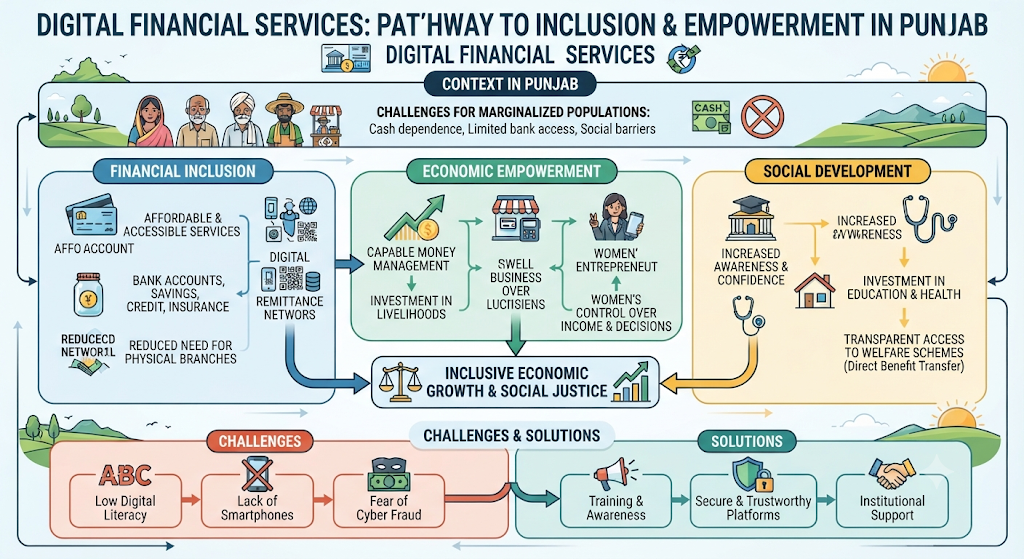
Economic empowerment is closely connected with financial inclusion. When marginalized people gain access to formal financial services, they become more capable of managing money, investing in livelihood activities, starting small enterprises, reducing debt dependency, and improving household security. Women’s access to digital financial services can increase their control over income and decision-making within the family. Similarly, small farmers and labourers can benefit from digital payments, crop-related schemes, insurance, and credit services.
Digital financial services also contribute to social development. They improve awareness, confidence, participation, transparency, and access to welfare programmes. When people are financially included, they are better able to invest in education, healthcare, housing, nutrition, and social mobility. Digital financial access may also reduce exploitation by middlemen and informal lenders. Thus, financial inclusion supports not only economic growth but also dignity, equality, and social justice.
However, the effective use of digital financial services among marginalized populations is not free from challenges. Many people face difficulties due to low digital literacy, lack of smartphones, poor internet connectivity, fear of cyber fraud, language problems, lack of trust, and limited knowledge of digital platforms. Elderly persons, women, rural residents, and less-educated users may feel hesitation in using mobile banking or online payment systems. Therefore, digital financial inclusion requires not only access to technology but also training, awareness, trust, safety, and institutional support.
The present study is important because it examines the impact of digital financial services on financial inclusion, economic empowerment, and social development among marginalized populations in Punjab. It seeks to understand whether digital financial services are truly helping disadvantaged groups or whether certain barriers still prevent them from receiving full benefits. The study may provide useful insights for policymakers, banking institutions, government agencies, social organizations, and development planners to make digital financial services more accessible, inclusive, secure, and beneficial for marginalized communities.
Digital Financial Services and Financial Inclusion#
Digital financial services have become an important medium for promoting financial inclusion among marginalized populations in Punjab. Financial inclusion means providing affordable and useful financial services to every section of society, especially those who are socially and economically weaker. These services include bank accounts, savings, loans, insurance, pension, remittance, government welfare payments, and digital transactions. Earlier, many poor and rural households remained outside the formal banking system because of distance from banks, lack of documents, low income, illiteracy, and social barriers. Digital financial services have helped reduce many of these problems by bringing banking facilities closer to people through mobile phones, micro-ATMs, Aadhaar-enabled payment systems, UPI, and digital wallets.
In Punjab, marginalized populations such as landless labourers, small farmers, women, scheduled caste communities, migrant workers, elderly persons, and low-income families often face difficulty in accessing formal financial services. Digital platforms can help these groups by allowing them to receive money, transfer funds, pay bills, save money, and access welfare benefits without depending completely on physical bank branches. Direct Benefit Transfer has also strengthened financial inclusion because government benefits can be directly credited into bank accounts, reducing delays, leakage, and dependence on middlemen.
Digital financial services also save time and travel cost. For rural people, visiting a bank branch may require loss of daily wages, transport expense, and long waiting time. With digital services, basic transactions can be done through mobile phones, banking correspondents, or local service points. This improves convenience and encourages people to use formal financial channels. Digital payment systems also help small vendors, workers, and farmers participate in the wider economy.
However, financial inclusion through digital services is not only about opening bank accounts. It also requires active and meaningful use of financial services. Many marginalized people may have bank accounts but may not use them regularly because of lack of awareness, fear of fraud, poor internet access, or low digital literacy. Therefore, digital financial inclusion must include training, financial education, safe transaction practices, local language support, and trust-building measures.
Thus, digital financial services have strong potential to improve financial inclusion among marginalized populations in Punjab. They can connect excluded groups with formal banking, government schemes, savings, insurance, and credit facilities. But their success depends on accessibility, affordability, awareness, security, and continued institutional support.
Digital Financial Services and Economic Empowerment#
Economic empowerment refers to the ability of individuals and communities to control financial resources, make economic decisions, improve income, reduce dependency, and achieve better livelihood security. Digital financial services can play an important role in economic empowerment among marginalized populations in Punjab. When people get access to banking, savings, credit, insurance, and digital payments, they become more capable of managing their financial life.
Marginalized groups often depend on informal moneylenders for loans because they do not have easy access to banks. Such informal loans usually involve high interest rates and exploitation. Digital financial services can reduce this dependency by connecting people with formal credit, microfinance, self-help group banking, government loan schemes, and digital credit platforms. Small farmers, street vendors, artisans, women entrepreneurs, and daily wage workers can use digital financial services for business payments, savings, and small investments.
Digital payments also support small businesses and self-employment. In Punjab, many small shopkeepers, vegetable sellers, dairy workers, artisans, and service providers now use digital payment options. This helps them receive payments quickly and maintain transaction records. These records may also help them access loans in the future. For women and low-income households, digital access can increase control over income and savings. When women receive payments directly into their accounts, their financial independence and decision-making power may improve.
Economic empowerment is also linked with government welfare schemes. Digital financial services help beneficiaries receive pensions, scholarships, subsidies, wages, and other benefits directly into their bank accounts. This increases transparency and ensures that money reaches the intended person. For poor households, regular and direct access to such benefits can improve food security, education, healthcare, and household stability.
However, digital economic empowerment also faces challenges. Many marginalized users may not fully understand digital platforms. Some depend on others to operate mobile banking or withdraw money, which may reduce their control over finances. Cyber fraud, OTP sharing, transaction failure, and lack of complaint redressal may create fear. Therefore, economic empowerment through digital finance requires digital literacy, financial awareness, cyber safety education, and simple grievance systems.
Overall, digital financial services can become a powerful tool for economic empowerment in Punjab. They can help marginalized people save money, access credit, receive welfare benefits, expand livelihood activities, and reduce financial dependence. When properly supported, digital finance can improve income security and strengthen the economic position of disadvantaged communities.
Challenges and Measures for Effective Digital Financial Inclusion in Punjab#
Although digital financial services have great potential, their effective use among marginalized populations in Punjab faces many challenges. The first major challenge is low digital literacy. Many people know how to use mobile phones for calls or messages but do not know how to safely use banking apps, UPI, internet banking, or digital wallets. Lack of knowledge creates fear and hesitation. Some people depend on shopkeepers, relatives, or agents for transactions, which may reduce privacy and increase chances of misuse.
The second challenge is limited access to digital infrastructure. In some rural areas, internet connectivity may be weak, and not every person owns a smartphone. Poor households may share one mobile phone among many family members. Women and elderly persons may have less independent access to mobile devices. Without proper devices and connectivity, digital financial services cannot reach everyone equally.
The third challenge is cyber fraud and lack of trust. Many people fear losing money through wrong transactions, fake calls, OTP fraud, phishing links, or technical errors. Marginalized users may not know how to file complaints or recover failed transactions. This reduces confidence in digital finance. Language barriers and complex app designs also create difficulty for less-educated users.
The fourth challenge is inactive bank accounts and limited meaningful usage. Many people may have accounts opened under financial inclusion schemes, but they may not use them regularly for savings, insurance, credit, or digital payments. True financial inclusion requires regular, safe, and beneficial use of services, not only account ownership.
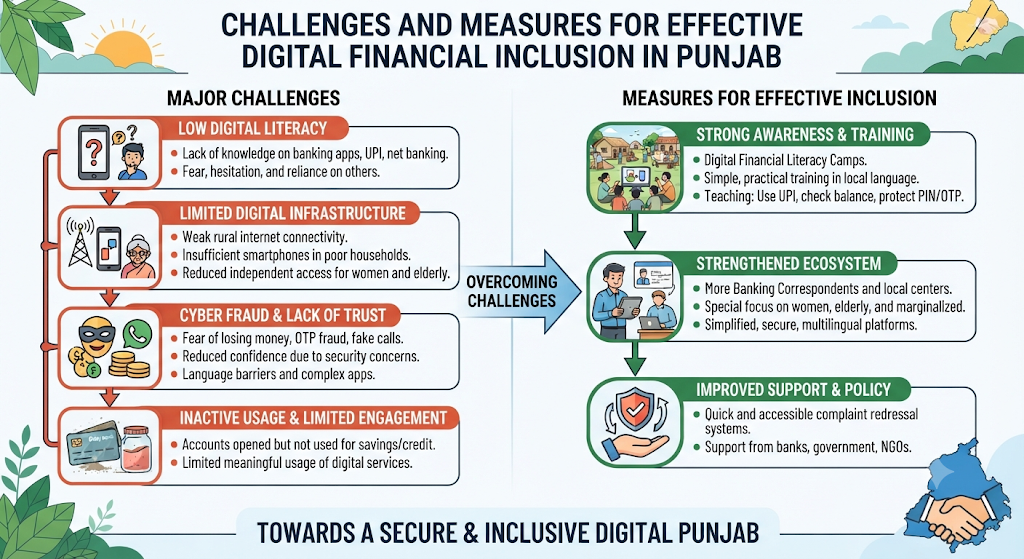
To overcome these challenges, strong awareness and training programmes are required. Banks, government departments, panchayats, schools, colleges, self-help groups, and NGOs should conduct digital financial literacy camps in villages and low-income communities. Training should be simple, practical, and available in local language. People should be taught how to use UPI, check balance, avoid fraud, protect PIN and OTP, and report complaints.
Banking correspondents and local service centres should be strengthened because they act as a bridge between banks and rural communities. Special attention should be given to women, elderly persons, scheduled caste communities, migrant workers, and small farmers. Digital platforms should be made simple, secure, multilingual, and user-friendly. Complaint redressal systems should be quick and accessible
Conclusion#
The study concludes that digital financial services play an important role in promoting financial inclusion, economic empowerment, and social development among marginalized populations in Punjab. Services such as mobile banking, UPI, digital wallets, Aadhaar-enabled payment systems, direct benefit transfer, online savings, digital credit, and insurance facilities have made financial services more accessible, faster, and more convenient for rural and disadvantaged groups.
Digital financial services help marginalized people connect with formal banking systems, receive government benefits directly, save money, make payments, access credit, and reduce dependence on informal moneylenders. They also support small businesses, self-employment, women’s financial independence, and household economic security. In this way, digital finance contributes to economic empowerment and improves the confidence of weaker sections.
The study also highlights that digital financial services contribute to social development by improving transparency, reducing middlemen, increasing awareness, and supporting access to education, healthcare, welfare schemes, and social security. However, challenges such as low digital literacy, poor internet connectivity, lack of smartphones, cyber fraud, language barriers, and fear of digital transactions still limit their effective use. Therefore, it is necessary to strengthen digital financial literacy, improve rural internet infrastructure, provide local-language support, ensure cyber safety awareness, and make banking services more user-friendly.
Works Cited#
- Aggarwal, Ruchika. Financial Inclusion in India: Challenges and Opportunities. New Century Publications, 2019.
- Beck, Thorsten, Asli Demirgüç-Kunt, and Ross Levine. "Finance, Inequality and Poverty: Cross-Country Evidence." World Bank Policy Research Working Paper, no. 3338, 2004, pp. 1–42.
- Demirgüç-Kunt, Asli, et al. The Global Findex Database 2021: Financial Inclusion, Digital Payments, and Resilience in the Age of COVID-19. World Bank, 2022.
- Ghosh, Saibal. "Financial Inclusion, Digital Payments, and Economic Development in India." Economic and Political Weekly, vol. 55, no. 17, 2020, pp. 45–52.
- Government of India. Economic Survey of India 2024–25. Ministry of Finance, Government of India, 2025.
- Gupta, Shalini, and R. K. Sharma. Digital Banking and Financial Inclusion in Rural India. Sage Publications, 2021.
- Jack, William, and Tavneet Suri. "Risk Sharing and Transactions Costs: Evidence from Kenya's Mobile Money Revolution." American Economic Review, vol. 104, no. 1, 2014, pp. 183–223.
- Kaur, Manpreet, and Harpreet Singh. "Digital Financial Inclusion and Rural Development in Punjab." International Journal of Rural Development Studies, vol. 12, no. 2, 2023, pp. 88–101.
- Reserve Bank of India. Report on Trend and Progress of Banking in India 2024-25. Reserve Bank of India, 2025.
- Sen, Amartya. Development as Freedom. Oxford University Press, 1999.
- Sharma, Neha, and Pardeep Kumar. "Impact of Digital Payment Systems on Financial Inclusion among Rural Households." Journal of Banking and Finance Studies, vol. 15, no. 3, 2022, pp. 112–126.
- Singh, Jaspreet, and Baljit Kaur. "Financial Literacy and Digital Banking Adoption among Marginalized Communities in Punjab." Punjab Journal of Social Sciences, vol. 18, no. 1, 2024, pp. 54–68.
- United Nations Development Programme. Human Development Report 2023/2024. UNDP, 2024.
- World Bank. Digital Financial Services. World Bank Group, 2020.
- World Bank. World Development Report 2021: Data for Better Lives. World Bank Publications, 2021.
- Yadav, Rakesh, and Suman Lata. "Role of Digital Financial Services in Economic Empowerment of Rural Women." Indian Journal of Social Research, vol. 64, no. 4, 2023, pp. 421–435.
- Yunus, Muhammad. Banker to the Poor: Micro-Lending and the Battle Against World Poverty. Public Affairs, 2007.
- Zins, Alexandra, and Laurent Weill. "The Determinants of Financial Inclusion in Africa." Review of Development Finance, vol. 6, no. 1, 2016, pp. 46–57.
- Reserve Bank of India. Financial Inclusion Index 2024. Reserve Bank of India, 2024.
- NITI Aayog. Strategy for New India @75. Government of India, 2018.