Abstract
The present study examines the role of corporate social responsibility practices in promoting sustainable development, community welfare, and organizational reputation. Corporate social responsibility reflects the commitment of business organizations to operate ethically while contributing to social, environmental, and economic well-being. CSR practices such as environmental protection, education support, healthcare initiatives, skill development, rural development, employee welfare, and community engagement help organizations address social needs beyond profit-making activities. The study explores how responsible business practices contribute to sustainable development by reducing environmental harm, supporting inclusive growth, and improving quality of life in communities. It also highlights that effective CSR enhances organizational reputation, stakeholder trust, brand image, and long-term competitiveness. The study concludes that CSR is not only a legal or ethical responsibility but also a strategic approach for creating shared value for business and society.
- Corporate Social Responsibility
- Sustainable Development
- Community Welfare
- Organizational Reputation
- Ethical Business
- Stakeholder Trust
Introduction#
Corporate Social Responsibility has become an important part of modern business management and sustainable development. In the present global economy, business organizations are not judged only by profit, production and market success, but also by their contribution to society, environment and community welfare. Corporate Social Responsibility refers to the ethical responsibility of companies to conduct business in a way that benefits stakeholders, protects the environment and supports social development.
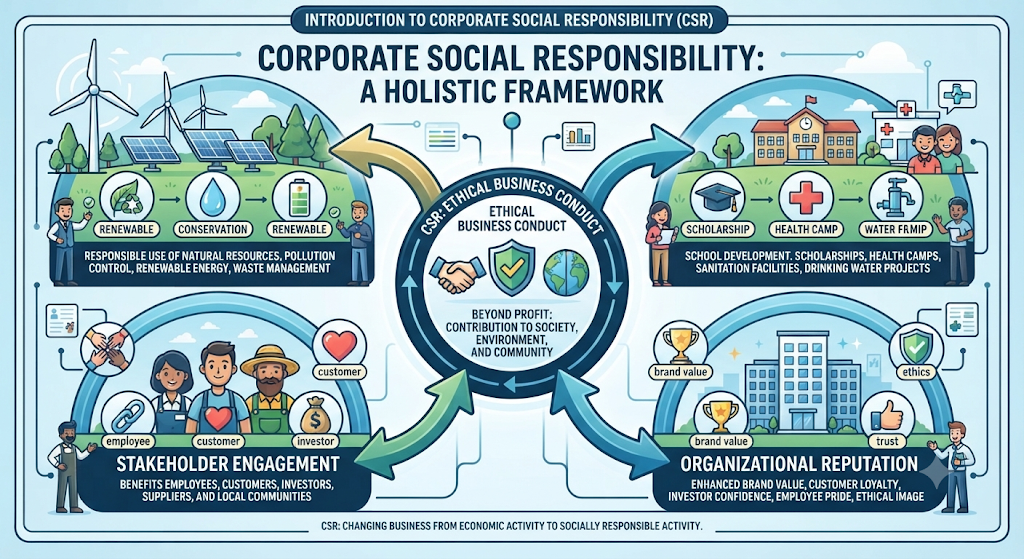
Traditionally, the main objective of business was considered profit maximization. However, changing social expectations, environmental challenges, consumer awareness and stakeholder pressure have expanded the role of business organizations. Today, companies are expected to contribute toward education, healthcare, environmental protection, rural development, poverty reduction, skill development, women empowerment and community welfare. Thus, CSR has changed the idea of business from only economic activity to socially responsible activity.
Sustainable development is closely linked with CSR. Sustainable development means meeting present needs without harming the ability of future generations to meet their own needs. CSR practices support sustainable development by encouraging responsible use of natural resources, pollution control, renewable energy, waste management, water conservation and inclusive economic growth. Organizations that adopt sustainable CSR practices contribute to environmental protection and long-term social well-being.
Community welfare is another important area influenced by CSR. Many companies undertake social projects for improving the living conditions of local communities. These projects may include school development, scholarships, health camps, sanitation facilities, drinking water projects, livelihood training, digital literacy, support for farmers and development of rural infrastructure. Such activities help companies create positive relationships with communities and improve social trust.
CSR also plays a significant role in enhancing organizational reputation. Companies that actively contribute to society are viewed as ethical, responsible and trustworthy. A strong CSR image improves brand value, customer loyalty, investor confidence and employee pride. In a competitive market, reputation is an important intangible asset, and CSR helps organizations build a positive public image.
Conceptual Foundations and Evolution of Corporate Social Responsibility in Modern Business#
Corporate Social Responsibility (CSR) has emerged as one of the most significant concepts in contemporary business management. In the modern global economy, business organizations are increasingly expected to contribute not only to economic growth but also to social welfare, environmental protection, and sustainable development. The traditional perception that the sole purpose of business is profit maximization has gradually evolved into a broader understanding that organizations have responsibilities toward multiple stakeholders, including employees, customers, communities, governments, investors, and the environment. Consequently, Corporate Social Responsibility has become an essential component of responsible and sustainable business practices.
The concept of Corporate Social Responsibility refers to the voluntary and ethical commitment of business organizations to conduct their operations in a socially responsible manner while contributing to economic development and improving the quality of life of employees, local communities, and society at large. CSR emphasizes that organizations should integrate social, environmental, and ethical considerations into their business strategies and decision-making processes. It encourages companies to move beyond legal compliance and actively participate in addressing societal challenges.
The conceptual foundations of CSR are rooted in the idea that businesses are social institutions operating within society and, therefore, have obligations that extend beyond generating profits. Businesses utilize societal resources, depend upon public infrastructure, employ human capital, and affect various stakeholders through their activities. Consequently, organizations are expected to reciprocate by contributing positively to societal development and minimizing adverse impacts arising from their operations.
The evolution of Corporate Social Responsibility can be traced through several historical stages. During the early industrial period, business organizations primarily focused on profit generation with limited concern for social and environmental consequences. Industrialization led to significant economic growth; however, it also resulted in problems such as labour exploitation, environmental degradation, unsafe working conditions, and social inequalities. Such challenges gradually prompted demands for greater corporate accountability and social responsibility.
The modern conceptualization of CSR began to emerge during the mid-twentieth century. One of the earliest and most influential scholars in CSR literature was Howard R. Bowen, often regarded as the "Father of Corporate Social Responsibility." In his seminal work Social Responsibilities of the Businessman (1953), Bowen argued that business executives should pursue policies and decisions that align with societal values and expectations. Bowen's work laid the intellectual foundation for subsequent developments in CSR theory and practice.
During the 1960s and 1970s, societal expectations regarding corporate behaviour expanded considerably. Civil rights movements, environmental activism, consumer protection campaigns, and labour rights advocacy increased public awareness regarding corporate impacts on society. Businesses increasingly faced pressure to address social issues such as discrimination, environmental pollution, consumer safety, and employee welfare. Consequently, CSR evolved from philanthropic activities toward broader considerations of ethical and social responsibilities.
One of the most influential theoretical contributions to CSR was provided by Archie B. Carroll through his Pyramid of Corporate Social Responsibility. Carroll proposed that CSR comprises four interconnected responsibilities: economic, legal, ethical, and philanthropic responsibilities. Economic responsibility forms the foundation, emphasizing profitability and organizational survival. Legal responsibility requires compliance with laws and regulations. Ethical responsibility involves conducting business fairly, honestly, and responsibly beyond legal requirements. Philanthropic responsibility refers to voluntary contributions toward community development and social welfare. Carroll's framework remains widely utilized in understanding and evaluating CSR practices.
Another important conceptual perspective is the Stakeholder Theory, developed primarily by Edward Freeman. Stakeholder theory argues that organizations should consider the interests and expectations of all stakeholders rather than focusing exclusively on shareholders. Stakeholders include employees, customers, suppliers, communities, governments, investors, and environmental groups. According to this perspective, sustainable organizational success depends upon balancing diverse stakeholder interests and maintaining positive stakeholder relationships.
The concept of Triple Bottom Line (TBL) has further expanded the scope of CSR in contemporary business. Introduced by John Elkington, the Triple Bottom Line framework emphasizes that organizational performance should be evaluated not only in economic terms but also through social and environmental dimensions. The framework highlights three interconnected pillars: People, Planet, and Profit. Businesses are therefore expected to generate economic value while simultaneously contributing to social welfare and environmental sustainability.
The globalization of business activities has significantly influenced the evolution of CSR. Multinational corporations operate across diverse social, cultural, and regulatory contexts, increasing their social and environmental responsibilities. Globalization has heightened public scrutiny of corporate practices related to labour standards, human rights, environmental protection, and ethical conduct. International organizations such as the United Nations, International Labour Organization, and Organisation for Economic Co-operation and Development have developed guidelines and frameworks encouraging responsible corporate behaviour.
The emergence of sustainable development has further strengthened CSR practices. The concept of sustainable development, popularized by the Brundtland Commission Report (1987), emphasizes meeting present needs without compromising future generations' ability to meet their own needs. Contemporary CSR increasingly incorporates sustainability principles by promoting responsible resource utilization, environmental conservation, social inclusion, and long-term value creation.
Environmental concerns have become particularly significant in modern CSR discourse. Climate change, biodiversity loss, pollution, resource depletion, and ecological degradation have intensified expectations for corporate environmental responsibility. Businesses are increasingly adopting environmentally sustainable practices such as renewable energy utilization, waste reduction, carbon emission management, water conservation, and green supply chain management. Environmental stewardship has therefore become a fundamental dimension of contemporary CSR.
Technological advancements and digital transformation have also influenced CSR evolution. Social media and digital communication technologies have increased transparency and public accountability by enabling stakeholders to monitor corporate behaviour more effectively. Consumers, investors, and civil society organizations increasingly evaluate companies based on their environmental, social, and governance performance. Consequently, organizations are compelled to adopt transparent and responsible business practices.
In India, Corporate Social Responsibility has acquired particular significance due to socio-economic development needs and legislative initiatives. The Companies Act, 2013 introduced mandatory CSR provisions for certain categories of companies, making India one of the first countries to legislate CSR spending requirements. Under Section 135 of the Act, eligible companies are required to allocate a specified proportion of profits toward CSR activities related to education, healthcare, environmental sustainability, rural development, poverty alleviation, and other social causes. This legislative framework has significantly institutionalized CSR practices within Indian corporate sectors.
Modern CSR encompasses diverse activities, including employee welfare programmes, community development initiatives, environmental conservation projects, educational support, healthcare services, disaster relief, gender equality promotion, skill development, and ethical business practices. Organizations increasingly recognize that effective CSR contributes not only to social development but also to enhanced reputation, stakeholder trust, employee satisfaction, customer loyalty, and long-term competitiveness.
Despite its widespread acceptance, CSR continues to face certain criticisms and challenges. Critics argue that some organizations engage in greenwashing, wherein CSR activities are primarily utilized for public relations purposes without substantial commitment to social responsibility. Others contend that excessive emphasis on profit maximization may undermine genuine CSR efforts. Measuring CSR outcomes, balancing stakeholder interests, and integrating CSR into core business strategies remain significant challenges for organizations.
A multidisciplinary perspective enriches understanding of CSR because the concept intersects with management, economics, sociology, ethics, environmental studies, and public policy. Management studies examine strategic CSR implementation; economics explores value creation and stakeholder relationships; sociology investigates societal impacts; ethics focuses on moral obligations; and environmental studies address sustainability concerns. Such interdisciplinary approaches facilitate comprehensive understanding and effective CSR practices.
Corporate Social Responsibility as a Catalyst for Sustainable Development and Environmental Stewardship#
Corporate Social Responsibility plays a significant role in promoting sustainable development and environmental stewardship in modern business. Sustainable development refers to development that fulfils present needs without harming the ability of future generations to fulfil their own needs. In this context, CSR encourages business organizations to operate in a manner that supports economic growth, social welfare and environmental protection together.
CSR acts as a catalyst for sustainable development because it motivates companies to move beyond profit-making and contribute to long-term social and environmental well-being. Through CSR practices, organizations can support education, healthcare, poverty reduction, skill development, sanitation, rural development and livelihood generation. These initiatives help improve quality of life and promote inclusive growth among communities.
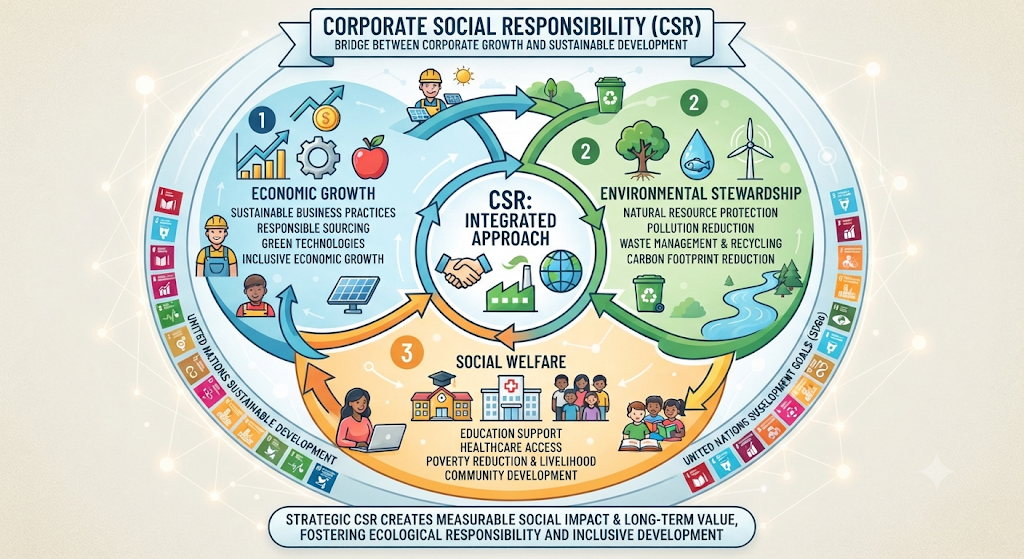
Environmental stewardship is an important part of CSR. It means responsible management and protection of natural resources. Companies influence the environment through production, energy use, waste generation, water consumption and supply-chain activities. Therefore, responsible organizations are expected to reduce pollution, conserve resources and adopt eco-friendly practices. CSR activities such as tree plantation, renewable energy use, waste management, water conservation, recycling and carbon reduction help protect the environment.
CSR also encourages companies to adopt sustainable business practices within their own operations. This includes reducing plastic use, improving energy efficiency, using green technologies, promoting sustainable packaging and following responsible sourcing practices. Such actions reduce environmental damage and help organizations contribute to climate protection and ecological balance.
In developing economies, CSR is especially important because many communities face challenges related to poverty, poor health facilities, lack of education, unemployment and environmental degradation. Corporate participation in social and environmental development can support government efforts and improve local living conditions. CSR projects in rural development, drinking water, sanitation, health camps and livelihood training can directly benefit weaker sections of society.
CSR also supports the United Nations Sustainable Development Goals by contributing to areas such as quality education, good health, clean water, decent work, reduced inequalities, sustainable cities and climate action. Companies that align CSR activities with sustainable development goals can create measurable social impact and long-term value.
Thus, CSR serves as a bridge between corporate growth and sustainable development. It enables businesses to become responsible partners in social progress and environmental protection. When CSR is planned and implemented sincerely, it can promote ecological responsibility, community welfare and inclusive economic development. Therefore, CSR is not only a moral duty but also a strategic approach for sustainable and responsible business.
Conclusion#
Corporate Social Responsibility plays a vital role in connecting business growth with social welfare and sustainable development. CSR practices help organizations contribute to education, healthcare, environmental protection, community development, skill training and social inclusion. These initiatives improve the quality of life of communities and support broader development goals.
The study highlights that CSR also strengthens organizational reputation, stakeholder trust and long-term business sustainability. Companies that act responsibly are viewed as ethical, trustworthy and socially committed. Thus, CSR is not only a philanthropic activity but also a strategic approach for creating shared value for business and society.
Therefore, effective CSR practices are essential for promoting sustainable development, community welfare and responsible corporate citizenship. A sincere and well-planned CSR approach can build stronger communities, protect the environment and enhance the positive image of organizations.
Works Cited#
- Bowen, Howard R. Social Responsibilities of the Businessman. Harper & Row, 1953.
- Carroll, Archie B. “A Three-Dimensional Conceptual Model of Corporate Performance.” Academy of Management Review, vol. 4, no. 4, 1979, pp. 497–505.
- Carroll, Archie B. “The Pyramid of Corporate Social Responsibility.” Business Horizons, vol. 34, no. 4, 1991, pp. 39–48.
- Freeman, R. Edward. Strategic Management: A Stakeholder Approach. Pitman, 1984.
- Elkington, John. Cannibals with Forks: The Triple Bottom Line of 21st Century Business. Capstone, 1997.
- Porter, Michael E., and Mark R. Kramer. “Strategy and Society: The Link between Competitive Advantage and Corporate Social Responsibility.” Harvard Business Review, vol. 84, no. 12, 2006, pp. 78–92.
- Porter, Michael E., and Mark R. Kramer. “Creating Shared Value.” Harvard Business Review, vol. 89, no. 1/2, 2011, pp. 62–77.
- Kotler, Philip, and Nancy Lee. Corporate Social Responsibility: Doing the Most Good for Your Company and Your Cause. Wiley, 2005.
- Matten, Dirk, and Jeremy Moon. “Implicit and Explicit CSR.” Academy of Management Review, vol. 33, no. 2, 2008, pp. 404–424.
- McWilliams, Abagail, and Donald Siegel. “Corporate Social Responsibility: A Theory of the Firm Perspective.” Academy of Management Review, vol. 26, no. 1, 2001, pp. 117–127.
- Garriga, Elisabet, and Domènec Melé. “Corporate Social Responsibility Theories.” Journal of Business Ethics, vol. 53, no. 1/2, 2004, pp. 51–71.
- Dahlsrud, Alexander. “How Corporate Social Responsibility Is Defined.” Corporate Social Responsibility and Environmental Management, vol. 15, no. 1, 2008, pp. 1–13.
- World Commission on Environment and Development. Our Common Future. Oxford UP, 1987.
- United Nations. Transforming Our World: The 2030 Agenda for Sustainable Development. United Nations, 2015.
- European Commission. A Renewed EU Strategy 2011–14 for Corporate Social Responsibility. European Commission, 2011.
- ISO. ISO 26000: Guidance on Social Responsibility. International Organization for Standardization, 2010.
- Ministry of Corporate Affairs, Government of India. Companies Act, 2013. Government of India, 2013.
- Ministry of Corporate Affairs, Government of India. National Voluntary Guidelines on Social, Environmental and Economic Responsibilities of Business. Government of India, 2011.
- Blowfield, Michael, and Alan Murray. Corporate Responsibility. 3rd ed., Oxford UP, 2014.
- Visser, Wayne. The Age of Responsibility: CSR 2.0 and the New DNA of Business. Wiley, 2011.
"Impact of Remote and Hybrid Work Arrangements on Employee Productivity, Organizational Culture,